
LiveOne’s Multi-Format Streaming and OEM Tie-Up Face Revenue Concentration and Cash Flow Challenges
LiveOne leverages integrated live music streaming, podcasting, and merchandise sales but confronts sizable customer concentration risks alongside continued operating losses.
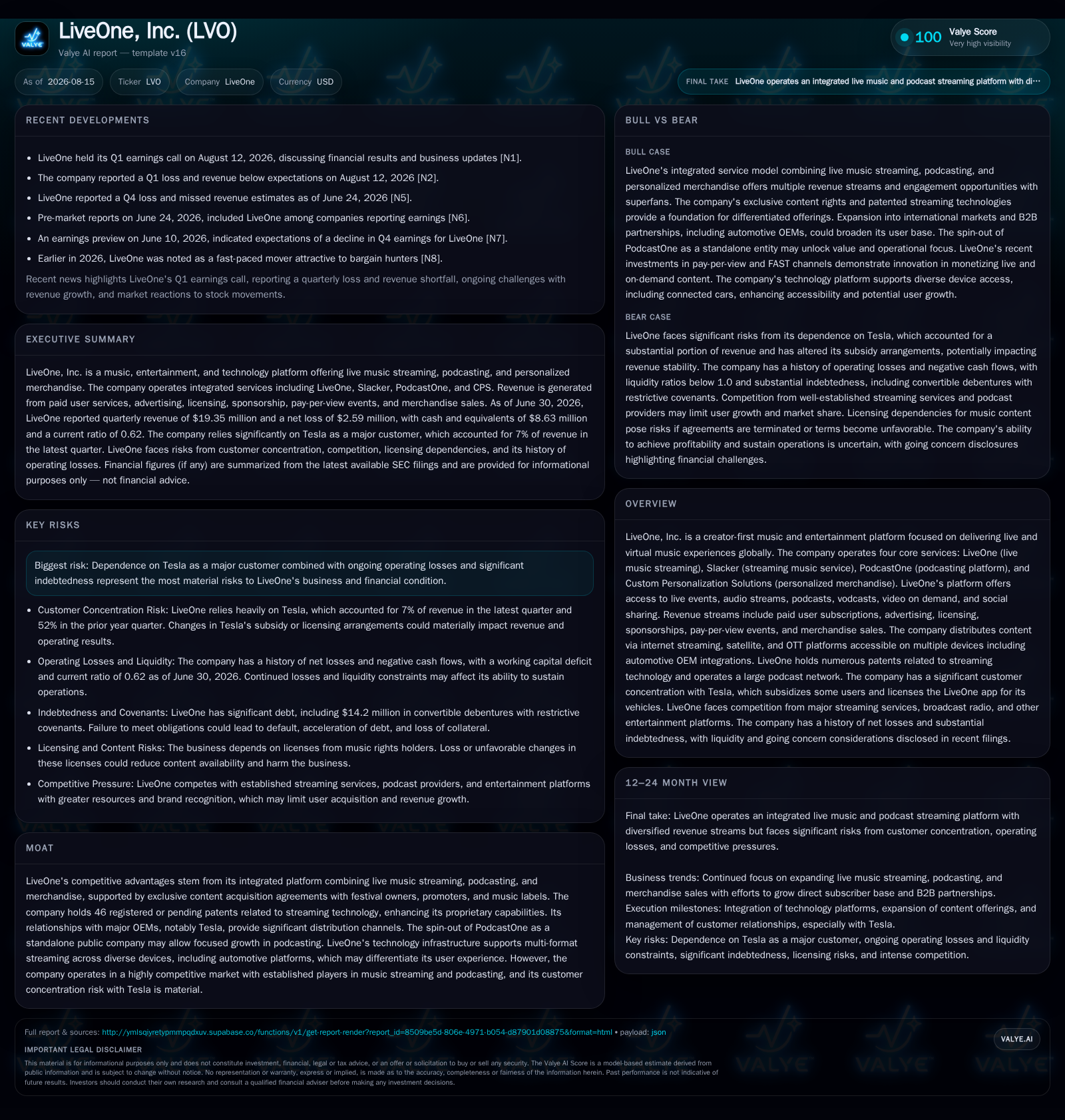
LiveOne, Inc. operates a multifaceted digital music and entertainment platform combining live music streaming, podcasting via its PodcastOne subsidiary, and personalized merchandise retail. Recent quarterly updates show revenue growth driven by advertising offset by ongoing operating losses and a significant dependence on Tesla for distribution and a large share of revenue. The company faces challenges in converting Tesla vehicle users to direct subscribers post-subsidy changes while investing to grow its ecosystem across multiple OTT platforms and devices. Financially, LiveOne maintains constrained liquidity with a current ratio below 1, reflecting working capital deficits amid steady debt levels. The ongoing customer concentration risk alongside industry competition and high content acquisition costs merit close monitoring of user conversion rates and margin improvements as keys to sustainable growth.
Recent Operating Update: Progress and Challenges Amid Transition
Tesla accounted for only about 7% of revenue in Q1 FY26 compared to above 50% previously due to a structural realignment effective December 2024 where Tesla ceased subsidizing subscriptions for most users onboarded through their vehicles [S2],[S21]. LiveOne now offers those users a conversion path to become direct subscribers via the LiveOne app embedded within Tesla’s infotainment system—introducing typical subscription churn risks common in OTT streaming transitions. Maintaining this direct subscriber growth will be pivotal for revenue stability given Tesla’s right under existing contracts to discontinue or renegotiate terms post-2027 license expiration [S2].
Business Model: Integrated Platform Centered on Multi-Stream Monetization
LiveOne's business model is strategically built around a flywheel concept fueling synergy across four primary services: (1) LiveOne live music streaming platform offering access to premium original content, (2) Slacker—a subscription and ad-supported music service tightly integrated into LiveOne’s OTT apps, (3) PodcastOne—a large podcasting network majority-owned by LiveOne complementing audio content breadth, and (4) Custom Personalization Solutions (CPS), focusing on merchandising directly aimed at superfans through personalized products [S1].
Revenue derives from multiple streams including paid user subscriptions for Slacker and LiveOne music services; advertising sales leveraging both streaming audio and podcast inventory; licensing income from exclusive content agreements such as festivals; sponsorships attached to live event broadcasts; pay-per-view ticket sales capturing virtual concert attendance; plus merchandise retail margins from CPS operations [S1]. This diversification aligns well with broader industry trends where companies like Spotify or SiriusXM increasingly mix subscriptions with advertising and other ancillary revenue sources.
Critical to these monetization pathways are extensive content acquisition agreements involving digital rights management for millions of tracks alongside exclusive festival/promoter partnerships that create differentiated live event offerings unavailable elsewhere [S1]. Proprietary technology protected by 46 patents supports low-latency multi-format streaming optimized for multiple platforms including mobile devices, desktops, smart TVs (Roku/Apple TV/Amazon Fire), OTT providers (STIRR/XUMO), social media sharing integration, and crucially automotive OEM infotainment systems including Tesla—ensuring broad device reach for maximum engagement [S1]. This integrated technology stack aims at improving user experience quality barriers that often differentiate consumer willingness to pay.
Industry Structure and Competitive Position
LiveOne operates within the intensely competitive digital music entertainment streaming sector characterized by rapid technological advancement and shifting consumer preferences toward hybrid live-on-demand experiences. Its competitors span vertically: global-scale pure music streamers like Spotify and Apple Music compete heavily on scale and content breadth; major podcast operators such as iHeartMedia pursue dominant network effects; meanwhile live event promoters integrate physical/digital hybrid models. Furthermore, Amazon Music and YouTube Music add assault on user time across formats.
Against these giants, LiveOne leverages two potential moats: first its specialized multi-format integration combining live concert streams with podcasts plus merchandise which may enhance fan 'stickiness' beyond audio alone; second its close partnership with premier automotive OEMs such as Tesla supplying embedded app experiences directly into new vehicles—this upstream channel partnership serves as a de facto distribution moat difficult for new entrants without OEM ties to duplicate rapidly given lengthy integration cycles [S1],[S2]. However, dependence on Tesla creates outsized customer concentration risking revenue disruption if contract terms change or utilization declines drastically [S2].
Growth Drivers
Key growth levers hinge on increasing user conversion rates from Tesla’s formerly subsidized customers into paid direct subscribers accessible across multiple devices using LiveOne’s OTT application model implemented since December 2024. Success here expands subscription revenue whilst reducing reliance on gradual renewals from OEM subsidy schemes now phased out for new users [S2],[S21].
Additionally, growth will be propelled by scaling advertising sales through slots packaged with consistently rising listening hours delivered via podcasts (PodcastOne's network expansion) plus Slacker’s ad-supported tiers exhibiting solid engagement metrics. The migration toward hybrid virtual concerts drives pay-per-view event attendance levels upward—with potential sponsorship cross-selling benefiting margins compared to pure ad-based formats.
Innovations in personalized merchandising via CPS align closely with fan engagement trends seen elsewhere where concertgoers seek collectible items tied electronically or physically to artists/events—improving monetization per customer while expanding wallet share beyond basic listening consumption models [S1]. International expansion planned into Europe and Asia Pacific promises incremental new paid subscriber pools but requires upfront marketing spend that weighs on near-term profitability given competitive entry hurdles [S1].
Risks / Watchpoints / Growth Constraints
Foremost risk surrounds Tesla dependency comprising historically over half of revenues until recently—any termination or renegotiation risks substantial declines since conversions from subsidized customers are uncertain amid high churn inherent in OTA subscription markets especially automotive segments transitioning away from dealer-prepaid models [S2],[S21]. Ongoing operational risk includes meeting stringent service-level agreements under license contracts risking termination or penalty.
Furthermore, LiveOne faces pressure balancing costly content acquisition—both music royalty costs under agreements like Merlin extended through November 2027—and expansive technology infrastructure investments needed to maintain seamless streaming quality across diverse device ecosystems—all while controlling operating expenses amidst historically negative EBITDA margins [S17],[S10].
Liquidity is another watchpoint: as of June 30, 2026, LiveOne’s current assets total approximately $21.8 million against current liabilities near $34.9 million, resulting in a current ratio of about 0.62, indicating a working capital deficit and constrained ability to cover short-term obligations without additional capital or improved cash flow generation [F1]. Total debt remains modest at roughly $1.4 million, with cash and equivalents of $8.6 million, supporting a net cash position but not fully offsetting risks from ongoing negative operating cash flows [F1].
Competitive intensity from established global players with deeper pockets for exclusive rights acquisition also challenges LiveOne’s ability to scale faster without disproportionately increasing sales/marketing spend or risking heightened churn if quality falls behind peers.
What To Watch Next
Future performance hinges critically on milestones tracking paid subscriber growth outside Tesla-subsidized cohorts integrated into the LiveOne app ecosystem along with retention metrics signaling stickiness post-transition away from OEM subsidies. Monitoring monthly active users (MAU), average revenue per user (ARPU), pay-per-view attendance figures during live event launches plus effectiveness of merchandising campaigns can provide early read-throughs into sustainable monetization gains.
Financially significant events include any new contracts announced with other automotive OEMs replicating Tesla’s distribution leverage or expanded licensing agreements extending selected exclusive content beyond November 2027 currently secured via Merlin extensions partially compensated by equity issuance rather than cash settlement arrangements [S1],[N1],[N2].[N4]
Watch also potential restructuring moves targeting expense rationalization versus innovation investment balance particularly within product development spend which has been cut nearly by half recently possibly impacting long-term competitiveness if underfunded too aggressively [S17].[N1]
Continued scrutiny of quarterly liquidity indicators alongside stock repurchase activity authorized up to $12 million may offer insight into corporate confidence levels and capital allocation priorities moving forward [S25].[N3]
Financial Profile Discussion
As of June 30, 2026, LiveOne holds $8.6 million in cash and equivalents against modest total debt of approximately $1.4 million based on best-effort estimates [F1]. Current liabilities stand at nearly $35 million, resulting in a working capital deficit and a current ratio of 0.62, which implies liquidity risk requiring careful management given recurring operating losses exceeding $15 million annually and negative operating cash flows [F1]. Expense reductions in marketing and product development have helped tighten the burn rate, though overall SG&A remains near $20 million annually [F1],[S17].
The company retains flexibility through a universal shelf registration allowing issuance of up to $150 million in equity or debt securities subject to market conditions, potentially alleviating short-term funding concerns depending on successful execution of its business momentum [S8]
Overall financial stewardship amidst escalating competitive pressures and operational transition risks centered on the Tesla relationship highlight critical sensitivity points investors should monitor closely over coming quarters.
This analysis focuses exclusively on information derived from LiveOne's recent SEC filings combined with relevant industry context without offering investment advice or specific forward-looking guidance.
Disclaimer: This is research-only, informational analysis and not investment advice. It may include AI-generated interpretation and general industry context. Always verify important details using primary sources.

Comments