
Transcode Therapeutics Advances RNA-Based Oncology Pipeline Amid Nasdaq Compliance and Capital Constraints
Clinical progress with lead candidate TTX-MC138 meets key trial milestones as company navigates listing compliance and funding needs.
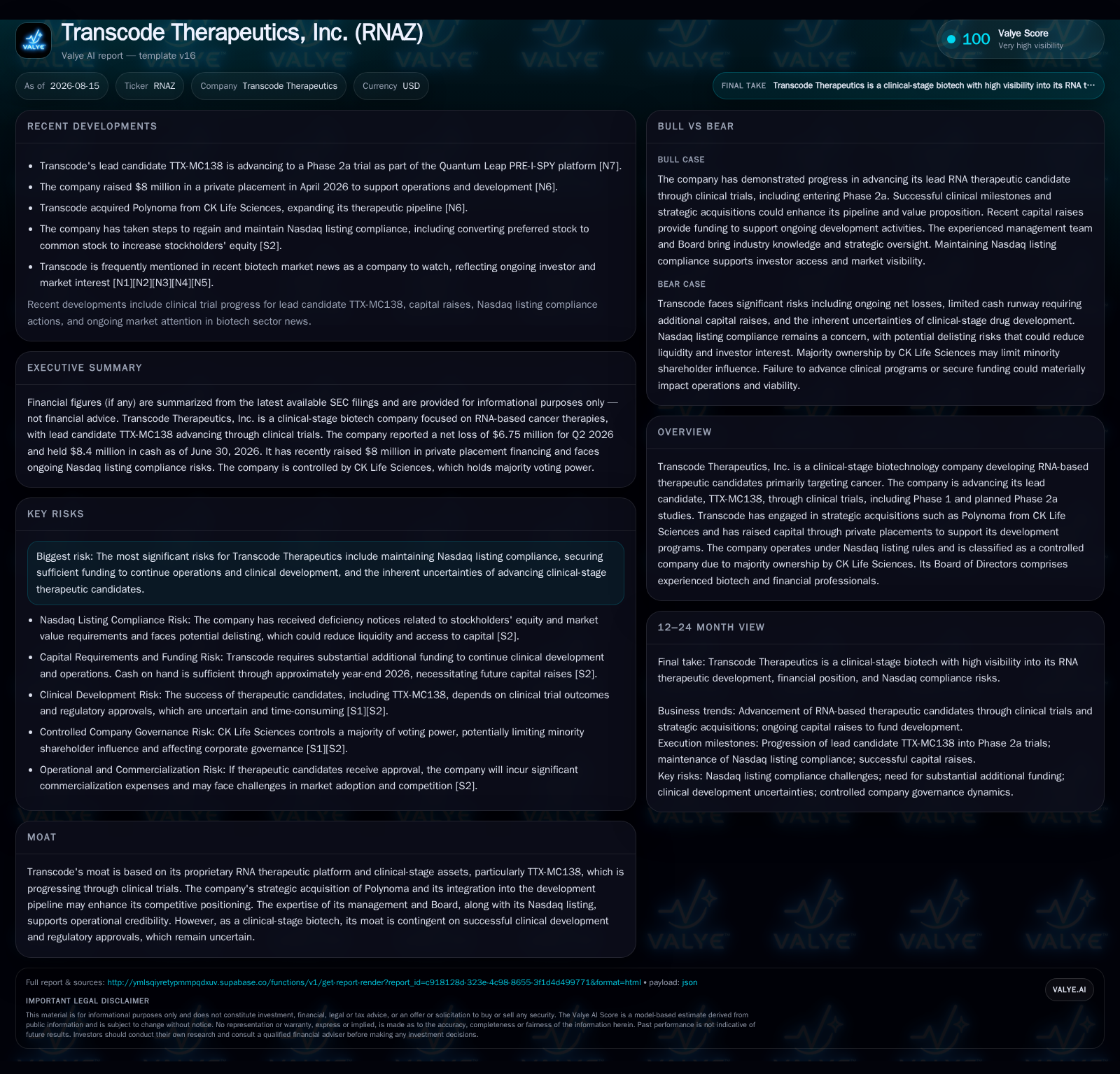
Transcode Therapeutics, a clinical-stage biotech focused on RNA therapeutics for cancer, reported continued advancement of its lead candidate TTX-MC138 through Phase 1 trials, with plans for Phase 2a initiation. The company addressed Nasdaq listing deficiencies by converting preferred shares to common stock, helping regain compliance. Despite a current cash position sufficient through late 2026, Transcode must raise further capital to sustain ongoing clinical development. Strategic acquisitions like Polynoma and licensing deals expand Transcode’s pipeline breadth, but operational execution hinges on trial enrollment progress and regulatory milestone achievements. Risks include the potential loss of Nasdaq listing if market capitalization falters, clinical trial uncertainties, and funding constraints typical in the clinical-stage biotech sector.
Recent Operating Update: Trial Progress and Listing Compliance
Transcode Therapeutics most recently reported in its August 14, 2026 Form 10-Q continuing advancement of its lead RNA-based therapeutic candidate, TTX-MC138. Clinical activities focus on a Phase 1 dose escalation trial designed to establish safety and tolerability while gathering early efficacy signals in oncology patients. Concurrently, the company is preparing for a Phase 2a study to further assess therapeutic potential in targeted cancer indications [S2], [S10]. This steady progress along the clinical trial pathway is pivotal as transition from early stage to proof-of-concept validates platform technology and informs partnering or licensing discussions.
Addressing a critical near-term risk, Transcode received a Nasdaq deficiency notice in May 2026 due to insufficient stockholders’ equity. The company took decisive action by obtaining stockholder approval in July for converting all outstanding preferred shares into common stock—a move confirmed by Nasdaq as restoring minimum equity compliance [S2], [S13], [S14]. However, new Nasdaq rules imposing immediate delisting if market value falls below $5 million for 30 consecutive days impose ongoing vigilance risks given the volatility of small-cap biotech stocks.
Business Model Specifics: RNA Therapeutics Development for Oncology
Transcode operates as a clinical-stage biotechnology firm primarily engaged in discovering and developing innovative RNA-based therapies targeting various cancers. Its lead asset, TTX-MC138, utilizes oligonucleotide technology aiming to modulate gene expression implicated in tumor progression. Monetization is deferred until later stages involving milestone payments from potential partners or eventual product sales post-regulatory approval [S1]. Until then, revenues are minimal or nonexistent; operating losses driven by high R&D expenses characterize this phase
The company’s revenue mechanics hinge significantly on incremental clinical progress (e.g., successfully enrolling patients, meeting trial endpoints) that unlock milestone payments or enhance attractiveness for licensing deals, both critical to funding-intensive drug development cycles. Clinical collaborations or strategic alliances remain optional but represent valuable pathways to supplement internal funding and expedite late-stage development or commercialization.
Industry Structure and Competitive Position
Within the biotechnology sector focused on RNA therapeutics and oncology indications, Transcode is positioned among a diverse peer set including established developers like Moderna and BioNTech—broad platform leaders—and smaller specialized firms focusing on niche oncologic targets. Unlike larger peers that have already achieved some commercial success and greater capital access, Transcode remains highly dependent on demonstrating early clinical efficacy while managing capital prudently.
The RNA therapeutic modality offers scientific differentiation through precise gene regulation capabilities compared to conventional chemotherapies or immunotherapies. However, competition is intense given multiple players pursuing similar molecular targets or delivery technologies. Intellectual property robustness derived from proprietary platform technology and exclusive licensing agreements are vital defenses against encroachment.
Growth Drivers: Pipeline Expansion and Clinical Milestones
Key drivers include advancing TTX-MC138 through clinical phases with clear demonstration of safety and meaningful efficacy signals that justify further development investment. Patient enrollment rates directly affect study timelines; thus operational efficiency interacting with multiple site investigators affects speed to data readouts.
Strategic moves such as acquiring Polynoma from CK Life Sciences inject additional pipeline candidates into preclinical development focused on engineered adenoviruses for immuno-oncology applications [S1], expanding disease target scope beyond current assets. These acquisitions reinforce growth capacity by diversification while positioning Transcode for broader partnership discussions.
Capital market conditions also influence ability to secure necessary funds at reasonable cost; private placements—including convertible notes with Yorkville—indicate active financing efforts supportive of sustained R&D programs but highlight dependence on investor confidence linked closely to clinical progress [S8], [S21].
Risks and Watchpoints: Funding Pressure and Regulatory Hurdles
The most immediate risk revolves around retaining Nasdaq listing status amid new market value thresholds that require consistent trading performance or shareholder equity maintenance [S2]. Delisting would impair liquidity significantly and restrict capital-raising avenues crucial for ongoing clinical operations.
Funding availability remains uncertain despite recent capital raising efforts totaling several million dollars through convertible notes and equity issuances under private placements [S8], [S21]. With cash reserves around $8.4 million as of June 30, 2026 supporting operations through year-end at best, further financing rounds will be mandatory unless rapid progress yields partner-funded milestones or licensing deals.
Clinical development carries inherent uncertainties: any delays or failures in patient enrollment or failure to meet safety/tolerability endpoints could derail pipeline progression timelines impacting valuation and investor sentiment. Given reliance on external CROs for trial execution typical in small biotechs, operational risks include site activation delays or data integrity challenges.
Additionally, intellectual property challenges pose threats if competitors contest patent claims tied to RNA technologies or product composition. Regulatory pathways for novel RNA therapeutics remain intricate; unexpected agency requests or safety concerns could prolong review times delaying market authorization.
What to Watch Next: Milestones Defining Value Realization
Investors and industry observers should monitor upcoming announcements regarding:
- Completed enrollment or interim data releases from the Phase 1 TTX-MC138 trial as signals of biological activity or tolerability.
- Initiation dates for Phase 2a studies indicating confidence in early-stage data supporting expanded patient cohorts.
- Outcomes of stockholder votes related to preferred stock conversions affecting Nasdaq listing status permanence.
- Additional capital raises or convertible note issuances that maintain adequate runway beyond late 2026.
- Updates from integration efforts following Polynoma acquisition illuminating how new preclinical assets fit into long-term pipeline strategy.
- Any partnership agreements materializing from demonstrable clinical progress that mitigate funding dependency risks.
Financial Profile Discussion
As of June 30, 2026, Transcode held approximately $8.4 million in cash equivalents against current liabilities of nearly $5.4 million yielding a current ratio close to 1.97—suggesting modest short-term liquidity adequacy without excessive risk of immediate creditor pressure [F1]. Total debt metrics reference older instruments with no updated indications of new senior borrowings [F1].
Operating losses remain substantial given R&D intensity typical for a clinical-stage biotech; reported net income was a negative $34.7 million for the full year ending December 31, 2025 reflecting ongoing investment ahead of revenue generation [F1]. Cash burn likely remains heavy into successive quarters absent material milestone inflows or partnerships.
Equity structure complexity increased due to issuance conversions approved mid-2026 aimed at curing Nasdaq deficiencies by enhancing reported stockholders’ equity via conversion of Series A/B preferred shares into common stock—an essential step reducing risk of delisting repercussions [S2], [S13], [S14].
The company’s forward funding requirement emphasizes necessity of successful fundraising deployments timed carefully to ensure uninterrupted advancement through costly clinical phases where delays could compound financial strain.
This analysis synthesizes SEC filings through August 14, 2026 alongside known industry context without offering investment research views. Readers should consider biotechnology sector dynamics characterized by high uncertainty and prolonged developmental horizons when evaluating Transcode Therapeutics’ prospects.
Disclaimer: This is research-only, informational analysis and not investment advice. It may include AI-generated interpretation and general industry context. Always verify important details using primary sources.

Comments