
Harte Hanks Navigates Merger Uncertainty While Managing Declining Revenues and Transaction Costs
The marketing services firm faces operational constraints amid a pending acquisition by Star Equity, with recent financial results reflecting pressure on revenue and profitability.
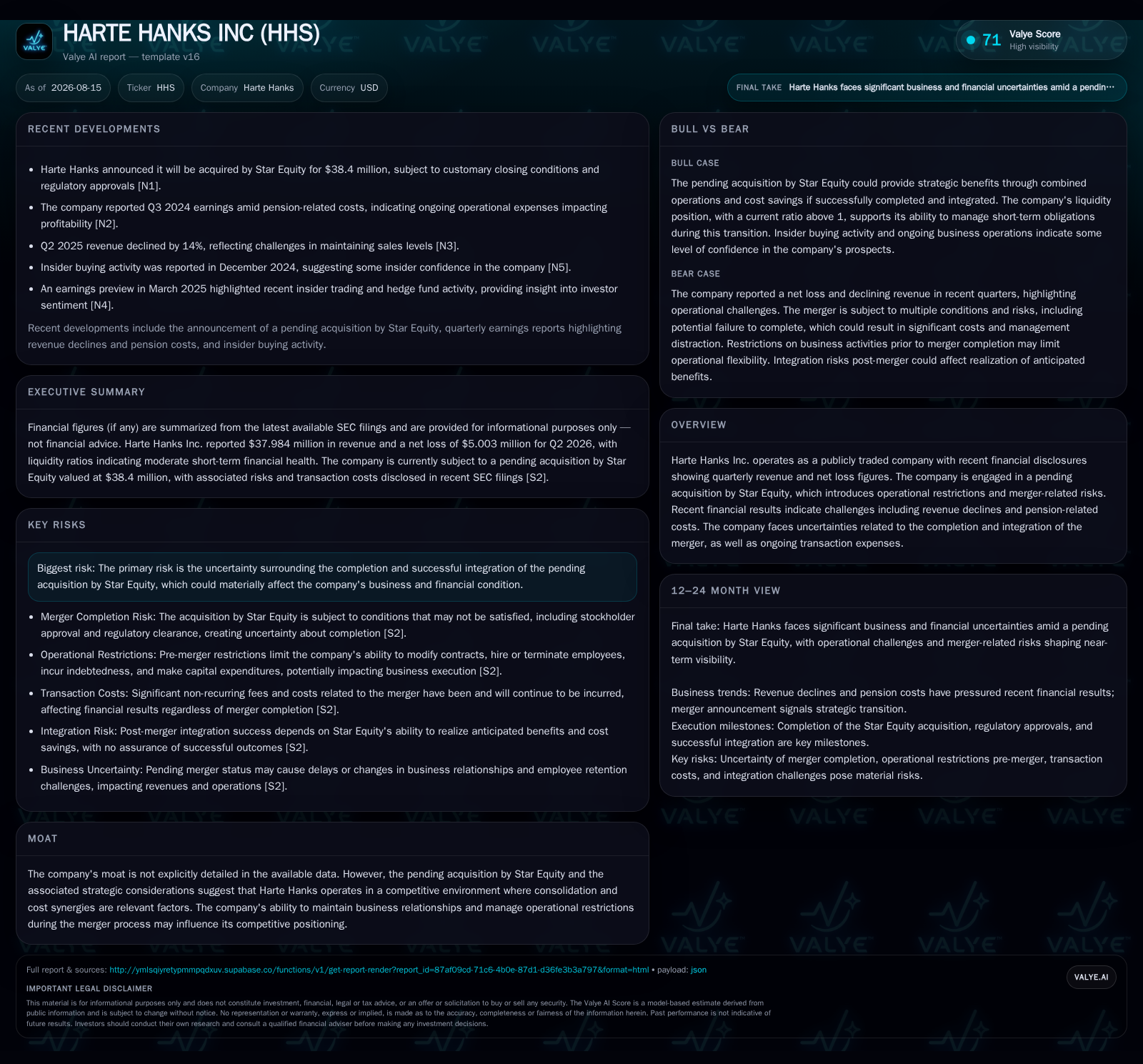
Harte Hanks Inc. reported ongoing declines in revenue coupled with net losses for the trailing twelve months through the end of 2025. The company is currently undergoing a strategic transition as it awaits completion of a merger agreement with Star Equity, which introduces operational restrictions and execution risks. Transaction-related expenses have further weighed on profitability, while merger uncertainty poses challenges to client relationships and employee retention. Harte Hanks operates within a competitive marketing services space characterized by rapid digital transformation and consolidation dynamics. The company's cash position remains modest but sufficient relative to liabilities as it manages these integration risks.
Recent Operating Update: Merger Pending Amid Financial Challenges
Harte Hanks’ most recent quarterly filing dated August 14, 2026 ([S2]) provides critical insight into the company’s immediate operating environment marked by its pending acquisition by Star Equity announced earlier in 2026 ([N1]). The merger remains subject to customary conditions such as shareholder approval of the merger agreement, absence of regulatory impediments, and SEC registration statement effectiveness for Star Equity’s preferred stock issuance. These conditions introduce timing uncertainty around transaction closure.
While awaiting consummation, Harte Hanks faces operational constraints explicitly stipulated by the merger agreement. These include restrictions on entering new contracts or modifying existing arrangements, limitations on asset transactions and capital expenditures, and constraints on human resources decisions like hiring or severance actions [S2][S10]. Such limitations risk impairing Harte Hanks’ ability to pursue growth initiatives or respond flexibly to market opportunities during this transitional period.
The filing also flags risks associated with partner behavior instability; certain clients might delay purchasing decisions or renegotiate terms due to uncertainty over the company’s future ownership structure. Similarly, employee morale and retention may suffer given unclear post-merger roles threatening service quality continuity—an essential factor in client retention within marketing services [S2]
The company discloses significant ongoing transaction costs related to legal, accounting, advisory fees linked to merger activities that weigh down earnings. Although some are non-recurring charges typical in M&A scenarios, their impact on quarterly profitability metrics cannot be ignored.
Business Model: Integrated Marketing Services Under Transitional Constraints
Harte Hanks operates primarily as a provider of marketing services characterized by customer engagement solutions encompassing direct marketing campaigns, data analytics integration, CRM capabilities, digital marketing solutions including omnichannel strategies, customer segmentation for targeted advertising efforts, marketing automation tools deployment, lead generation programs, and retention marketing tactics designed for sustained client relationships ([S1], industry knowledge).
Revenue is predominantly generated via service contracts awarded by corporate clients seeking outsourced expertise in managing complex marketing initiatives across multiple channels. Contracts often include recurring retainer agreements supplemented by project-specific fees depending on campaign scale or analytics requirements. This hybrid monetization approach makes revenue sensitive both to contract renewals (client retention) and new project acquisitions (sales pipeline).
Margins are constrained by personnel costs since skilled marketers and data scientists drive service delivery alongside technology platform investments needed to maintain competitiveness in a digitally transforming landscape. Effectiveness is measured through KPIs like campaign success rates fostering client satisfaction and eventual contract renewals.
Industry Structure and Competitive Positioning
Marketing services form a highly fragmented yet consolidating industry segment where scale can enhance bargaining power with media vendors while enabling investment in proprietary data analytics platforms required for differentiated offerings (). Key peers include large diversified agencies such as Omnicom Group or WPP plc alongside specialized data-driven firms like Epsilon or Merkle.
To remain viable amid intense competition centered on ROI demonstrability for clients’ marketing spend (ROMI), providers like Harte Hanks must continuously adapt via technology adoption—AI-enabled automation platforms—and deliver measurable performance metrics aligned with client business outcomes. Failure to do so invites loss of account share to more digitally mature competitors.
Pending merger integration positions Harte Hanks potentially to leverage greater scale from Star Equity’s backing but simultaneously exposes short-term disruption risks affecting client confidence.
Growth Drivers
- Increasing enterprise demand for data-driven customer engagement solutions motivates growth in analytics-backed marketing services.
- Expansion of digital and omnichannel marketing budgets throughout industries promotes adoption of integrated service models like Harte Hanks offers.
- Rising emphasis on compliance services in regulatory environments can open ancillary revenue streams within client engagements.
- Outsourcing trends where businesses delegate marketing functions externally favor companies with diverse capabilities across traditional fulfillment (direct mail) and digital channels.
- Consolidation momentum enables accretive acquisitions enhancing service breadth—potentially benefiting Harte Hanks aboard Star Equity’s platform.
Risks / Watchpoints / Growth Constraints
Chief among risks is whether the merger successfully closes under the outlined conditions or is delayed/canceled leading to sunk cost impacts plus operational distractions compromising business continuity ([S2][S10]). Integration difficulties could dilute anticipated synergy benefits or erode core client relationship value.
Operational restrictions before deal close may stifle critical buying decisions internally or externally constraining volume/mix improvements necessary for margin expansion. Customer concentration remains a standard risk here due to reliance on key accounts whose decision-making might be sensitive during ownership transitions.
Competitive pressures mandate ongoing investment in technology upgrades; financial resource allocation may become limited due to transactional expenses reducing discretionary spend.
Economic downturns impacting marketing budgets can disproportionately impact companies like Harte Hanks reliant on enterprise discretionary spending patterns. Additionally, data privacy regulations require continuous adaptation raising compliance costs that pressure margins.
What to Watch Next
Key upcoming milestones include timing of shareholder vote approving the merger along with successful SEC registration statement clearance detailed by Form S-4 submission status ([S2]). Monitoring legal or regulatory developments affecting deal closing will be critical given uncertainties noted in filings.
Financially relevant updates will encompass transaction cost run-rates mitigating post-merger synergies observable from operating income trajectories post-close. Client retention trends evidenced via contract renewals or churn rates will serve as early signals for business stability amid change.
Management guidance updates confirming revised strategy execution under new ownership constitute another important focus area informing longer-term durability prospects.
Financial Profile Discussion
As of June 30, 2026, Harte Hanks held approximately $5.2 million in cash and equivalents against current liabilities near $34.9 million yielding a current ratio around 1.3—a modest but adequate liquidity stance under current assessment ([F1]).
Longer-dated debt disclosures remain sparse regarding incremental borrowings beyond amounts reported up to end-2021 at roughly $5 million; however net debt position appears near neutral factoring available cash resources ([F1]). This balance sheet posture should allow continued funding of transactional costs with limited financing strain near term.
Trailing twelve-month revenues ended December 31, 2025 stood at approximately $159.6 million accompanied by an operating income marginally above breakeven ($386K) but an overall net loss nearing $811K attributed partly to pension costs and sizeable non-recurring merger expenses ([F1]). Operating margin compression linked directly to these headwinds illustrates the challenging profit environment prevailing pre-merger closure.
Managing cost structures effectively while navigating pre-close restrictions will be essential for improving bottom-line performance before any potential turnaround derived from combined entity synergies post-acquisition.
This analysis is based solely on publicly available filings as of August 2026 alongside industry context known for marketing services firms comparable to Harte Hanks Inc. It does not contain investment advice or specific price targets.
Disclaimer: This is research-only, informational analysis and not investment advice. It may include AI-generated interpretation and general industry context. Always verify important details using primary sources.

Comments