
Nuvve Holding Advances Commercial V2G Platforms Amid Liquidity and Scaling Challenges
Nuvve’s AI-driven GIVe platform expands virtual power plant services in commercial EV fleets but faces financial and operational constraints.
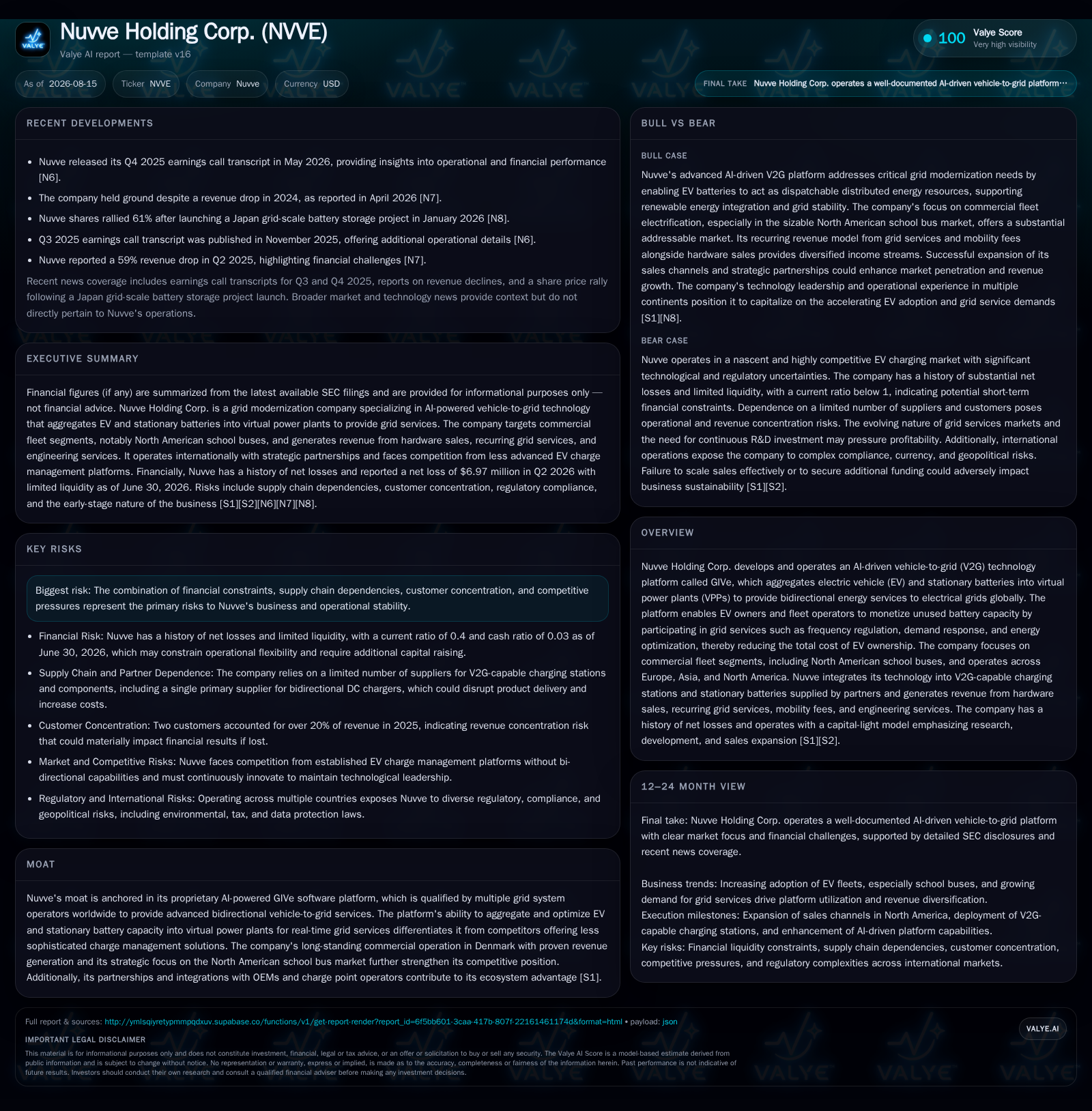
Nuvve Holding Corp. continues to develop and deploy its proprietary vehicle-to-grid (V2G) technology platform, GIVe, which aggregates electric vehicle (EV) batteries into virtual power plants providing bidirectional grid services globally. The company focuses on high-growth commercial fleet segments such as North American school buses and has established a competitive moat via AI-powered energy management and strategic OEM partnerships. However, near-term execution is constrained by tight liquidity, customer concentration, reliance on hardware partners, and regulatory complexities as reported in its latest quarterly filing. Nuvve’s growth hinges on accelerating EV adoption, expanding recurring grid service revenues, and scaling VPP deployments while managing financial and operational risks.
Recent Operating Update
Nuvve Holding Corp.’s latest quarterly filing dated August 14, 2026 confirms the company remains deeply invested in scaling its AI-driven vehicle-to-grid (V2G) platform called GIVe but continues to operate at net losses consistent with an early-stage growth profile [S2],[F1]. The company issued a press release alongside this filing confirming ongoing operational execution focused on the commercial fleet sector with particular emphasis on the North American school bus market segment—a priority supported by ramping electrification trends among over 600,000 legacy diesel buses [S3],[S24]. However, liquidity remains strained: as of June 30, 2026 Nuvve held just $0.5 million in cash against total debt of approximately $2.1 million, resulting in a depressed current ratio of about 0.4 that highlights working capital constraints inherent to its capital-intensive growth strategy [F1].
Business Model Analysis
Nuvve operates at the intersection of software-based energy management and grid service provision by aggregating bidirectional charging assets into virtual power plants (VPPs) capable of delivering real-time ancillary services such as frequency regulation, demand response, and energy optimization. Its proprietary GIVe software leverages artificial intelligence to orchestrate the energy flow between EV batteries—primarily within commercial fleets—and electrical grids worldwide [S1]. The ability to monetize otherwise unused battery capacity allows fleet operators to offset or reduce their total cost of ownership through mobility fees tied to vehicle usage plus recurring revenues from grid service contracts.
Revenue streams are diversified across several vectors: hardware sales or integration partnerships supplying V2G-compatible chargers and stationary batteries; recurring fees linked to participation in regulated energy markets; engineering services for deployment customization; and mobility fees enabled through software-charge orchestrations that coordinate EV fleet operations with grid demands [S1]. This multi-channel monetization aligns well with the industry's broader archetype where software licensing blends with hardware procurement and long-term service-level contracts.
Customer acquisition largely targets commercial fleet operators (school buses included), charge point operators integrating V2G capabilities into their charger networks via partner ecosystems globally, and strategic utility partnerships that validate platform qualification within diverse regulatory frameworks—the latter being critical for market access and competitive differentiation [S24],[S21].
Industry Structure and Competitive Position
The vehicle-to-grid sector is characterized by a complex value chain encompassing software innovators like Nuvve who develop AI-powered platforms; hardware manufacturers deploying compatible charging stations; energy aggregators operating virtual power plants; fleet management firms that adopt these technologies; utilities requiring regulatory compliance; and battery storage providers advancing energy resiliency. Within this ecosystem, Nuvve distinguishes itself through its qualified GIVe platform recognized by several grid system operators worldwide—a barrier not easily replicated given the need for extensive regulatory approvals combined with real-time software sophistication for aggregation and dispatch reliability [S1].
Peers such as Fermata Energy and Wallbox also target similar V2G solutions but often lack Nuvve’s demonstrated cross-continental operating history or specialized focus on high-value commercial segments like school buses. Hardware-centric companies Tesla or ChargePoint provide charging infrastructure with some bidirectional features but do not yet match Nuvve's integrated platform approach combining software orchestration with multi-fleet management capabilities.
The company's competitive moat also derives from strategic OEM partnerships facilitating seamless charging station integration plus established ventures like Dreev (recently divested) that accelerated European market entry—the combined effect reinforcing ecosystem lock-in despite international regulatory complexity [S1],[S24].
Growth Drivers
Nuvve’s growth proposition is backed by several structural trends:
- Accelerating global EV adoption increases aggregate battery capacity available for grid services.
- Rising deployment of smart grids supports advanced demand response requirements.
- Government incentives proliferate clean energy integration mandates enhancing V2G appeal.
- Commercial fleet electrification—particularly public transport bus segments—is expanding rapidly given regulatory pressure to decarbonize.
- Cost declines in battery technologies coupled with efficiency gains in bidirectional chargers improve total cost economics.
- Advancements in AI algorithms fortify system optimization enabling higher ancillary service revenue capture.
- Increasing awareness among fleet operators of total cost ownership reductions via battery monetization boosts adoption intent [S1],[S24].
Confirmation of durable demand will hinge on KPIs such as scale-up in connected EVs/stationary batteries measured in MWh under management; virtual power plant dispatch frequency validating revenue consistency; recurring contract renewal rates reflecting customer retention; and incremental hardware units integrated indicating adoption momentum.
Risks and Growth Constraints
Nuvve faces several risks typical to nascent technology companies operating across regulated energy markets:
- Financial constraints are acute with restricted cash resources forcing reliance on capital raises amid continued negative operating margins exceeding $32 million annually most recently [F1],[S2]. Frequent financing needs can dilute shareholders or limit agility.
- Customer concentration risk emerges as two customers accounted for over 20% of revenues historically—losing or downsizing accounts could have material implications [S20].
- Supply chain dependencies impede hardware availability impacting deployment cadence especially amid semiconductor shortages affecting integrated chargers.
- Regulatory uncertainties persist given varying electric utility statutes internationally complicating uniform product rollout and impacting qualification timeliness essential for revenue recognition [S21].
- Cybersecurity vulnerabilities inherent to connected grid software platforms pose evolving threats.
- Management’s limited experience navigating public company cost structures could hinder operational efficiency under increasing compliance demands [S22].
- Multi-jurisdictional operations raise tax exposure complexity while legal proceedings or intellectual property disputes could divert resources [S19],[S21].
These risks necessitate vigilant operational execution focusing on strengthening sales infrastructure while maintaining robust relationships with manufacturing partners and regulators.
What to Watch Next
Near-term milestones critical to validating Nuvve’s growth trajectory include:
- Expansion within the North American school bus market featuring both direct sales volume increase plus contract renewals signaling stickiness among fleet operators.
- New geographic market entries aided by successful grid operator qualifications unlocking additional virtual power plant revenue streams.
- Scalability improvements evidenced through rising aggregate managed battery capacity (MWh) dispatched via the GIVe platform.
- Progress on acquisitions such as BESS Sibiu’s 42 MW battery storage project bolstering stationary asset portfolio supporting VPP services [S29].
- Demonstrated gross margin improvement from hardware integration allied with expanding recurring service revenue ratios signifying improved cash conversion potential.
- Stabilization or improvement in liquidity reflected by enhanced current ratio beyond current low levels (~0.4), coupled with reduced net debt burdens post-financing activities.
- Organizational capability development through sales team ramp-up aimed at accelerating customer acquisition costs payback periods.
Financial Profile Discussion
As of June 30, 2026, Nuvve holds approximately $500 thousand in cash against total debt nearing $2.1 million resulting in net debt around $1.58 million—highlighting a challenging liquidity position vis-à-vis imminent capital needs inherent in technology commercialization cycles [F1]. Current assets stand at roughly $5.87 million dwarfed by elevated current liabilities totaling approximately $14.75 million supporting a depressed current ratio of only 0.4 signaling potential short-term coverage challenges absent infusion of additional capital or improved receivables management [F1].
Operating income remains deeply negative exceeding $32 million annually per last full-year data with net losses similarly pronounced indicating ongoing investment phase without profitability yet achieved [F1]. Such financial leverage underscores dependency on external financing rounds which will require careful balancing against dilution risk given historical share-building measures including a recently executed reverse stock split consolidating shares at an 18-for-1 ratio completed mid-2026 intended to restore listing compliance and improve per-share metrics [S26].
Ongoing R&D expenditures underpin future competitive positioning but further strain cash flows necessitating prudent capital allocation decisions aligned with scaling priorities focused on recurring grid service revenues which hold prospect for stabilizing margins relative to hardware-centric sales alone.
This analysis synthesizes disclosures from Nuvve Holding's recent SEC filings focusing on the evolving dynamics within the vehicle-to-grid energy technology sector where software-driven aggregation of EV batteries into virtual power plants offers novel pathways for grid interaction economies amid ongoing electrification trends globally. All statements here reflect evidence-based interpretation without investment research view intent.
Disclaimer: This is research-only, informational analysis and not investment advice. It may include AI-generated interpretation and general industry context. Always verify important details using primary sources.

Comments