
abrdn Palladium ETF Trust Reshapes Accessibility with Strategic Share Split
The 5-for-1 forward share split in May 2026 enhances liquidity and accessibility for abrdn’s physically-backed palladium ETF amid stable operational and risk conditions.
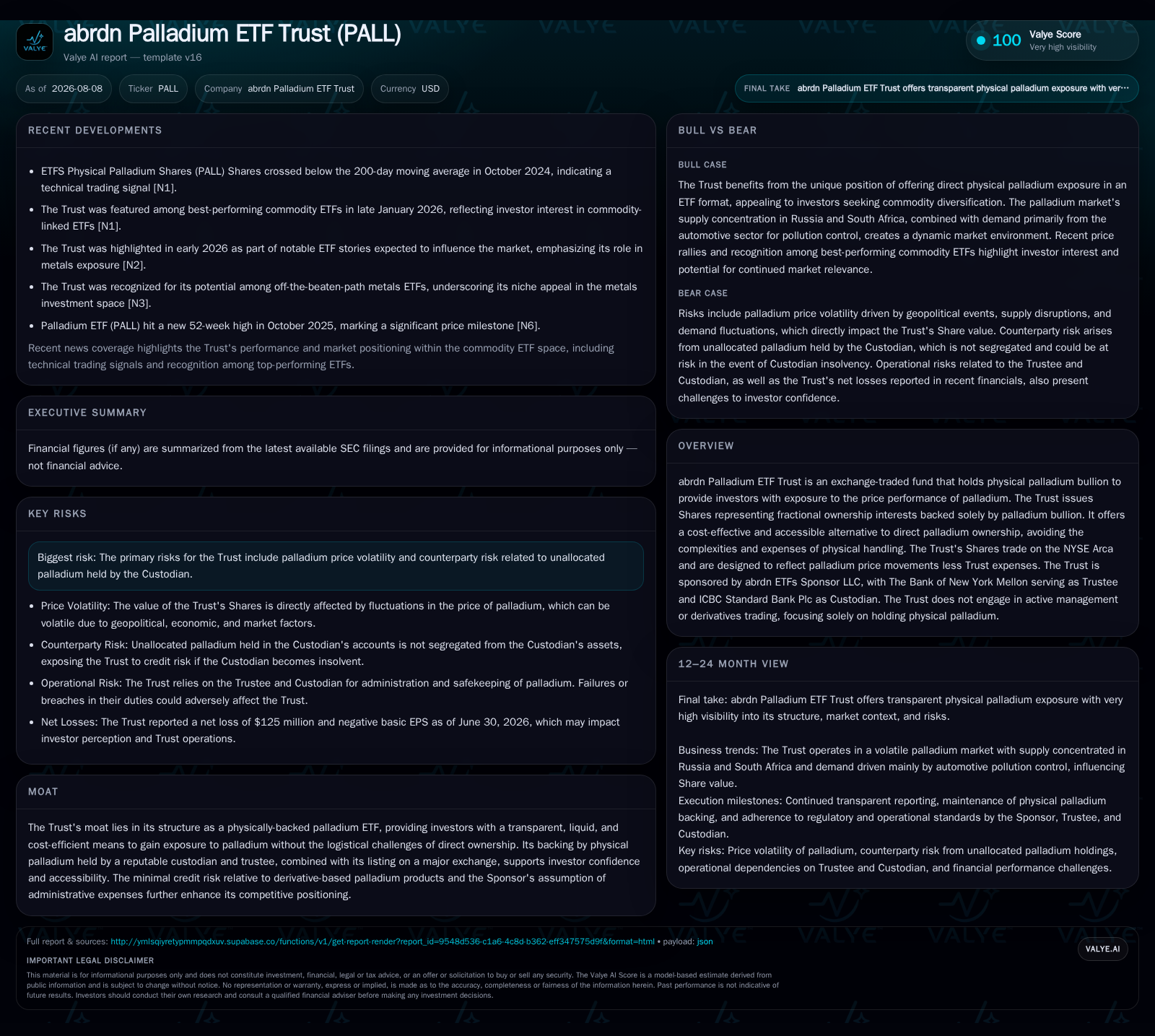
The abrdn Palladium ETF Trust executed a 5-for-1 forward share split effective May 18, 2026, increasing shares outstanding fivefold and lowering the NAV per share from $128.69 to $25.74 [S11][S12]. This move aims to improve market liquidity and lower barriers to entry for retail investors, supporting trading volume and authorized participant activity in this niche physical commodity ETF. The Trust’s latest quarterly report confirms no material changes to its established risk factors, mainly palladium price volatility and custodial counterparty risks [S2]. Its business model, centered on physical palladium holdings managed by ICBC Standard Bank Plc and administrative oversight by abrdn ETFs Sponsor LLC, provides cost-efficient, low-credit-risk exposure to palladium without derivatives [S1]. The Trust’s creation/redemption mechanisms via baskets and authorized participants facilitate alignment between share price and net asset value, enhancing market efficiency. Compared to futures-based commodity ETFs, abrdn Palladium ETF’s physical backing fosters investor confidence through transparency and minimized tracking error, supported by reputable custodian and trustee roles. Going forward, metrics such as share volume trends, AUM fluctuations, and NAV premium/discount will be key indicators of ecosystem health following the share split.
5-for-1 Share Split Amplifies Market Accessibility
The abrdn Palladium ETF Trust undertook a significant capital structure adjustment by executing a 5-for-1 forward share split effective prior to trading on May 18, 2026 [S11][S12]. This action quintupled the number of issued shares outstanding from approximately 6.11 million to over 30.56 million while correspondingly reducing the net asset value (NAV) per share from $128.69 to $25.74. Such a split lowers the absolute price per share thereby potentially broadening the pool of investors able or willing to transact in the shares.
Lowering price per share reduces friction for retail investors who might have been deterred by higher nominal prices despite unchanged underlying economic exposure per unit. Moreover, increasing shares outstanding theoretically augments trading volume and market depth as fractional ownership increments become more divisible and liquid.
The absence of any change in ticker symbol or CUSIP preserves continuity in secondary market recognition while ensuring post-split quotes reflect adjusted valuations seamlessly [S11]. Overall, this maneuver strategically targets more efficient market functioning within the niche environment of physically-backed palladium ETFs.
Unchanged Risk Landscape Confirms Operational Stability
In its most recent quarterly report filed August 7, 2026, the Trust confirmed there have been no material changes to the risk factors detailed in its prior annual disclosure from March 3, 2026 [S2]. Core risks remain consistent with expectations for physically-backed commodity ETFs:
Palladium Price Volatility: As an unhedged vehicle tracking spot palladium prices less expenses, fluctuations driven by supply-demand imbalances, geopolitical events affecting producers (notably Russia and South Africa accounting for over three-quarters of global palladium supply), autocatalyst automotive demand shifts (~85% of use), or speculative trading directly impact NAV and market price [S1].
Counterparty Risk: While physical palladium is custodially held by ICBC Standard Bank Plc in London vaults with sub-custodians as needed, unallocated palladium temporarily held during creations/redemptions presents some credit risk exposure due to lack of segregation from other custodian assets [S1]. This is a standard consideration relative to derivative-based products reliant on counterparty creditworthiness.
This stability underscores predictable operating environs for investors seeking direct spot metal exposure without leverage or derivatives complexities. The Trust also avoids regulatory complications encountered by commodity futures pools or derivative vehicles given it holds physical metal exclusively under securities laws rather than CFTC jurisdiction.
Physical Palladium ETF Structure: Fee, Custody, and Trading Dynamics
abrdn Palladium ETF Trust operates as a passive investment vehicle holding only physical palladium bullion corresponding fractionally to outstanding shares [S1]. The Sponsor entity—abrdn ETFs Sponsor LLC—manages administrative functions including compliance filings and expense payments while The Bank of New York Mellon acts as Trustee ensuring governance oversight.
Custody is entrusted to ICBC Standard Bank Plc which acts as the secure holder of physical metal stored primarily in London vaults secured under industry best practices involving approved weighers and market makers aligned with London Platinum & Palladium Market (LPPM) protocols [S1]. This custody arrangement establishes trust through independent verification mechanisms reducing credit/default risk relative to synthetic exposures.
Revenue primarily derives from management fees charged as a percentage of Assets Under Management (AUM), collected pro rata across shares outstanding [S1]. Importantly, the Sponsor assumes certain recurring operating costs enhancing investor cost efficiency compared to direct bullion ownership where storage fees, insurance premiums, assay costs and logistical complexities are prohibitive at smaller scales
Trading occurs exclusively on NYSE Arca where Shares offer margin account eligibility appealing to institutional investors alongside retail participation. Since Shares do not trade futures or derivatives but purely represent fractional interests in physical metal holdings valued daily based on publicly available LBMA Palladium prices minus expenses plus portfolio accounting gains/losses, transparency is high which bolsters investor confidence.
Market Mechanisms: Creation Units, Authorized Participants, and NAV Alignment
The Trust maintains continuous arbitrage-enabled liquidity through creation/redemption processes performed only by Registered Authorized Participants (APs) who are broker dealers or financial institutions qualified via agreements with Sponsor and Trustee [S1][S24]
Authorized Participants deliver physical palladium corresponding to NAV when creating shares or receive metal upon redemption thus anchoring secondary market Prices close to true NAV reducing premium/discount deviations typical outside AP-managed arbitrage dynamics.
This mechanism’s efficiency directly impacts key operating KPIs such as average premium/discount spread between share price and computed NAV per Share alongside daily creation/redemption volumes—metrics essential for close correlation between shareholder value realization and actual palladium price exposure.
Baskets' adjustable size over years highlights sponsor responsiveness optimizing balancing minimum trade sizes with participant operational economics fostering tighter spreads that underpin secondary market utility similar to benchmark liquid precious metals ETFs like SPDR Gold Shares (GLD).
Competitive Context: Peer Comparisons Highlight Cost-Efficiency and Transparency
Positioned among a small group of physical precious-metal backed commodity ETFs—such as SPDR Gold Shares (GLD) providing gold bullion exposure or iShares Silver Trust (SLV) for silver—the abrdn Palladium ETF offers comparable transparency advantages inherent in owning actual metal rather than derivative contracts prone to counterparty default risk.
Unlike commodity futures-based funds like United States Oil Fund (USO), which are exposed to roll yield complications and regulatory limits governing futures contracts usage causing tracking error deviations especially during contango/backwardation market states, PALL’s purely physical backing ensures minimal tracking error approximating spot palladium price less trust expenses consistently.
Reputable custodianship via ICBC Standard Bank Plc combined with BNY Mellon Trustee oversight aligns closely with peer standards observed at major metal bullion ETFs employing JPMorgan Chase or HSBC custodial services reinforcing investor protection dimensions critical amidst episodic commodity volatility.
Cost structures influenced heavily by management fee levels relative to AUM scale impact long-term attractiveness vis-à-vis competitors; abrdn’s absorption of some administrative fees further strengthens competitive cost positioning against independent bullion purchase or derivative substitutes.
Growth Catalysts: Investor Demand and Regulatory Trends for Physical Commodity ETFs
Growth within this segment hinges largely on expanding investor appetite for tangible asset classes amid persistent macroeconomic uncertainties including inflation concerns driving flight-to-safety allocations toward precious metals [S1].
Palladium’s dominant use-case remains autocatalysts for internal combustion engines emissions control (~85% global demand), segment dynamics influenced by automotive industry recovery patterns predominantly in China/US markets offsetting European softening introduces structural demand support albeit tempered by electric vehicle adoption trajectories [S1].
Regulatory clarity surrounding physical commodity ETFs has matured significantly enabling broader institutional engagement alongside retail adoption through brokerage platforms offering simple access via NYSE Arca listing.
Counterparty risk related particularly to unallocated metal held during basket creations/redemptions demands scrutiny given potential insolvency or operational failures at custodian level though mitigated through stringent LPPM-aligned protocols implemented by ICBC Standard Bank Plc reduces breach probabilities substantially versus derivative instruments reliant on third-party creditworthiness alone.
The liquidity profile may fluctuate if participation wanes amongst key APs responsible for significant daily trading volume; such attrition could increase bid-ask spreads exacerbating premiums/discounts impacting total shareholder returns independent from palladium spot movements [S19]
A "short squeeze" scenario described where insufficient shares are available relative to short interests can trigger volatile price spikes unrelated directly to fundamental commodity values requiring monitoring.[S19]
Upcoming Monitors: Share Volume Trends, AUM Fluctuations, and NAV Tracking Accuracy
Post-split performance metrics will provide critical insight into ecosystem robustness:
- Secondary market trading volumes reflecting adjusted fractional ownership ease,
- Creation/redemption activity frequencies signaling AP engagement efficacy,
- Premium/discount spread tightening indicating arbitrage smoothness,
- Fluctuations in total Assets Under Management demonstrating investor appetite shifts tied closely to underlying metal pricing dynamics,
- Daily NAV updates maintaining fidelity across trust valuation assumptions aligned against public palladium benchmarks. These indicators collectively serve as barometers measuring how effectively PALL leverages its structural design enhancements post-share split while sustaining transparency assurances foundational for investor confidence.
Financial Profile Discussion: Revenue Drivers Aligned With Scale Expansion
While granular current quarter financial data directly linked to fee revenues are limited within filings reviewed up to August 7, 2026 [S2], it is established that all revenue derives principally from management fees calculated as a fixed percentage of Assets Under Management (AUM) [S1]. As AUM fluctuates according to net inflows/outflows coupled with underlying palladium price changes impacting NAV denominated assets effectively managed under custody arrangements without leverage or debt obligations, the Trust signals financial stability absent balance sheet leverage concerns.
This analysis is based solely on publicly filed SEC disclosures up through August 7th, 2026 supplemented by industry-standard knowledge frameworks relevant for physically-backed precious metals ETFs. It does not contain investment advice or forward-looking statements.
Disclaimer: This is research-only, informational analysis and not investment advice. It may include AI-generated interpretation and general industry context. Always verify important details using primary sources.

Comments