
Merck Strengthens Oncology and Vaccine Portfolio Through Acquisitions and Regulatory Approvals
Merck’s Q2 2026 update highlights strategic pipeline enhancement, expanding commercial execution, and managing R&D investment amid evolving competitive pressures.
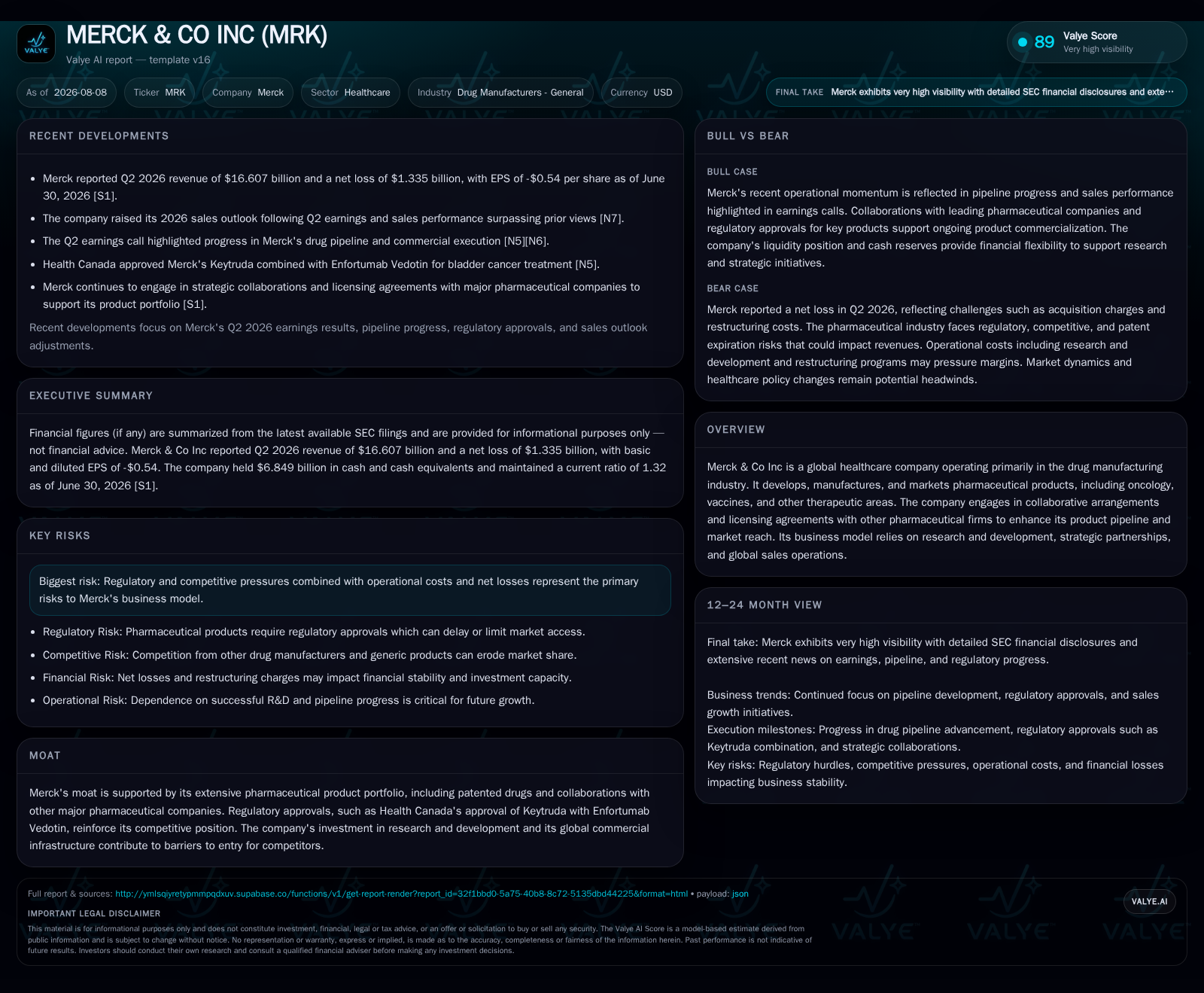
In its latest quarterly filing, Merck reported continued growth driven by core products like Keytruda and Gardasil, alongside integration of recent acquisitions Terns Pharmaceuticals and Cidara Therapeutics. Regulatory approvals, including Health Canada’s nod for Keytruda combined with Enfortumab Vedotin, bolster Merck’s oncology portfolio. The company's business model emphasizes R&D-led innovation with collaborations, while facing risks from regulatory costs and patent expirations. Monitoring clinical trial progress and commercialization efficiency will be critical going forward.
Recent Operating Update
This quarter also saw the strategic integration of two substantial acquisitions: Terns Pharmaceuticals at approximately $6.7 billion and Cidara Therapeutics at about $9.2 billion. Terns’ lead candidate, TERN-701—an oral allosteric BCR::ABL1 tyrosine kinase inhibitor targeting chronic myeloid leukemia patients who have failed previous therapies—is in phase 1/2 clinical evaluation [S5]. Cidara adds MK-1406 (formerly CD388), a long-acting antiviral aimed at influenza prevention undergoing Phase 3 trials involving at-risk adult populations [S8]. These transactions underscore Merck’s acquisition-driven pipeline expansion strategy targeting both oncology and infectious disease segments.
Furthermore, partnership arrangements such as a $700 million funding deal with Blackstone Life Sciences to support sacituzumab tirumotecan development indicate Merck's approach to risk-sharing in high-cost late-stage programs while recognizing non-refundable milestone payments to offset R&D expenses [S8]. This financial collaboration helps manage research expense volatility, enabling sustained investment across multiple late-stage assets.
Business Model
Merck operates within the pharmaceutical value chain primarily focused on discovery through development to global commercialization of patented drugs, vaccines, and biologics. Revenue is principally derived from product sales with supplemental income from licensing agreements, royalties, milestone payments related to collaborative drug development deals, and occasional divestitures. Its business model is deeply reliant on continuous research & development expenditure to maintain a robust drug pipeline that compensates for inevitable patent cliffs on established products.
The company’s global footprint enables effective distribution to diverse healthcare providers including hospitals, clinics, specialty pharmacies, government agencies, and public health programs worldwide. Pricing power stems from product innovation (e.g., first-in-class immune-oncology agents) combined with negotiated reimbursement contracts. Multi-year patent protections coupled with regulatory exclusivities create substantial barriers for generic entrants.
Recent acquisitions complement internal R&D efforts by bringing differentiated molecule classes—such as allosteric TKIs and drug-Fc conjugates—into the pipeline. By absorbing late-stage clinical programs poised for approval or launch into its portfolio, Merck aims to accelerate time-to-market impact while broadening addressable patient populations.
Industry Structure & Competitive Position
The pharmaceutical landscape is dominated by large multinational companies engaging in deep R&D investment cycles amid stringent regulatory scrutiny. Merck competes head-to-head with peers like Pfizer (oncology & vaccines), Roche (biologics focus), Bristol-Myers Squibb (immuno-oncology), Novartis (global reach), and Johnson & Johnson (diverse pharma operations). Each peer varies by specialty focus but shares similar challenges including patent expiration risk, pricing pressures from payers/governments, and the necessity to maintain innovative pipelines through internal discovery or external transactions.
Merck holds a competitive advantage through its blockbuster products such as Keytruda—an immuno-oncology cornerstone—alongside highly adopted vaccines like Gardasil that serve both developed and emerging markets globally. Its recent regulatory approvals add incremental differentiation by combining established agents with novel therapies to extend treatment lines.
Operational capacities encompass not only drug manufacturing but also extensive commercial teams specialized in navigating complex payer landscapes globally. Collaboration revenues further diversify income streams while enabling shared development risk mitigation.
Growth Drivers
Growth prospects hinge on several interconnected factors:
- Pipeline advancement: Progression of acquired agents like TERN-701 into later trial phases and potential approvals can unlock new revenue streams within hematologic oncology.
- Regulatory approvals: New labels like Health Canada's endorsement of Keytruda+Enfortumab expand market size within urothelial cancers.
- Vaccine expansion: Continued demand for Gardasil in global markets driven by public health initiatives sustains volume growth.
- Strategic partnerships: Financial collaborations reduce direct R&D expense exposure facilitating balanced investment across multiple projects.
- Emerging market penetration: Broadened geographic access improves addressable patient base beyond well-covered developed economies.
- Innovation in biologics and specialty segments: Novel modalities help circumvent traditional small molecule competition risks.
Each driver links directly to key performance metrics such as clinical trial progress milestones, regulatory submission/approval timelines, royalty/milestone income recognition events from partners, vaccine dose volumes sold, and real-world uptake rates.
Risks & Watchpoints
Despite fundamental strengths, several risks warrant close scrutiny:
- Regulatory hurdles: Delays or failures in clinical trials or approvals could defer anticipated launches or revenue recognition.
- Patent cliffs: Expirations expose flagship products to generic erosion unless successfully replaced by new offerings or label expansions.
- Pricing & reimbursement pressures: Heightened scrutiny from governments/payers may constrain pricing flexibility impacting margins.
- Integration risk: Assimilating acquired companies without disrupting development or commercial execution remains challenging at scale.
- R&D cost volatility: Substantial upfront charges from acquisitions add short-term expense burden potentially pressuring profitability metrics.
- Competitive intensity: Emergence of competing therapies or next-gen modalities could dilute market share if Merck’s innovations lag behind peers.
- Supply chain complexity: Global manufacturing dependencies may face disruption affecting product availability negatively impacting sales progression.
These factors collectively influence operating results; hence monitoring quarterly updates on pipeline status changes, milestone achievements, patent litigation developments, pricing comparisons versus peers, plus cost structure trends provide actionable insight into risk trajectory.
What to Watch Next
Key milestones include:
- Clinical data releases from Phase 1/2 TERN-701 trials addressing unmet chronic myeloid leukemia treatment needs.
- Progression of MK-1406 Phase 3 adult/adolescent influenza studies impacting antiviral portfolio scalability.
- Commercial launch effectiveness of newly approved combinations like Keytruda + Enfortumab Vedotin across regions following Health Canada approval.
- Updates on additional regulatory submissions or label expansions particularly within immuno-oncology indications where market competition intensifies.
- Financial disclosures regarding synergy realization post-acquisition including hit ratios on R&D-induced expense versus long-term revenue impact.
- Collaborator licensing milestone receipts influencing near-term income stability outside direct sales channels.
Tracking these variables against company guidance will illuminate pathway clarity around growth sustainability amidst evolving industry dynamics [N4][N5][N10]
Financial Profile Discussion
As of June 30, 2026, Merck reported cash and equivalents of approximately $6.85 billion, with current assets totaling about $36.68 billion and current liabilities near $27.73 billion, resulting in a current ratio of approximately 1.32, indicative of solid short-term liquidity adequate for ongoing operational needs [F1]
The company's significant investments in acquisitions during early 2026 contributed material charges recognized as acquired in-process R&D expenses directly expensed during respective quarters rather than capitalized; this accounting treatment impacts near-term profitability but aligns with pharmaceutical industry norms when acquiring pre-commercial asset portfolios at high valuations [S5][S8]
Revenue growth continues driven by core oncology drugs (Keytruda) combined with expanding vaccine franchises supporting gross margin resilience despite elevated R&D spending aimed at securing future innovation pipelines. Overall operating margins demonstrate management’s discipline balancing current profit generation alongside reinvestment imperatives required for sustainable competitive positioning sector-wide.
In sum, Merck maintains financial flexibility via cash reserves coupled with disciplined cost management enabling it to pursue aggressive R&D-led expansion strategies while managing the inherent risk profile typical of multinational pharmaceutical enterprises.
Disclaimer: This is research-only, informational analysis and not investment advice. It may include AI-generated interpretation and general industry context. Always verify important details using primary sources.

Comments