
MAIA Biotechnology Advances Telomere-Targeting Immunotherapy as NSCLC Trials Expand
The clinical-stage biotech pursues pivotal and expanded Phase 2 trials for ateganosine in advanced lung cancer, leveraging strategic partnerships and FDA Fast Track status.
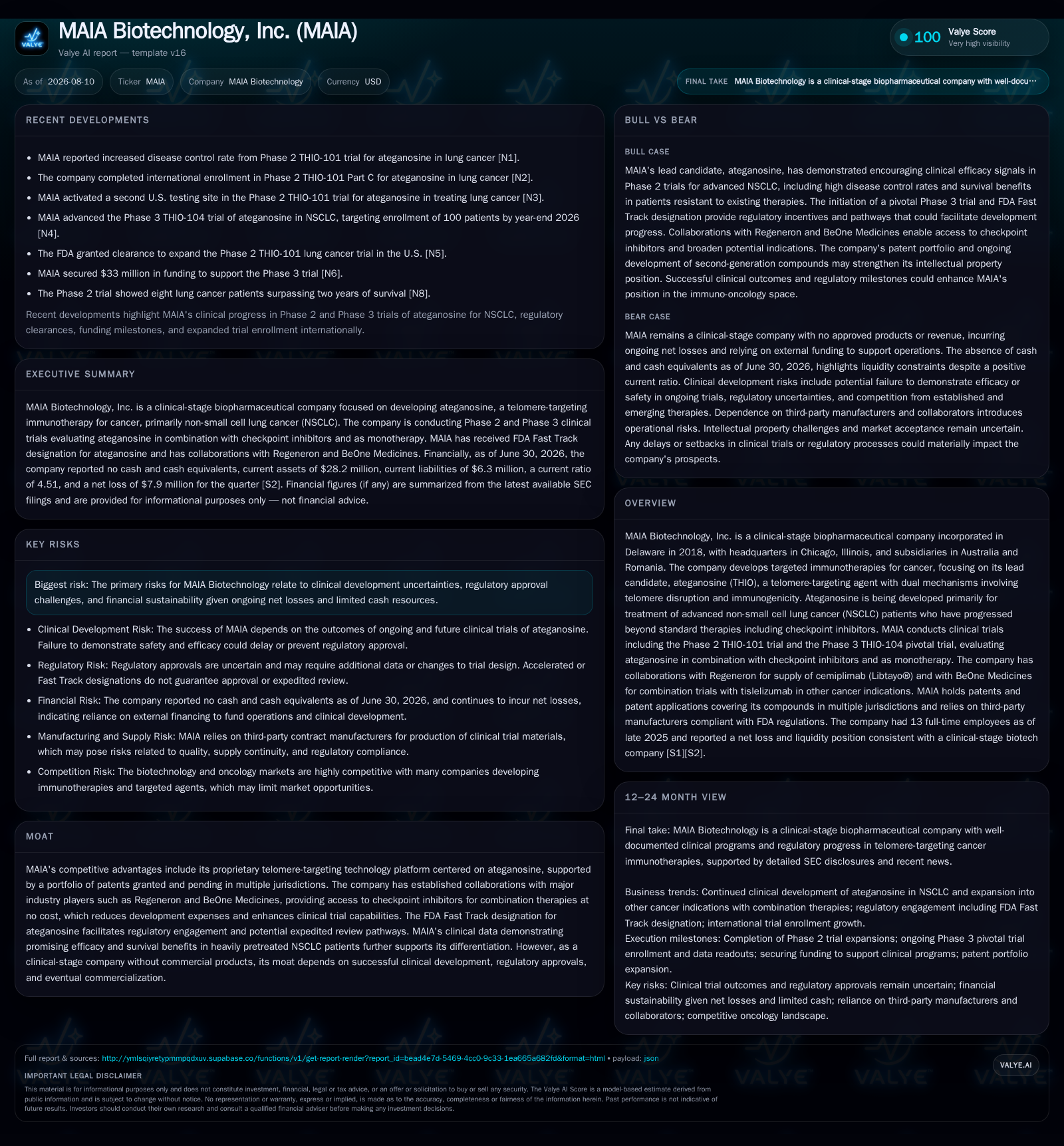
MAIA Biotechnology is advancing its lead immunotherapy candidate, ateganosine, through critical late-stage trials targeting advanced non-small cell lung cancer (NSCLC) patients resistant to standard treatments. The company expanded its Phase 2 THIO-101 trial with combination and monotherapy arms and initiated a pivotal Phase 3 trial directly comparing ateganosine-based therapy against chemotherapy. Collaborations with Regeneron and BeOne Medicines reduce clinical costs and provide access to checkpoint inhibitors essential for combination regimens. While promising efficacy signals support regulatory ambitions, MAIA faces typical biotech risks including clinical and regulatory uncertainties, patient enrollment challenges, capital needs, and pipeline concentration. Financially, the company holds a strong current ratio of approximately 4.5 with no reported debt as of mid-2026, supporting ongoing development efforts [S2][S1][F1].
Recent Operating Update
MAIA Biotechnology’s latest quarterly filing dated August 10, 2026 [S2] confirms continued advancement of its lead candidate ateganosine (THIO), a telomere-targeting immunotherapy under clinical evaluation primarily in advanced non-small cell lung cancer (NSCLC). In July 2025, the Phase 2 THIO-101 trial was expanded to enroll up to 48 third-line NSCLC patients resistant to checkpoint inhibitors and chemotherapy. This expansion introduced two distinct arms: one combining ateganosine with Regeneron's PD-1 inhibitor cemiplimab (Libtayo®), supplied under a cost-free clinical supply agreement executed in February 2021 [S1], and another arm evaluating ateganosine monotherapy [S1][S2].
Simultaneously, MAIA initiated the pivotal Phase 3 THIO-104 trial designed as an open-label randomized study enrolling up to 300 refractory NSCLC patients. This trial directly compares ateganosine combined with a checkpoint inhibitor against standard chemotherapy [S1]. This head-to-head design reflects MAIA’s strategy to establish superiority or non-inferiority over existing standards rather than placebo controls.
Business Model and Strategic Position
MAIA operates as a clinical-stage biotechnology company focused on developing novel targeted immunotherapies for oncology indications. Its lead asset, ateganosine, combines telomere disruption—a mechanism inducing selective cancer cell death—with immunogenic effects aimed at enhancing response when sequenced with checkpoint inhibitors such as PD-1 monoclonal antibodies [S1]. This dual mechanism differentiates MAIA from many peers that rely solely on immune checkpoint blockade.
Currently generating no product revenue [F1], MAIA’s operating model depends heavily on R&D investment funded through equity markets or partnerships. Strategic collaborations notably reduce development costs: the agreement with Regeneron provides cemiplimab at no charge for clinical use [S1], while an arrangement with BeOne Medicines supplies tislelizumab for upcoming Phase 2 trials targeting hepatocellular carcinoma (HCC), colorectal cancer (CRC), and small cell lung cancer (SCLC) [S1]. These partnerships enable efficient access to validated checkpoint inhibitors critical for combination regimens without incurring supply expenses.
Monetization remains contingent on successful regulatory approvals followed by commercialization or licensing deals. Until then, milestone payments or royalties could provide episodic revenues but are not currently recognized.
Industry Structure and Competitive Landscape
MAIA competes within the immuno-oncology subsector of biotechnology characterized by intense innovation around immune checkpoint inhibitors (CPIs) and emerging novel mechanisms. While companies like Adaptimmune and Iovance Biotherapeutics focus on cellular therapies or other modalities, few competitors target telomeres combined with immunogenic stimulation.
Checkpoint inhibitors have become standard first- and second-line therapies globally for NSCLC; thus refractory populations represent an unmet need but pose enrollment challenges due to smaller patient pools [S1]. Regulatory authorities such as the FDA are experienced in evaluating combination therapies under accelerated approval pathways when supported by surrogate endpoints—an opportunity MAIA aims to leverage given its Fast Track designation [S1].
MAIA’s partnerships mitigate financial risk relative to stand-alone early-stage biotechs lacking big pharma collaborations while providing access to clinically validated CPIs essential for combination validation. Its patent estate covering the telomere-targeting platform offers some protection against direct substitution but requires ongoing vigilance amid biosimilar competition or next-generation CPIs.
Growth Drivers
Primary growth drivers include successful completion of the Phase 3 THIO-104 pivotal trial demonstrating statistically significant benefit over chemotherapy in refractory NSCLC—critical for regulatory submissions anticipated starting in 2026 [S1]. Interim or final data from the expanded Phase 2 THIO-101 cohorts may reinforce efficacy signals.
Pipeline diversification through planned Phase 2 studies targeting HCC, CRC, and SCLC using BeOne’s tislelizumab represents potential expansion into broader oncology indications if proof-of-concept is established [S1]. These collaborations may facilitate co-development or licensing opportunities.
Regulatory incentives like Fast Track designation help accelerate interactions but do not guarantee expedited approvals. Emerging companion diagnostic requirements may add complexity but also improve patient selection efficiency.
Risks and Watchpoints
Risks typical of clinical-stage biotech apply: trial failures or delays due to challenges enrolling heavily pretreated patient populations could extend timelines [S1]. Regulatory uncertainty persists around novel mechanisms necessitating additional safety or companion diagnostic data. Financial sustainability depends on securing further capital as net losses driven by R&D expenditures continue; although current assets significantly exceed liabilities yielding a solid current ratio (~4.5) [F1], cash burn without revenue requires future funding rounds that could dilute shareholders or impose contractual constraints [S1]. Dependence on a single lead asset amplifies exposure amid evolving competitive dynamics.
Market competition from next-generation immunotherapies entering refractory settings could pressure MAIA unless it demonstrates clear clinical advantages. Pricing and reimbursement remain uncertain post-approval amid shifting healthcare policies globally [S1]
What To Watch Next
Near-term indicators include enrollment pace and response data from expanded THIO-101 cohorts testing monotherapy versus combination arms with cemiplimab [N2][S2]. Progress updates on the THIO-104 pivotal trial recruitment will inform feasibility of timelines toward top-line data release.
Regulatory interactions culminating in accelerated approval filings will be key milestones; confirmation that endpoints meet FDA expectations remains crucial [S1]. Initiation timing of Phase 2 trials in HCC, CRC, and SCLC leveraging BeOne’s partnership will signal pipeline breadth development.
Patent grant activity sustaining intellectual property protection across jurisdictions will impact long-term competitive positioning. Monitoring cash consumption relative to financing milestones will also be important given volatility in biotech funding markets.
Financial Profile Discussion
As of June 30, 2026, MAIA Biotechnology held approximately $28.2 million in current assets against $6.3 million in current liabilities resulting in a strong current ratio near 4.5 without any reported debt obligations [F1]. This liquidity profile supports ongoing clinical development without immediate leverage risk.
Operating losses remain substantial; the latest annual data show net losses exceeding $22 million driven primarily by research & development spending intrinsic to late-stage investigational therapy advancement [F1][S2]. This financial pattern aligns with typical pre-commercial biotech companies investing heavily ahead of potential market entry.
No debt is outstanding per recent disclosures which limits interest burden but implies dependence on equity financing or milestone payments going forward [F1][S2]. Monitoring quarterly cash burn against available resources will be critical given market conditions affecting capital availability.
This analysis integrates recent quarterly disclosures with industry context highlighting MAIA Biotechnology’s strategic positioning within late-stage NSCLC immunotherapy development leveraging novel telomere mechanisms combined with key external collaborations that reduce costs while supporting progression toward pivotal regulatory milestones. Investors should closely track upcoming clinical data releases, enrollment metrics, partnership developments, intellectual property status, and financing execution given inherent risks typical for early-stage oncology drug developers.
Disclaimer: This is research-only, informational analysis and not investment advice. It may include AI-generated interpretation and general industry context. Always verify important details using primary sources.

Comments