
American Vanguard’s Financial Restructuring and Operational Pressures in Agrochemicals
Q2 2026 reveals ongoing margin pressures driven by customer incentive liabilities and goodwill challenges alongside completed debt refinancing.
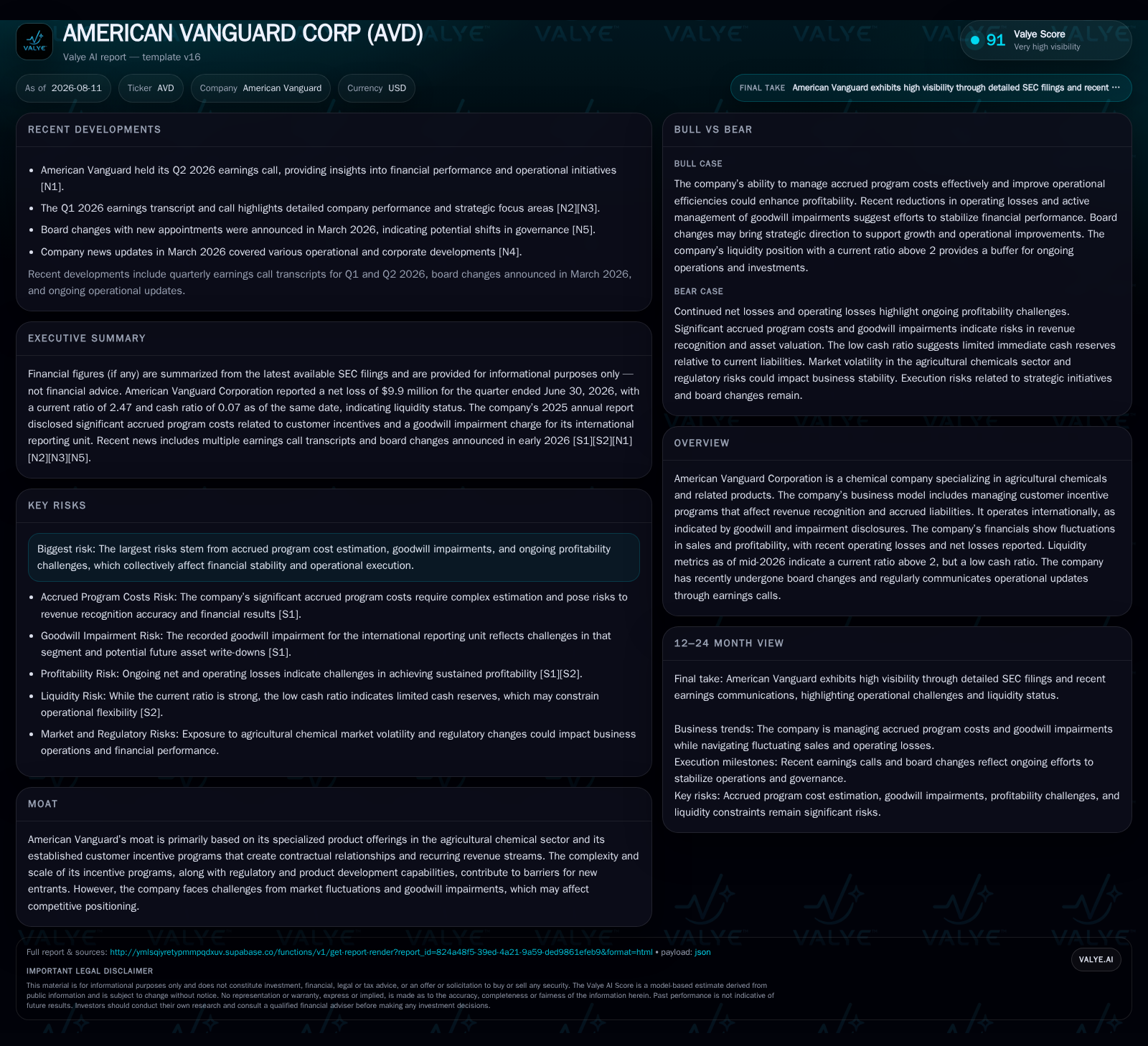
American Vanguard Corporation’s Q2 2026 results underscore the continuing impact of customer incentive programs on revenue recognition and recorded liabilities, contributing to operating losses despite modest sales growth. Goodwill impairments remain a drag on financial health, while the company has recently completed a significant debt restructuring that extends maturity and revises covenants, offering some near-term liquidity relief. The firm operates in a competitive agrochemical landscape with complex regulatory demands and supply chain volatility, where innovation and emerging market exposure could spur growth if execution stabilizes.
Updating Q2 Operating Realities: Loss Trends and Incentive Program Ripples
American Vanguard's latest quarterly filing dated August 10, 2026 reports an operating loss of about $4.3 million for Q2, reflecting continued pressure from elevated accrued liabilities primarily related to its customer incentive programs [S2]. Despite incremental sales growth in core crop protection products, these incentive arrangements delay or modify revenue recognition timing and increase accrued program costs, weighing on operating income. Such dynamics are evident in the net loss of $4.15 million reported in Q2 2026, an improvement from a wider loss last year but still negative overall [N1][S2]. This persistent operating deficit signals that margin recovery remains elusive under current pricing and cost structures.
Inventory valuations and asset impairments also add complexity to quarterly results; the company noted impairments linked to rationalizing manufacturing facilities mainly during prior quarters but with residual impact continuing into Q2 as reorganization efforts progress toward completion by year-end [S2][N1]. Together with higher interest expense stemming from debt refinancing activities earlier in the year, these factors contribute to constrained profitability in an intensely competitive agrochemical market.
Core Business Model Mechanics: How Customer Incentives Shape Revenue & Profitability
American Vanguard generates revenue predominantly by manufacturing formulated agricultural chemicals — herbicides, insecticides, fungicides — sold mainly to distributors and agricultural retailers with broad international reach [S1]. A distinctive feature of its business model is the structured customer incentive programs designed to stimulate volume purchases and foster long-term contracts. These incentives result in accrued liabilities representing expected program costs that must be estimated periodically.
The effect on revenue recognition is significant: sales received under such programs may be deferred or partially offset by these accrued costs, introducing earnings volatility quarter-to-quarter due to estimation complexities and potential adjustments [S1][S2]. While these incentives enhance customer retention by deepening contractual relationships—an important moat given product commoditization risks—they also limit operational leverage since the associated cost fluctuations can erode gross margins even as sales volumes grow
In this respect, American Vanguard’s approach resembles peers like FMC Corporation that deploy similar customer incentive mechanisms. However, the scale at FMC and their integrated portfolio breadth provide more robust pricing power compared to AVD’s more specialized but narrower product set.
Industry Structure Context: Competitive Scale, Regulatory Overlay & Supply Chain Dynamics
Operating within the agrochemical industry value chain focused on manufacturing/formulation stages positions American Vanguard amid several challenges distinct from larger global players such as BASF or Corteva Agriscience. These rivals benefit from integrated manufacturing scale, extensive R&D resources for product innovation, and diversified distribution channels.
Conversely, AVD must navigate fluctuating raw material input prices affected by commodity cycles while complying with stringent regulatory environments that tightly govern product approvals and usage patterns across different geographies [S1]. Regulatory compliance demands slow down product development milestones but are vital for securing market access especially for newer benign formulations gaining favor due to increasing environmental concerns.
Supply chain complexities including warehousing, transportation logistics also impact cost structure; reductions in these operational inefficiencies formed part of recent transformation initiatives aimed at improving long-run operating leverage but are ongoing [S1]. Distribution through specialized agricultural channels further conditions sales velocity; success depends on managing inventory turnover aligned with seasonal farming cycles.
Growth Opportunities Rooted in Product Innovation and Emerging Market Exposure
The company continues investing in R&D at levels consistent with sector norms—targeting sustainable formulation innovations that meet evolving regulatory standards—a critical lever for competitive differentiation given pricing pressures on traditional crop protection chemicals [S1][S2]. Such innovation not only supports shifts toward environmentally friendly options but also enables premium pricing potential as farmers adopt integrated pest management strategies.
Additionally, international sales constitute a material portion of AVD’s revenues with exposure across markets including Mexico, Netherlands, Nicaragua among others—regions offering growth prospects as agricultural modernization drives demand for advanced chemical inputs [S1][S29]. Expansion into emerging markets aligns well with broader industry trends where mid-sized players capitalize on regional niches neglected by multinational giants.
If successful commercialization outcomes materialize from ongoing R&D projects alongside favorable regulatory decisions enabling new product launches, it could partially offset margin compression afflicting legacy portfolios.
Constraints from Financial Burdens: Goodwill Impairment, Accrued Costs & Capital Structure
Financially, American Vanguard has faced persistent headwinds from goodwill impairment charges recognized primarily during annual reviews that weaken equity cushions and signal asset overvaluation risks from past acquisitions [S1][S20]. These impairments reduce net worth although no recent charges were indicated specifically in Q2 2026; however, their legacy effects dampen overall financial flexibility.
Debt burden is considerable: recent refinancing executed in March 2026 replaced prior revolving credit facilities with longer-dated term loans totaling approximately $225 million (First Lien) alongside secondary tranches maturing later [S3][S4]. While interest expense rose due to higher borrowing costs post-refinancing (around SOFR plus ~8%), extension mitigates near-term liquidity risks providing tactical agility amid slow profit recovery [S3]. Notably, executive bonuses were awarded recently recognizing successful debt restructuring efforts highlighting management focus on stabilizing capital structure.
Key Risks: Regulatory Signals, Pricing Pressure & Program Liability Estimations
A confluence of sector-specific risks imperils durable margin expansion for American Vanguard [S1]. Regulatory changes remain unpredictable across multiple jurisdictions potentially delaying product approvals or imposing usage restrictions that restrain sales volume growth
Intense price competition amongst agrochemical producers compresses average selling prices limiting upside even amidst rising input costs inducing gross margin contraction [S1][S2]. Moreover, estimations related to customer incentive program costs introduce accounting uncertainties; material adjustments can cause erratic swings in reported operating income undermining visibility for stakeholders
Foreign exchange volatility tied to international operations represents another vector of earnings risk though wasn’t highlighted as immediate concern recently.
Forward-Looking Markers: What Investors Should Monitor Next
Key forward-looking indicators include quarterly movements in EBITDA margins signaling leverage improvements or continued cost pressures post-transformation initiatives [N1][S2]. Tracking R&D pipeline progression through clinical trials or regulatory filings will illuminate prospects for revenue diversification away from commoditized products.
Debt repayment schedules alongside compliance with amended covenants will be crucial milestones determining capital availability for reinvestment or shareholder returns. Additionally, any updates regarding modulation of customer incentive program accounting estimates could materially affect short-term earnings trajectories.
Monitoring agricultural commodity price trends indirectly helps gauge demand outlook given correlation between crop prices and chemical usage intensity.
Financial Profile Discussion: Refinancing, Net Debt & Liquidity as Tactical Weapons
As of June 30, 2026 American Vanguard maintained current assets totaling approximately $418 million against current liabilities around $169 million translating into a strong current ratio near 2.47 indicating sound liquidity buffer over upcoming obligations despite relatively low cash reserves near $11.5 million reported previously [F1][S2]
Net debt remains elevated albeit somewhat reduced post-refinancing — approximated near $29.9 million net of cash using latest available figures—with longer maturity profiles mitigating immediate refinancing risks yet imposing interest burdens needing offset by operational improvements [F1][S3]
The interplay between financial restructuring outcomes including debt refinancing extending maturities with capitalization adequacy paints a nuanced picture requiring continued vigilance around key KPIs such as EBITDA progression, R&D output maturation, regulatory developments coupled with accurate liability estimation management to clarify recovery paths moving forward.
The company's positioning amid peers like FMC Corporation signals competitive intensity yet underscores differentiation potential deriving from focused specialty formulations combined with international market penetration strategies. Nonetheless—risks relating to goodwill impairments’ legacy effects plus price pressures compounded by estimation errors inherent in complex incentive arrangements merit cautious assessment going ahead.
Disclaimer: This is research-only, informational analysis and not investment advice. It may include AI-generated interpretation and general industry context. Always verify important details using primary sources.

Comments