
Inogen’s Q2 2026 Results Reflect Rental Model Resilience Amid Reimbursement and Market Pressures
Inogen’s latest quarter highlights the ongoing importance of its direct-to-consumer rental strategy and diversified respiratory product portfolio amid reimbursement and supply chain challenges.
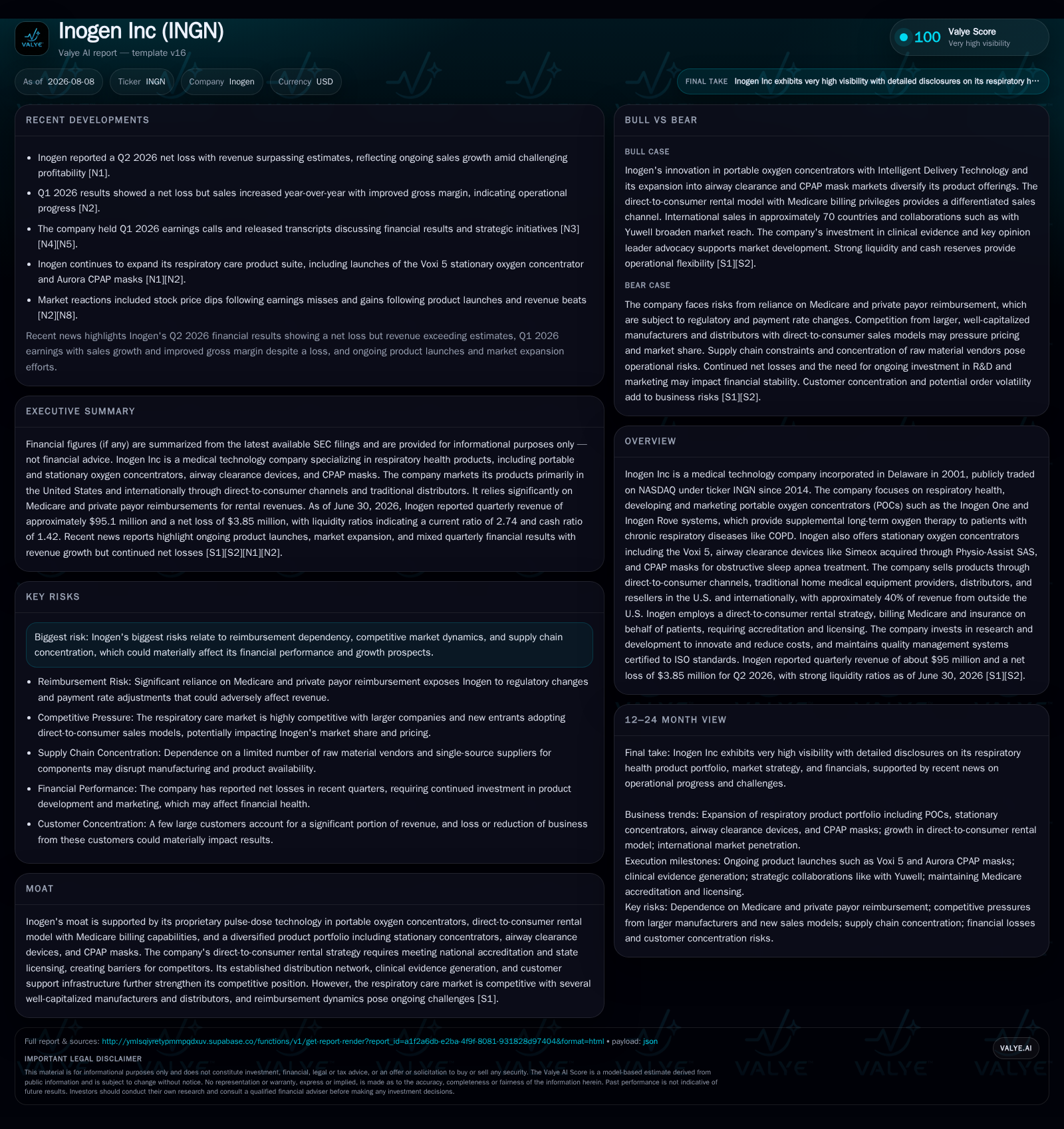
Inogen delivered Q2 2026 results that surpassed revenue expectations but posted a net loss, reflecting persistent pressures from reimbursement dynamics and competitive intensity in the respiratory medical device space. The company’s core business remains focused on portable oxygen concentrators (POCs) sold and rented primarily through a direct-to-consumer model leveraging Medicare reimbursement, supplemented by stationary concentrators, airway clearance devices, and CPAP masks. Inogen’s moat is supported by proprietary pulse-dose technology and regulatory barriers inherent in rental programs but challenged by supply chain concentration and evolving payor policies. Sustained growth will depend on expanding device usage, maintaining rental customer counts, navigating reimbursement changes, and broadening geographic reach through collaborations like with Yuwell.
Recent Operating Update
Inogen reported its Q2 2026 earnings on August 6th, revealing a mixed but strategically consistent performance [S2][S3]. Revenue topped consensus estimates, signaling continued strength in its portable oxygen concentrator (POC) rental business segmented largely through direct-to-consumer channels billed to Medicare. However, the company posted a net loss reflective of ongoing pressures from elevated cost of sales—driven partly by supply chain disruptions—and increased operating expenses including selling and administrative costs [N1][S2]. This dual dynamic—solid top-line demand coupled with margin compression—underscores the complex terrain Inogen navigates within the respiratory medical device industry.
Inventory management remains cautious with an increasing noncurrent inventory balance (items held over one year), highlighting some challenges in matching production to volatile order intake under just-in-time operations [S2]. The firm explicitly notes the absence of backlog due to flexible order cancellations by customers but acknowledges capacity constraints during peak periods. These factors reinforce the need for agile supply chain execution as well as prudent working capital management.
Business Model Overview
Inogen operates primarily in manufacturing and marketing specialized respiratory devices targeting supplemental long-term oxygen therapy (LTOT) for patients predominantly afflicted with chronic obstructive pulmonary disease (COPD) and other chronic respiratory illnesses [S1]. Its flagship products—the Inogen One® and Rove® systems—are proprietary POCs designed using pulse-dose oxygen delivery technology that differentiates Inogen by maximizing portability and battery life while meeting clinical efficacy standards. The rental revenue model is focused on direct customer engagement leveraging Medicare reimbursement pathways, which requires adherence to national accreditation and complex billing processes that set high entry barriers for competitors.
Supplementing POCs, Inogen markets stationary concentrators like Voxi 5®, airway clearance devices following the acquisition of Physio-Assist SAS (e.g., Simeox®), and CPAP masks under the Aurora® brand targeting obstructive sleep apnea treatment [S1]. This diversification allows cross-selling opportunities within home medical equipment (HME) providers and expands addressable patient populations.
The company's revenue streams blend unit sales—often directly or via distributors—and largely recurring rental income where customers pay monthly fees backed by insurance reimbursement [S1]. Rental economics hinge on factors such as customer acquisition cost, average rental duration per patient (reflecting device utilization), churn rates, and warranty claim intensities all of which materially impact margins. High fixed costs related to technology development (R&D) plus support services further influence profitability margins
Industry Structure & Competitive Position
Inogen sits amid established global respiratory care players such as Philips Respironics, ResMed, Invacare Corporation, Fisher & Paykel Healthcare, and Drive DeVilbiss Healthcare. Each competes on dimensions including product innovation (portability, battery life), breadth of portfolio (oxygen vs sleep apnea devices), distribution reach, clinical evidence backing FDA regulatory clearances, and crucially reimbursement expertise.
The industry's dependence on government healthcare payors—particularly Medicare—influences sales cycles extensively due to coverage policies shaping patient access to therapies [S1][S28]. Inogen's direct-to-consumer model augmented with Medicare billing is thus a differentiated element helping capture value through higher-margin rentals rather than pure sales. However, this also embeds risks: any policy reform or cutbacks can rapidly degrade revenue visibility
Supply chain concentration risk is salient as the company relies on a limited set of contract manufacturers for key components—a vulnerability witnessed across the sector recently when semiconductor shortages temporarily delayed new device shipments [S1]. Maintaining reliable supplier relationships while investing in inventory buffers is critical for preserving order fulfillment continuity
Growth Drivers
Several structural tailwinds position Inogen favorably for future growth:
- The aging global population drives increasing prevalence of COPD and related chronic lung diseases requiring LTOT solutions.
- Rising awareness among physicians and patients about home-based therapies fuels demand for convenient POCs improving mobility compared to traditional stationary units or compressed gas tanks.
- Technological innovation enhancing battery runtime, weight reduction, user interface advancements bolster end-user adoption.
- Expanding direct-to-consumer rental footprints enhance recurring revenue streams with potential scalability in underpenetrated international markets.
- Collaborations such as the 2025 agreement with Jiangsu Yuyue Medical Equipment & Supply Co., Ltd. (Yuwell) aim at widening distribution channels across Asia Pacific regions while jointly advancing product pipeline innovation [S1].
- Diversification into airway clearance devices via recent acquisitions strengthens clinical portfolio synergies.
Positive development or approval of new devices expanding addressable indications would provide further growth catalysts.
Risks & Watchpoints
Critical risk areas warrant monitoring:
- Reimbursement fluctuations: Changes in Medicare or private insurer coverage policies remain unpredictable yet materially affect unit economics. Competitive bidding outcomes or payment rate adjustments could compress margins or limit pricing flexibility [S28][S29].
- Competitive intensity: Entry by larger established healthcare equipment conglomerates could erode market share or force price concessions.
- Supply chain fragility: Concentration risks in suppliers or manufacturing partners may cause episodic shortages impacting customer satisfaction.
- Regulatory compliance hurdles: Complex FDA clearances for new products require sustained R&D investments with no guaranteed success.
- Customer concentration risk stemming from reliance on major HME providers or distributor agreements can create negotiation leverage imbalances.
- Economic conditions influencing healthcare spending might dampen demand trajectory amidst broader downturns.
KPIs such as rental customer retention rates, average duration of device usage per patient, warranty claim frequencies, inventory turnover ratios, alongside R&D productivity metrics will be revealing barometers of operational health going forward.
What To Watch Next
Future quarterly results should clarify if revenue growth sustainability aligns with margin improvements as supply chain normalizes post recent disruptions. Key demand indicators include stabilizing or rising rental customer counts paired with improved device utilization metrics indicating deeper patient adherence.
Additional milestones include progress with international rollout via Yuwell collaboration which could diversify revenue sources beyond the U.S., mitigating domestic market reimbursement risks.
Regulatory filings or launches of next-generation POC platforms or expanded airway clearance solutions would represent tangible pipeline advancement confirming innovation moat durability.
Monitoring evolving Medicare policy announcements will be essential given their outsized influence on cash collections timing and revenue recognition patterns.
Financial Profile Discussion
As of June 30, 2026, Inogen reported a strong liquidity position with cash and equivalents totaling approximately $87 million against minimal total debt near $80,000 resulting in a net cash surplus exceeding $87 million [F1][S2]. The current ratio stood comfortably at 2.74x highlighting solid short-term asset coverage relative to liabilities [F1]. This financial positioning affords operational agility to fund R&D initiatives and buffer against competitive or reimbursement headwinds without immediate refinancing concerns.
Despite top-line growth momentum from Q2 revenues surpassing estimates—which reflects resilient demand for POC rentals—the company incurred a net loss attributable primarily to operating expenses outpacing gross margin expansion likely due to cost inflation within supply chain elements plus increased selling/general administrative expenses requisite for broadening market penetration efforts [N1][F1]. The persistence of these losses underscores the importance of scale efficiencies and pricing power improvement along with disciplined expense management.
Research & development expenditure remains a strategic priority given rapid technological developments in respiratory care.
Robust cash reserves support continued innovations critical for product competitiveness.
Overall financial fundamentals underline a well-capitalized enterprise reliant on nuanced healthcare payor ecosystems where reimbursement policies are determinative. Financial discipline paired with execution on growth vectors will be decisive for translating top-line gains into profitability optimization over time.
This analysis focuses strictly on facts disclosed through official filings supplemented by credible news sources up to August 2026. It avoids speculative projections without underlying evidence and contextualizes Inogen’s business within its specific respiratory medical device industry niche including competitive forces, regulatory environment, reimbursement dependencies, operational KPIs relevance, risks profile, growth catalysts, and financial robustness reflecting current corporate filings.
Disclaimer: This is research-only, informational analysis and not investment advice. It may include AI-generated interpretation and general industry context. Always verify important details using primary sources.

Comments