
GPO Plus Consolidates Fragmented Midwest DSD Market via PRISM+ Tech and Private Label Focus
GPOX leverages proprietary technology and direct store delivery to regional convenience stores, aiming to scale a fragmented market segment.
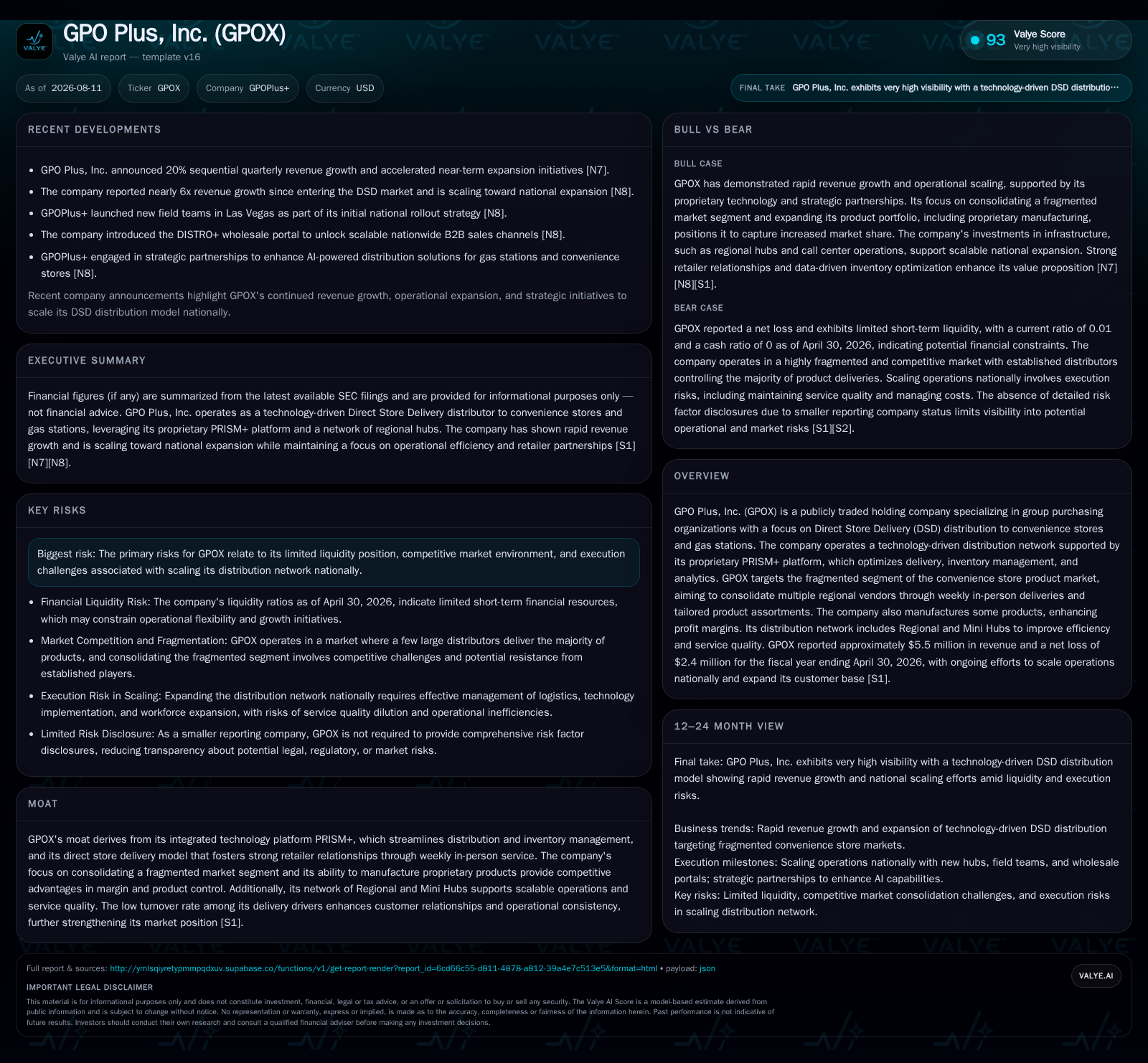
GPO Plus, Inc. operates a technology-driven Direct Store Delivery (DSD) distribution network focusing on convenience stores and gas stations in the Midwest, a region traditionally underserved by full-service DSD providers. The company’s proprietary PRISM+ platform optimizes delivery routes, inventory management, and analytics, enabling weekly personalized service that reduces out-of-stock incidents and labor costs for retailers. GPOX also manufactures select private label products, enhancing margins and product control. Despite trailing profitability with a net loss of $2.4 million on $5.5 million revenue in fiscal 2026, GPOX is investing in scalable infrastructure through Regional and Mini Hubs to consolidate the fragmented 15-20% portion of the market served by numerous small vendors.
Recent Operating Update
The latest quarterly filing dated March 10, 2026 [S2] provides limited incremental financial detail but confirms ongoing business activity centered on scaling GPO Plus's core DSD model. A subsequent June 23 event filing [S3] announced an updated Retail Investor Memorandum emphasizing their strategic narrative without disclosing new financial guidance.
The August 11 annual report [S1] consolidates insights into the company’s mission to consolidate a highly fragmented segment of convenience store FMCG distribution in the Midwest. This segment currently represents about 15%–20% of product volume served by hundreds of small vendors primarily using drop-ship models that do not offer the frequency or personalized service of DSD.
Business Model
GPO Plus's business hinges on providing Direct Store Delivery (DSD) services directly to convenience stores and gas stations, with a concentration in the Midwest — an area historically dominated by broadline or drop-ship distributors [S10]. Their customers are predominantly independent store operators who benefit from weekly deliveries featuring tailored fast-moving consumer goods (FMCG) assortments aligned with local consumer preferences.
Revenue is generated primarily through wholesale markups—the difference between product acquisition cost from manufacturers/vendors and sales price charged to retailers—augmented by volume discounts that leverage purchasing scale [S10]. Additionally, the company manufactures certain private label products internally, realizing superior margins compared to third-party product sales [S10]. Alongside product revenue, retailers pay delivery or distribution fees tied to weekly DSD services [S22].
A central element is their proprietary PRISM+ platform (Predictive Route, Inventory, and Service Management), which integrates route optimization, precise inventory tracking, demand forecasting, and data analytics for both operational excellence and customized retailer solutions [S10]. This technology underpins their ability to maintain low out-of-stock rates—a key metric impacting retail sales—and reduce operational waste.
Operationally, GPOX’s network consists of Regional Hubs supplemented by Mini Hubs strategically placed for timely deliveries while preserving local market responsiveness [S1]. Drivers visit stores weekly to perform shelf stocking directly at point of sale; this frequent touchpoint reduces retailers’ labor costs associated with pallet handling and inventory management while freeing up valuable retail space as inventories are minimized but replenished just-in-time [S11].
This repeat physical engagement fosters strong customer relationships—a competitive advantage reinforced by industry-low driver turnover rates—which facilitates real-time feedback loops for adjusting assortments and service parameters dynamically [S10].
Their private label manufacturing contributes strategic value by enabling exclusive product offerings that protect shelf space against national brand encroachment while delivering higher profitability per unit sold [S11]. This vertical integration complements vendor consolidation efforts aimed at simplifying store-level supplier footprints.
Industry Structure and Competitive Position
The DSD distribution industry serving convenience stores is characterized by high fragmentation: a few large national distributors dominate roughly 80%-85% of product volume; the remainder is distributed by many regional vendors often relying on drop-ship logistics without frequent in-store presence [S18]. This fragmentation creates opportunity for companies like GPOX to consolidate niche markets through weekly DSD service backed by technology-driven supply chain controls.
Peers in this space include established players such as Core-Mark Holding Company (a major national distributor) and Eby-Brown Company (regional-focused), who leverage scale but may not penetrate certain Midwest independent retailer segments as deeply.
GPOX differentiates itself via its PRISM+ technology platform optimizing route efficiency and inventory controls tailored specifically to gas station and convenience store demands. Its integrated approach encompassing distribution plus private label manufacturing aims to elevate margins above peers reliant solely on wholesale markups.
By focusing on independent stores—often underserved due to smaller order sizes or mix variability—GPOX targets an addressable market where service frequency and tailored assortments create loyalty barriers against larger competitors relying on less frequent broadline deliveries.
Growth Drivers
Key drivers include:
- Market Consolidation: GPOX’s mission focuses on consolidating fragmented regional vendors servicing ~15%-20% of convenience store products—a significant growth runway if successful [S18].
- Expansion of Weekly Delivery Footprint: Increasing number of retail locations served enhances purchasing scale benefiting gross margin expansion via better vendor terms [S18].
- Private Label Product Growth: Expanding proprietary product lines offers higher margin streams while cultivating stronger store partnerships due to exclusivity [S11].
- Technology Adoption: Continuous enhancements in PRISM+ can reduce operating expenses through optimized routes & inventory management increasing delivery frequency without proportional cost increases.
- Retailer Demand for In-Stock Assurance: Convenience stores seek partners minimizing out-of-stock incidence; GPOX’s frequent visits supported by analytics aligns well with this need.
- Support for New Store Launches: Offering unique solutions beyond standard logistics positions GPOX as an indispensable partner aiding client growth strategies [S11].
Risks / Watchpoints / Growth Constraints
Several risks temper optimism:
- Liquidity Constraint: Companyfacts data shows cash & equivalents of $7,506 against current liabilities exceeding $6.7 million as of April 30, 2026, resulting in a very low current ratio (~0.01), indicating potential working capital challenges [F1].
- Competitive Pressure: Large national distributors’ scale economies present pricing challenges; GPOX must maintain differentiated service quality & technological edge to defend niche position.
- Execution Risk During Scaling: Growing from regional hubs toward a national footprint involves complexity managing decentralized supply chains without degrading service quality [S18].
- Market Fragmentation Limits Pricing Power: Multiple small vendors in target segment could lead to pricing pressure or margin compression.
- Private Label Acceptance: Consumer perception risks exist around quality compared to national brands potentially limiting private label growth unless rigorously managed.
- Reliance on Driver Retention: While current turnover is low—positive for relationships—any future rise would undermine customer loyalty gains built through personal contact.
- Supply Chain Disruptions: External factors affecting vendor ability to supply high-demand products affect fill rates impacting revenue reliability.
What to Watch Next
Key milestones to monitor include:
- Expansion progress in store count across Midwest regions reflecting traction beyond initial markets.
- Improvements in net income trends driven by scaling efficiencies or enhanced private label penetration.
- Updates on PRISM+ functionality releases especially around predictive analytics which may unlock better inventory turns.
- Any capital raises or debt refinancing addressing liquidity concerns are critical signals for sustaining growth expectations.
- Retailer retention rates or renewal metrics that might validate relational strength inherent in weekly DSD model.
- Commentary on competitive dynamics from recent investor communications signaling shifts vs large national distributors.
Financial Profile Discussion
As of April 30, 2026, companyfacts data indicates cash and equivalents of $7,506 against current liabilities exceeding $6.7 million, resulting in a current ratio near 0.01, which suggests significant liquidity constraints [F1]. Total debt is approximately $188,000 as of January 31, 2024, with net debt around $180,494 [F1]. These figures imply a modest absolute debt level relative to liabilities, with much of the current liabilities likely comprising trade payables or accrued expenses rather than long-term debt [F1].
Capital expenditures appear focused on expanding Regional and Mini Hub infrastructure to support scalable weekly deliveries, though detailed capex disclosures are limited. Efficient deployment of these investments will be critical to improving operating leverage as delivery volumes increase, supported by PRISM+ system insights.
It does not constitute investment advice or research views regarding GPO Plus, Inc. Readers should conduct their own due diligence before making investment decisions.
Disclaimer: This is research-only, informational analysis and not investment advice. It may include AI-generated interpretation and general industry context. Always verify important details using primary sources.

Comments