
Cannae Holdings Advances Portfolio Diversification with Exeter Rugby Acquisition Amid Goodwill Impairment
The latest quarterly filing spotlights Cannae’s strategic acquisition of Exeter Rugby alongside a goodwill impairment at 99 Restaurants, reflecting active portfolio rebalancing.
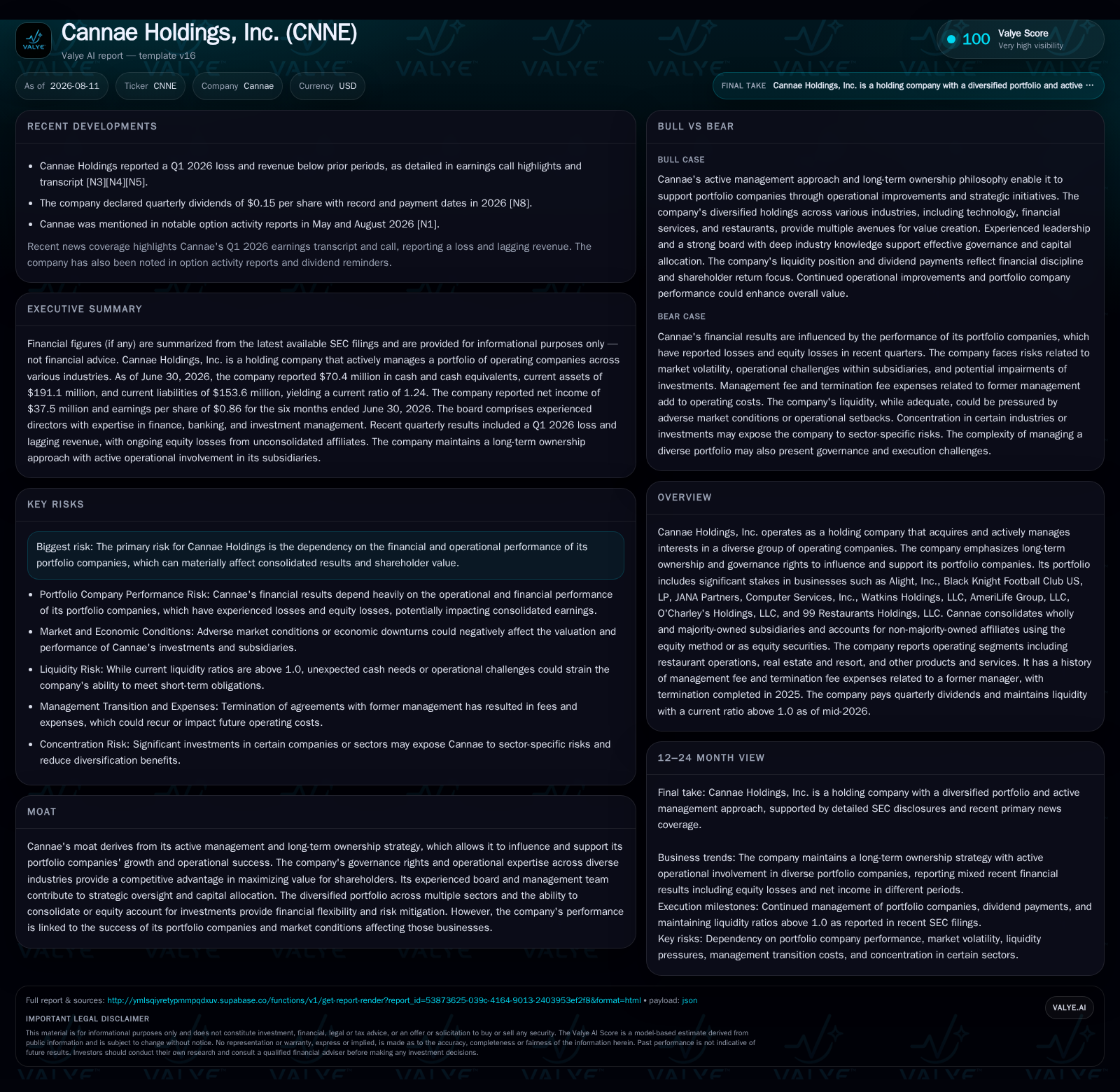
In its August 2026 quarterly report, Cannae Holdings disclosed the acquisition of Exeter Rugby through its subsidiary Black Knight Rugby, marking an expansion into professional sports. Concurrently, fair-value testing triggered a goodwill impairment on the underperforming 99 Restaurants unit, signaling challenges in legacy assets. The company continues to leverage long-term governance rights and active portfolio management across diverse operating segments, balancing capital deployment between growth initiatives and shareholder returns. Financially, minimal net debt and a current ratio above one support ongoing strategic flexibility despite operating losses driven by impairments.
Strategic Acquisition Expands Portfolio into Professional Sports
Cannae Holdings’ August 2026 quarterly report reveals a strategic shift with the acquisition of Exeter Rugby through its newly formed subsidiary Black Knight Rugby, LLC. This marks an expansion into the professional sports sector by acquiring full ownership of a top-tier English rugby union club [S2]. Such diversification complements Cannae’s existing portfolio mix and exemplifies its approach of active governance and long-term ownership designed to influence operational performance and value creation.
Goodwill Impairment Highlights Asset Quality Challenges in Restaurant Segment
The same quarter’s goodwill impairment test for the 99 Restaurants reporting unit identified significant valuation pressure: the estimated fair value stood at $38 million compared to a carrying amount of $70.1 million as of June 30, 2026 [S2]. This substantial write-down signals challenges within legacy hospitality assets that may reflect competitive headwinds or operational underperformance. It underscores the inherent volatility investment holding firms face when managing retail-exposed subsidiaries subject to market fluctuations
Complex Operating Structure Combines Consolidated Subsidiaries with Equity Method Affiliates
Cannae’s business model integrates fully consolidated subsidiaries—such as restaurant operations and real estate development entities—with equity method accounted affiliates including Alight Inc., Black Knight Football Club US LP, and Computer Services Inc. This hybrid structure diversifies revenue streams through direct operational cash flow, dividends from affiliates, and management fees [S1][S2]. For instance, equity earnings from Alight reflect sizable revenues but also variability tied to broader market conditions impacting affiliate profitability.
This complexity requires nuanced interpretation of consolidated results since operating losses can coexist with positive dividend inflows that bolster net asset value. Additionally, internalizing management functions has reduced fee expenses over time, enhancing margin control [S1]
Active Stewardship Drives Long-Term Value Creation Across Diversified Investments
Cannae leverages governance rights to exert strategic oversight across its portfolio companies, enabling operational improvements and growth initiatives critical to unlocking intrinsic value. Since inception through end-2025, management has realized roughly $3 billion in monetization proceeds exceeding original investments, demonstrating effective capital deployment and selective portfolio optimization [S1]
This hands-on approach aligns Cannae philosophically with large diversified holding firms like Berkshire Hathaway that emphasize both scale and active governance to maximize returns while managing risk across disparate industries.
Capital Allocation Balances Shareholder Returns with Strategic Reinvestment
The company maintains a commitment to consistent quarterly dividends supported by recurring income from dividends and fees on equity investments [S1]. Opportunistic share repurchases remain discretionary based on capital availability and valuation considerations.
However, recent investments such as the Exeter Rugby acquisition illustrate reinvestment priorities that require upfront capital deployment potentially constraining immediate shareholder distributions. This balance reflects typical tensions in holding companies between funding growth platforms requiring longer-term horizons versus returning cash through dividends or buybacks.
Risks Focused on Portfolio Performance Volatility and Asset Valuation Pressures
Cannae's financial results are sensitive to the operational success of underlying portfolio businesses that drive earnings and net asset values. The goodwill impairment on the restaurant segment highlights how adverse market conditions or sector-specific challenges can rapidly translate into accounting charges affecting reported profitability [S1][S2].
Sector concentration risks persist given exposure to hospitality and real estate segments which may be more cyclical or sensitive to economic downturns than other investments. Additionally, while leverage is moderate, any increase without earnings recovery could raise servicing risks emphasizing liquidity preservation importance [F1][S2]
Near-Term Watchpoints: Integration Progress, Impairment Monitoring, Capital Return Execution
Investors should track integration outcomes for Exeter Rugby as an indicator of successful diversification impact. Subsequent goodwill impairment assessments will be critical to monitor ongoing asset quality trends particularly in restaurant-related holdings.
Dividend sustainability and share repurchase activity will provide insight into capital return policy adherence amid reinvestment demands. Furthermore, any announcements around acquisitions or disposals will signal continued portfolio optimization efforts aligning with Cannae’s active management strategy [S2][S3].
Monitoring organic revenue growth trends within portfolio companies will also be essential for assessing underlying operational momentum supporting valuation assumptions.
Financial Profile Discussion: Strong Liquidity Amid Operating Losses Driven by Impairments
As of June 30, 2026, Cannae held approximately $70.4 million in cash against total debt near $69.9 million resulting in negligible net debt (~negative $0.5 million), which supports strategic flexibility despite operating losses primarily driven by non-cash impairment charges rather than cash outflows [F1][S2]
While the company reported a net loss of roughly $7.4 million for the first half of 2026 excluding non-cash adjustments,[S2] this reflects transient valuation impacts rather than fundamental cash generation issues.
This analysis is grounded exclusively in SEC filings from April through August 2026 combined with contemporaneous financial data snapshots. It provides contextually relevant commentary situating Cannae Holdings within recognized paradigms for diversified investment holding companies without speculative forward-looking statements.
Disclaimer: This is research-only, informational analysis and not investment advice. It may include AI-generated interpretation and general industry context. Always verify important details using primary sources.

Comments