
DiaMedica Advances Phase 2 Trials in Ischemic Diseases With Solid Liquidity Cushion
The company progresses clinical-stage development of DM199 for preeclampsia and acute ischemic stroke while maintaining a strong balance sheet.
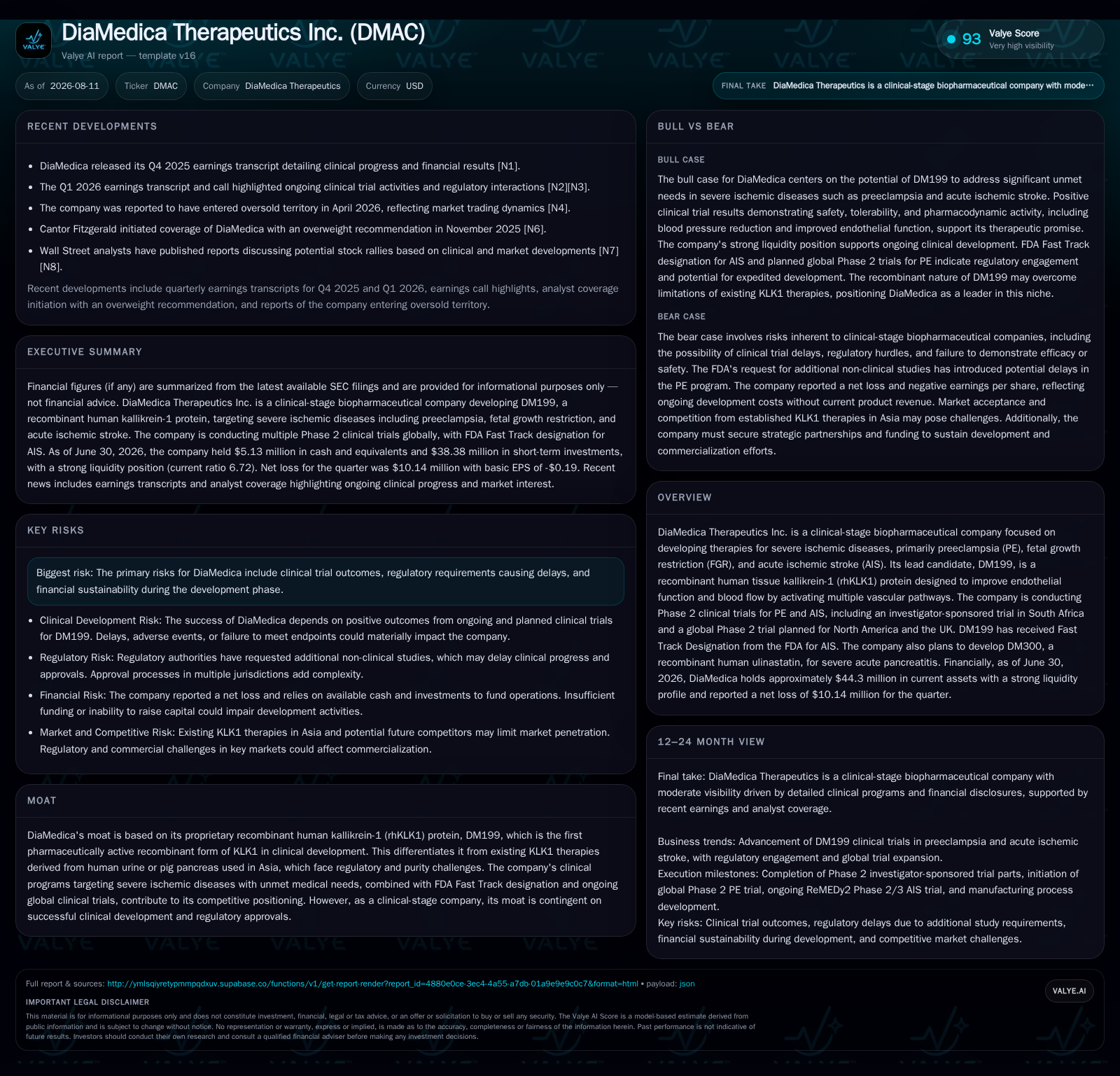
DiaMedica Therapeutics Inc. is progressing its recombinant protein therapeutic DM199 through multiple Phase 2 clinical trials targeting severe ischemic conditions including preeclampsia (PE), fetal growth restriction (FGR), and acute ischemic stroke (AIS). The latest quarterly filing highlights ongoing enrollment and trial expansions across South Africa, North America, and the UK, supported by FDA Fast Track designation for AIS that could shorten regulatory timelines. With $44.3 million in current assets and a strong liquidity position as of June 2026, DiaMedica is positioned to sustain its R&D efforts through these pivotal clinical milestones. Its proprietary rhKLK1 platform offers a differentiated biologic approach distinct from existing therapies primarily developed in Asia, addressing significant unmet needs in vascular ischemic diseases.
Recent Operating Update
DiaMedica Therapeutics’ Q2 2026 filing [S2] confirms steady advancement of its lead candidate DM199 through Phase 2 clinical studies focused on severe ischemic diseases characterized by endothelial dysfunction. The compound is a recombinant human tissue kallikrein-1 (rhKLK1) protein designed to enhance microcirculation and tissue perfusion via vasodilatory pathways.
The ongoing investigator-sponsored trial at Tygerberg Hospital in South Africa involves multiple parts: dose escalation (Part 1a), dose expansion (Part 1b), expectant management cohorts for preeclampsia (PE) and fetal growth restriction (FGR), cumulatively enrolling up to approximately 130 subjects [S1]. Interim data from Part 1a demonstrated DM199’s favorable safety profile alongside statistically significant blood pressure reductions sustained up to 24 hours post-infusion—key pharmacodynamic evidence supporting further dose optimization [S1]. The company is currently enrolling an extension cohort at therapeutic doses while preparing Part 1b to treat subjects with expected delivery within 72 hours.
Parallel to this African study, DiaMedica is preparing an open-label, dose-ranging Phase 2 trial targeting early onset PE patients in North America and the UK. Health Canada approved initiation of this study in March 2026 [S1], with site activation planned for the second half of the year. This geographic expansion reflects strategic intent to validate DM199’s clinical profile across diverse regulatory environments and patient populations.
In acute ischemic stroke (AIS), DM199 has received FDA Fast Track designation [S1], an important regulatory milestone that may enable more frequent agency interactions and expedited review timelines if clinical efficacy is demonstrated. Given limited treatment options addressing neuroprotection post-stroke occlusion, this designation underscores the potential significance of DM199 within this underserved therapeutic area.
Business Model
DiaMedica operates as a clinical-stage biopharmaceutical developer specializing in recombinant protein therapeutics aimed at improving outcomes in severe ischemic diseases marked by endothelial impairment and compromised blood flow. The company’s lead candidate DM199 mimics the enzymatic activity of tissue kallikrein-1, promoting vasodilation through increased production of nitric oxide (NO), prostacyclin (PGI2), and endothelium-derived hyperpolarizing factor (EDHF) [S1]. This mechanism supports both symptomatic relief—such as blood pressure lowering in PE—and potential disease modification by enhancing tissue perfusion.
Revenue generation remains contingent on successful demonstration of safety and efficacy through phased clinical trials culminating in regulatory approvals. Until commercialization, DiaMedica depends primarily on capital raises, milestone payments from partnerships if any materialize, and grant funding to finance its R&D pipeline.
Beyond DM199, the company is developing DM300, a recombinant human ulinastatin targeting severe acute pancreatitis—a serine protease inhibitor with broader critical care applications [S1]. This diversification provides optionality for future revenue streams contingent on successful clinical validation.
Industry Structure and Competitive Position
Within the clinical-stage biotech sector focused on ischemic vascular diseases, DiaMedica occupies a niche leveraging biologic recombinant protein technology rather than small molecules or gene therapies pursued by many peers. Its rhKLK1 platform represents the first synthetic recombinant form of tissue kallikrein-1 evaluated clinically outside Asia where KLK1-based treatments derived from human urine or pig pancreas have long-standing use but face challenges related to purity and manufacturing scalability [S1].
This synthetic biology approach positions DiaMedica to potentially overcome limitations inherent to traditional KLK1 sources by enabling consistent quality control and scalable production—critical factors for late-stage development and commercialization.
The FDA Fast Track designation for AIS highlights regulatory receptivity to novel biologics addressing urgent unmet medical needs in stroke therapy—a space with limited approved neuroprotective agents beyond thrombolytics.
Clinical trial designs employing dose escalation, placebo controls where appropriate, and pharmacodynamic biomarker assessments align with industry best practices aimed at de-risking pivotal development stages.
Growth Drivers
Advancement through key Phase 2 enrollment milestones remains the primary growth driver. Establishing an optimal dosing regimen based on safety and pharmacodynamic activity will unlock expansion into cohorts assessing clinically meaningful endpoints such as maternal blood pressure control duration and perinatal outcomes.
Regulatory incentives like FDA Fast Track facilitate accelerated development timelines through enhanced agency engagement and eligibility for rolling submissions once pivotal data become available. Expansion into North American and UK patient populations broadens recruitment potential—a critical factor given enrollment challenges inherent to rare or vulnerable populations such as pregnant women with PE.
Portfolio growth via DM300 development adds strategic optionality by applying similar biologic mechanisms within adjacent indications requiring novel therapeutics.
Financially, DiaMedica’s $44.3 million current asset base as of June 2026 [F1] supports ongoing R&D investment without immediate financing pressures typical for early-stage biotechs.
Risks and Watchpoints
Principal risks include uncertainties around clinical trial outcomes where demonstrating convincing efficacy alongside safety is paramount given heterogeneous patient populations [S9]. Enrollment complexities are accentuated in sensitive indications like PE involving pregnant women or neurological conditions such as AIS requiring rapid intervention.
Regulatory hurdles may arise from requests for additional data or modifications to study protocols that could extend timelines and increase capital consumption.
Financial sustainability beyond current cash reserves depends on timely achievement of milestones that can attract investor confidence or partnership opportunities providing non-dilutive capital infusions.
Manufacturing scale-up challenges common to biologics could delay supply continuity essential for late-stage trials or eventual commercial launch.
What to Watch Next
Near-term catalysts include initiation of North American/UK Phase 2 sites following Canadian approval [S1], progress updates from Tygerberg Hospital expansion cohorts reflecting dose optimization efforts, plus emerging safety and pharmacodynamic data releases throughout late 2026.
Monitoring regulatory feedback particularly around AIS Fast Track progression will provide insights into approval pathway feasibility.
Quarterly financial disclosures detailing R&D expenditure trends versus cash burn will indicate runway adequacy ahead of anticipated clinical readouts.
Potential partnership announcements could validate asset value externally while providing strategic capital or commercialization expertise beyond internal capabilities.
Financial Profile Discussion
As of June 30, 2026, DiaMedica reported $44.3 million in current assets against $6.6 million in current liabilities, yielding a strong current ratio of approximately 6.7x indicative of solid short-term liquidity supportive of continued clinical operations [F1]. Cash and equivalents stood at about $5.13 million at quarter-end [F1], reflecting available liquid resources though typical biotech burn rates imply additional financing will be necessary over time absent product revenues.
Operating losses remain substantial; FY2025 saw an operating loss near $34.4 million driven by intensive research activities customary among clinical-stage developers without commercial products [F1]. The absence of material debt limits financial distress risk but also highlights reliance on equity markets or collaborations for future capital needs.
Maintaining disciplined cash management while advancing critical clinical milestones will be essential to sustaining investor confidence amid sector volatility.
This analysis synthesizes recent SEC disclosures alongside sector-specific industry knowledge without offering investment advice.
Disclaimer: This is research-only, informational analysis and not investment advice. It may include AI-generated interpretation and general industry context. Always verify important details using primary sources.

Comments