
BTC Development Corp. Leverages Bitcoin Expertise in SPAC with Strong Trust Account Capital
BTC Development Corp. maintains substantial capital reserves and a specialized focus on bitcoin-related acquisitions as it seeks to complete its initial business combination.
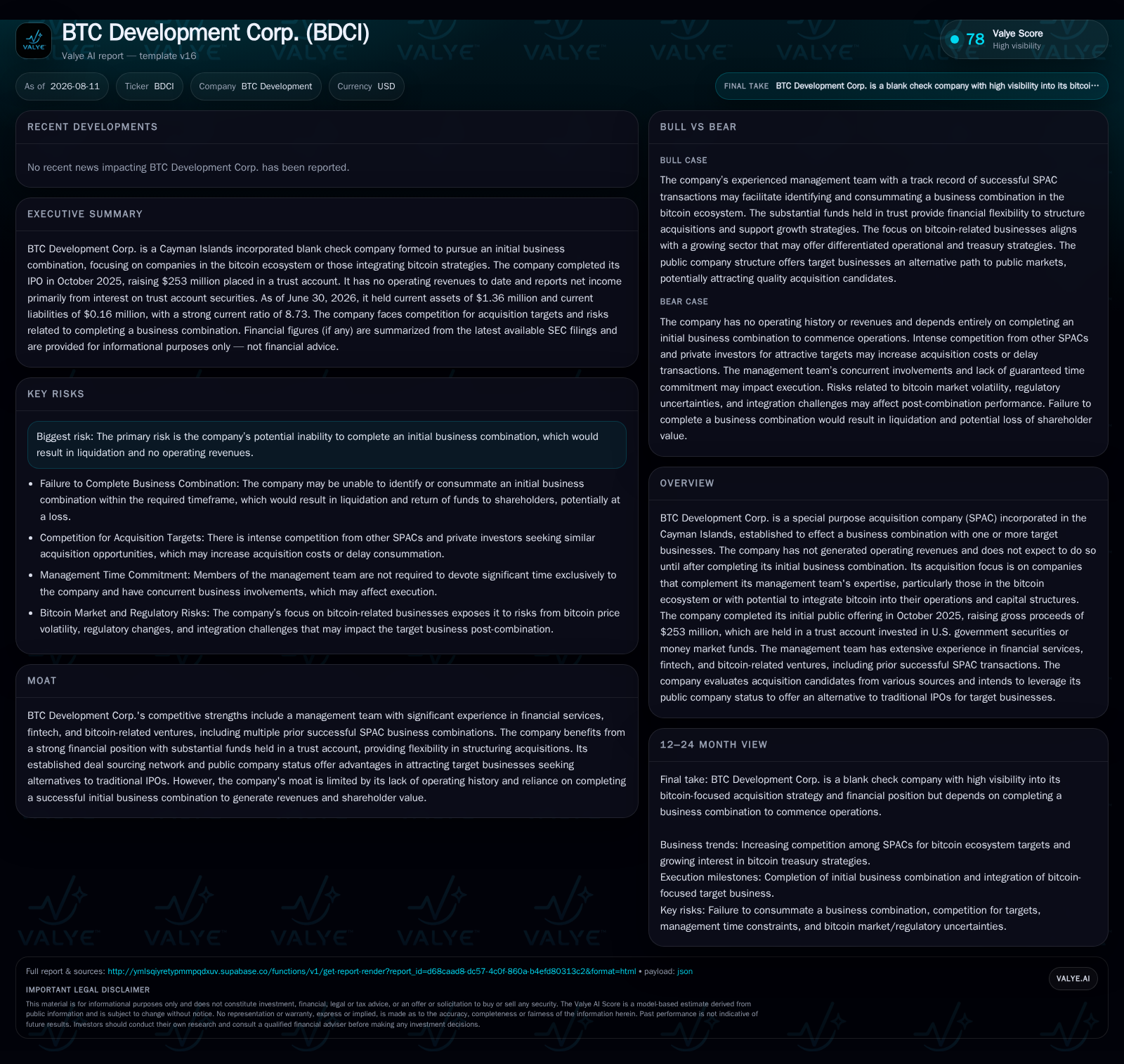
BTC Development Corp., a Cayman Islands-incorporated SPAC, holds $253 million raised in an October 2025 IPO in a trust account invested primarily in U.S. government securities. The company has no operating revenues yet, generating interest income on trust holdings, and leverages its management team's fintech and bitcoin experience to secure attractive targets. Its strong financial position offers flexibility and competitive advantages in negotiating transactions, though completing an initial business combination within the mandated timeframe remains the primary challenge for value creation.
Recent Operating Update
BTC Development Corp. (BDCI) remains a blank check company focused on completing its initial business combination, with no operating revenues reported as of its latest quarterly filing on August 10, 2026 [S2]. The company’s main activity continues to be identifying an acquisition target within its specified timeframe under Cayman Islands incorporation rules.
At the end of Q2 2026, BTC Development reported current assets of approximately $1.36 million against current liabilities near $0.16 million, resulting in a strong current ratio of 8.73 [F1]. This liquidity supports ongoing public company costs such as due diligence and regulatory compliance but does not yet reflect deployment of capital toward acquisition or operational activities.
Interest income earned on the trust account established at IPO remains the primary contributor to net income prior to any business combination [S1]. Risk factors disclosed remain consistent with those noted in the March 2026 annual report, highlighting typical SPAC challenges such as deal completion uncertainty and shareholder redemptions [S2].
Business Model Analysis
BDCI is a Cayman Islands exempted company formed solely to effectuate a merger, share exchange, asset acquisition, or similar transaction that would bring an operational business public via a de-SPAC process [S1]. To date, it has not generated operating revenues and expects to do so only after consummating its initial business combination.
The company completed its IPO in October 2025, raising $253 million through 25.3 million units priced at $10 each and an additional $7.6 million via private placement units sold to sponsors and underwriters [S1]. These proceeds were deposited into a trust account invested conservatively in short-term U.S. government securities or money market funds designed to preserve principal while generating modest interest income [S1].
Investor returns depend on management’s ability to identify a suitable target within approximately two years; failure results in liquidation with return of trust funds less permitted expenses. The units sold typically include one share plus warrant fractions, allowing investors potential upside upon successful de-SPAC transaction completion.
BDCI’s management team brings specialized expertise across financial services, fintech innovation, and bitcoin ecosystems—areas critical for sourcing and executing deals within its targeted niche [S18]. The strategy focuses on acquiring companies either directly engaged in bitcoin-related businesses or those aiming to integrate bitcoin into their capital structures or treasury operations.
This focus targets opportunities aligned with accelerated bitcoin adoption cycles anticipated over longer horizons—spanning payments infrastructure, treasury management technologies, and fintech platforms enabling digital asset integration—contrasting with more generalist SPAC approaches [S1].
Operating expenses before combination largely reflect costs typical for public companies without revenue: SEC compliance, audit fees, legal services related to deal sourcing and due diligence, plus administrative support agreements with affiliates [S1], [S24].
Industry Structure and Competitive Position
Within the growing SPAC universe, BDCI competes specifically in the fintech/blockchain/bitcoin sector where competition arises from other SPACs targeting similar niches as well as traditional private equity and venture capital investors offering direct financing alternatives.
BDCI's publicly listed status combined with substantial capital availability ($253M trust plus placement units) positions it attractively for target companies seeking faster access to public markets versus traditional IPOs—especially those valuing sector-specific expertise tied to bitcoin integration strategies [S18].
However, competition is intense amid proliferation of SPACs since the mid-2020s and increasing regulatory scrutiny around these vehicles [S1]. The company must balance valuation discipline against growth potential within a volatile emerging sector.
The management team's prior success with SPAC transactions enhances access to proprietary deal flow through established networks—a key advantage given that early access often determines deal quality versus late bidders facing crowded auctions [S18].
Growth Drivers
BDCI’s growth thesis centers on structural tailwinds from widespread bitcoin adoption expected over extended horizons. Management highlights bitcoin’s historical price appreciation relative to other major assets alongside technological adoption driving demand for innovation in treasury management involving digital assets [S1]
Investor appetite for SPACs tends to rise during favorable capital market conditions and clearer regulatory environments—factors that improve BDCI’s odds of consummating beneficial business combinations with limited dilution or shareholder redemptions.
Additional growth may come from leveraging PIPE financing during de-SPAC transactions to supplement trust account proceeds—enabling larger or multiple acquisitions depending on pipeline quality and investor interest.
Technological innovations facilitating operational adoption of bitcoin treasury strategies post-merger could enhance margins or revenue predictability for combined entities.
Risks and Watchpoints
The central risk remains failure to complete an initial business combination within contractual deadlines mandated by the Cayman Islands charter—triggering liquidation with no operating revenues or shareholder value creation beyond return of trust funds net expenses [S1]. Redemption risk may reduce available merger capital if shareholders choose to redeem upon transaction proposals.
Market volatility impacting bitcoin prices could indirectly affect acquisition valuations as well as investor appetite during PIPE rounds.
Regulatory developments targeting digital assets or SPAC structures may delay transactions or increase compliance costs materially.
Dilution risks from sponsor shares issuance, underwriting fees (including deferred commissions totaling $10.78 million), and placement unit overlaps warrant close monitoring relative to post-transaction equity value creation potential [S1]
Dependence on management continuity adds execution risk given their concurrent professional commitments potentially limiting full-time focus [S1].
Operating expenses remain manageable but could rise if due diligence complexities or legal challenges increase unexpectedly.
What To Watch Next
Key upcoming milestones include announcements or definitive agreements regarding one or more acquisition targets within the remaining combination period. Proxy filings will signal transaction progress.
Shareholder redemption rates upon transaction voting will indicate investor confidence; elevated redemptions dilute effective merger proceeds impacting capitalization.
Pipeline development encompassing quantity and quality of vetted targets plus PIPE investor engagement will reflect competitive positioning amidst market dynamics.
Quarterly disclosures detailing transaction-related fees should be monitored due to their impact on available working capital before closing.
Post-combination financial statements will begin reflecting operating revenues tied directly to acquired businesses’ performance metrics.
Disclaimer: This is research-only, informational analysis and not investment advice. It may include AI-generated interpretation and general industry context. Always verify important details using primary sources.

Comments