
Oramed’s Strategic Shift Enhances Oral Drug Delivery Focus with Lifeward Partnership
Oramed restructures its oral insulin platform via a major Lifeward transaction while maintaining clinical oversight and equity stakes in oncology innovation.
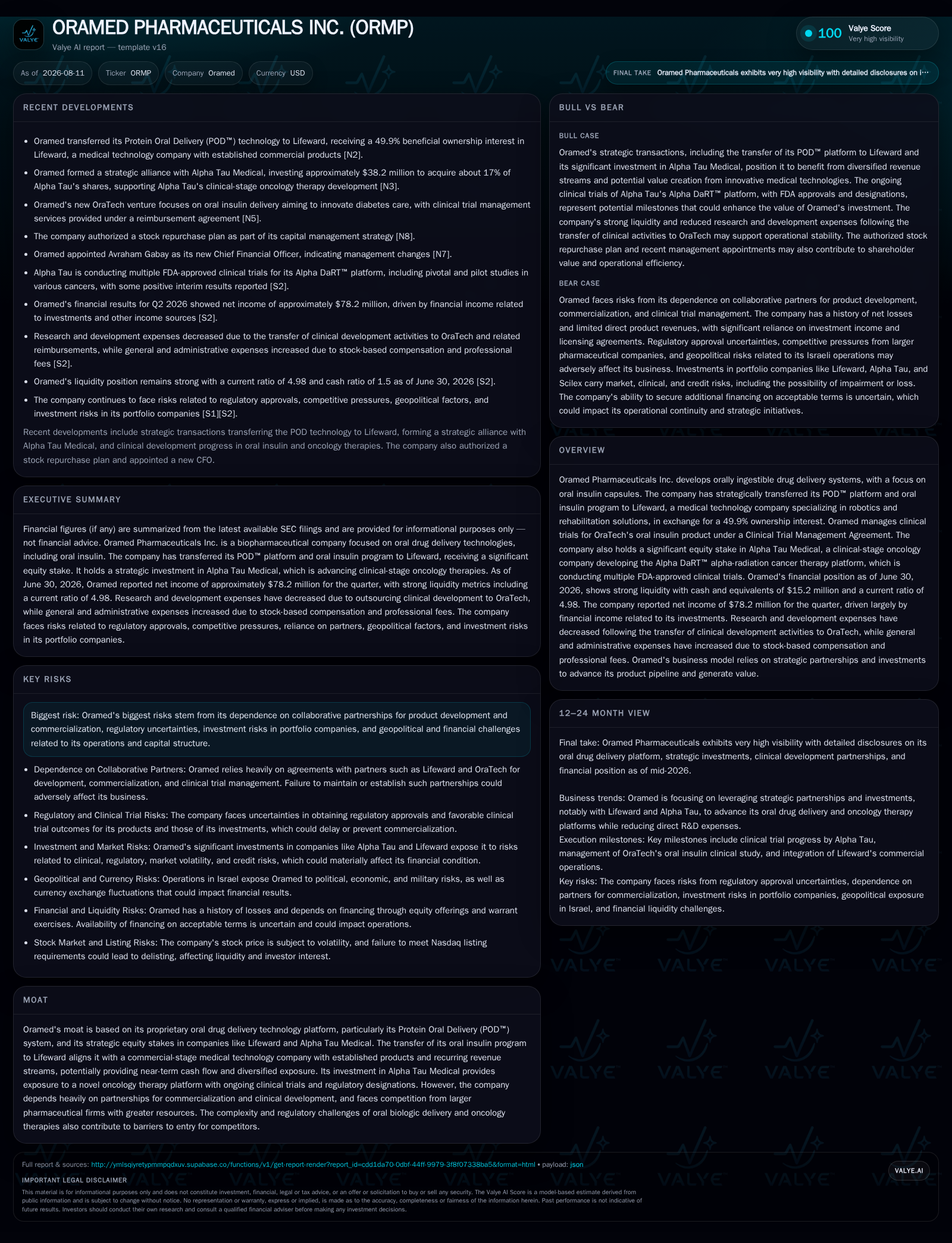
Oramed Pharmaceuticals has recently transferred its POD™ oral insulin program and related assets to Lifeward in exchange for a nearly 50% stake, aligning with a commercial-stage medical technology entity to leverage its distribution and product base. Oramed retains management of the ongoing oral insulin clinical trial and holds significant equity in Alpha Tau Medical, diversifying exposure into oncology therapeutic development. The company’s latest filings reveal stable cash runway but highlight the need to secure additional financing amid ongoing operating losses and high R&D intensity typical in the biotech oral delivery sector.
Recent Operating Update and Strategic Asset Transfer
Oramed Pharmaceuticals’ most consequential recent development is the transaction completed on March 25, 2026, transferring its Protein Oral Delivery (POD™) technology platform alongside the oral insulin program to Lifeward Ltd., a medical technology company specializing in rehabilitation robotics products such as the ReWalk exoskeleton [S24]. In return, Oramed received approximately 45% of Lifeward’s outstanding shares plus pre-funded warrants representing an aggregate nearly 50% economic ownership stake. Additionally, Oramed obtained senior secured convertible notes from Lifeward totaling $9 million at closing and agreed to a revenue-sharing agreement entitling Oramed to 4% of net revenues from Lifeward’s ReWalk Personal Exoskeleton products over ten years subject to caps and termination provisions [S24].
This deal marks an important strategic repositioning for Oramed by shifting most clinical development cost burden and late-stage commercialization responsibility onto a partner with an existing commercial revenue stream. The arrangement allows Oramed to benefit from near-term income visibility through Lifeward’s currently revenue-generating products while retaining significant upside in the transferred oral insulin technology via ownership interests as well as ongoing royalties tied to potential future revenues originating from that platform.
Concurrent with the sale of these assets, Oramed entered into a Clinical Trial Management Agreement (CTMA) with OraTech (now Lifeward’s subsidiary), whereby Oramed manages the clinical study for OraTech’s oral insulin capsule product through study completion [S25]. This agreement reimburses Oramed for reasonable out-of-pocket expenses but importantly maintains its operational role overseeing critical clinical validation efforts—preserving strategic influence in the development path amid transition to a quasi-partner role.
Business Model: Platform Licensing with Strategic Equity Stakes
Oramed operates in the biotechnology niche focused on oral biologic drug delivery—a complex domain where conventional injectable protein therapeutics face compliance and patient acceptance challenges. Its proprietary POD™ platform aims at enabling orally ingestible forms of drugs that traditionally require injection, notably insulin.
The company's business model leverages proprietary intellectual property developed internally but opts to outsource or license downstream activities such as manufacturing scale-up, regulatory approvals beyond early phases, and commercialization to external partners like Lifeward. Revenues typically derive from licensing fees, milestone payments linked to clinical/regulatory achievements, royalties on sales through partners, and strategic equity gains from investments in portfolio companies.
In addition to Lifeward, Oramed holds a significant equity position in Alpha Tau Medical—a clinical-stage oncology biotech developing novel alpha-radiation therapies (Alpha DaRT™), with multiple ongoing FDA-approved trials [S1]. This investment diversifies Oramed's risk profile across different therapeutic areas and modalities outside oral insulin.
This multi-pronged approach positions Oramed more as an enabler or platform technology integrator rather than solely a product-focused pharmaceutical entity. However, this structure inherently depends on successful alliances that can navigate regulatory pathways and market dynamics effectively.
Industry Context and Competitive Positioning
The broader biotechnology industry surrounding novel oral drug delivery systems is characterized by intense R&D challenges owing to barriers in formulating stable protein therapeutics that survive the gastrointestinal tract's enzymatic environment. Companies like Oramed invest heavily over many years in preclinical research, formulation optimization, animal studies, and multiple phases of human clinical trials before any regulatory approval becomes feasible.
Competition features both large pharmaceutical companies seeking improved patient-friendly biologic administration routes—some developing injectable long-acting analogs—and smaller innovators pursuing capsules or pills for proteins such as insulin or GLP-1 analogs. Peer firms comparable to Oramed often exhibit similar patterns: high research & development expenditures relative to revenues or milestone income, operating losses sustained while advancing pipelines through costly clinical programs.
The handoff of commercialization duties to medical device firms with established supply chains and revenue streams (as with Lifeward) is relatively uncommon but reflects an innovative partnership model designed to mitigate capital intensity risks typical within early-stage drug development. Furthermore, maintaining involvement via trial management agreements enables Oramed continued data access critical for further value creation or partnering arrangements.
Growth Drivers
Oramed’s potential growth is anchored on several key drivers:
- Advancement in Clinical Trials: Successful progression of OraTech’s oral insulin Phase 3 study managed by Oramed will be pivotal. Positive data could unlock regulatory submissions leading toward commercialization opportunities either directly via licensing deals or through Lifeward collaborations [S25].
- Regulatory Approvals: Achieving FDA or international regulatory approvals remains essential for eventual market access. Given prior setbacks—including earlier Phase 3 failures—the pathway will require demonstrated safety/efficacy validation supported by well-designed trials [S4], [S13].
- Market Demand Expansion: Growing global prevalence of diabetes drives demand for patient-convenient biologic therapeutics; effective oral insulin could capture significant chronic disease management market share if approved.
- Milestone Payments & Revenue Sharing: The Lifeward agreement provides near-term cash flow from established exoskeleton product lines plus up to $15 million potential developmental milestones from distribution collaborations such as Medicox [S14], providing diversified income streams reducing reliance on any single product launch timeline.
- Equity Appreciation: The investments in Lifeward and Alpha Tau Medical offer upside potential contingent on those entities’ operational success, trial outcomes, and ability to commercialize innovations within their respective fields.
Risks and Constraints
Despite strategic realignment benefits, several risks constrain Oramed's outlook:
- Partnership Dependency: Reliance on third-party collaborators like Lifeward and Alpha Tau Medical introduces execution risk—failure by these entities impacts Oramed's revenue realization prospects substantially [S4], [S14].
- Regulatory Uncertainty: Oral biologics face heightened scrutiny; previous Phase 3 failures reflect difficulty demonstrating consistent efficacy. Outstanding secured convertible notes owed by Scilex present credit risk given noted concerns over Scilex's going concern status; failure of repayment could impair liquidity further [S3], [S22].
- Intellectual Property Vulnerabilities: Patent protections are crucial yet fraught with legal challenges common in biotech; proprietary technology may face infringement risks or expiration reducing competitive advantage over time [S4].
- High R&D Burnrate & Limited Operating Income: Continued net losses highlight funding challenges within biotech; limited revenues necessitate close management of cash runway and supplementary financing availability amid volatile capital markets conditions [S2], [S12].
- Geopolitical Factors: Operations spanning Israel expose Oramed to regional political risks impacting talent retention and operational continuity [S2].
What To Watch Next
Critical developments that will serve as barometers for Oramed's trajectory include:
- Finalization and Results of OraTech Clinical Trials: Milestones around enrollment completion, interim analyses, topline efficacy data releases will signal pipeline viability.
- Lifeward Commercial Performance: Monitoring reported revenue growth trends from ReWalk products plus success in expanding geographic reach or new product launches will clarify near-term cash flow sustainability.
- Regulatory Milestone Announcements: FDA or international agency approvals or feedback stages affecting both oral insulin capsules and Alpha Tau Medical oncology therapies will materially affect valuation perceptions.
- Financial Metrics Trends: Changes in operating expenses vis-à-vis revenue streams—including milestone receipts—and liquidity levels indicate capital sufficiency amidst ongoing R&D demands.
- Debt Servicing Progression: Status updates related to note repayments by Scilex highlight risk mitigation on credit exposures influencing overall balance sheet health.
Financial Profile Discussion
At June 30, 2026, Oramed held cash and equivalents approximating $15.2 million with current assets totaling approximately $53.4 million against current liabilities near $10.7 million yielding a strong current ratio of 4.98—indicative of short-term liquidity comfort positioning it adequately against upcoming obligations [F1], [S2]. Total debt outstanding was last reported at approximately $74.5 million as of September 30, 2023, with net debt estimated around $59.3 million at that time; more recent disclosures indicate extensions granted on senior secured notes owed by Scilex Holding Company, highlighting refinancing risk that requires ongoing monitoring [F1], [S3], [S22].
Operating losses continue reflecting sector typical R&D intensiveness; six-month operating loss narrowed modestly year-over-year driven by reduced R&D expenditure following asset transfers offset partially by increased general administrative costs notably higher stock-based compensation expenses reporting $6.4 million loss versus prior period $7.0 million loss range—in line with expectations amid transitioning corporate structure focused more on trial management than direct discovery efforts going forward [S2], [S26].
Revenue recognition largely stems from equity stakes’ dividend/milestone income along with service fees under the clinical trial management contract indicating early diversification beyond traditional grant/license-based biotech monetization models though still far removed from self-sustaining commercial sales cycle maturity typical at later industry lifecycle stages.
In conclusion, while Oramed maneuvers its POD™ technology platform into joint ventures strategically aligned with more commercially advanced firms like Lifeward thereby mitigating certain R&D cost pressures, it faces typical biotech-sector hurdles including dependency risks on collaborative partners' execution capabilities alongside regulatory uncertainties inherent in pioneering complex oral biologic therapies. Its sizable stakeholding approach across complementary cutting-edge oncology technologies provides incremental upside yet also adds financial volatility reflective of developmental stage investing characteristic within specialized biopharma innovation ecosystems.
Disclaimer: This is research-only, informational analysis and not investment advice. It may include AI-generated interpretation and general industry context. Always verify important details using primary sources.

Comments