
Secured Debt and Operational Efficiency Shape Surf Air Mobility’s Immediate Outlook
Surf Air Mobility’s August 2026 quarter reveals operational improvements tempered by liquidity constraints and secured-debt challenges, framing near-term execution risks.
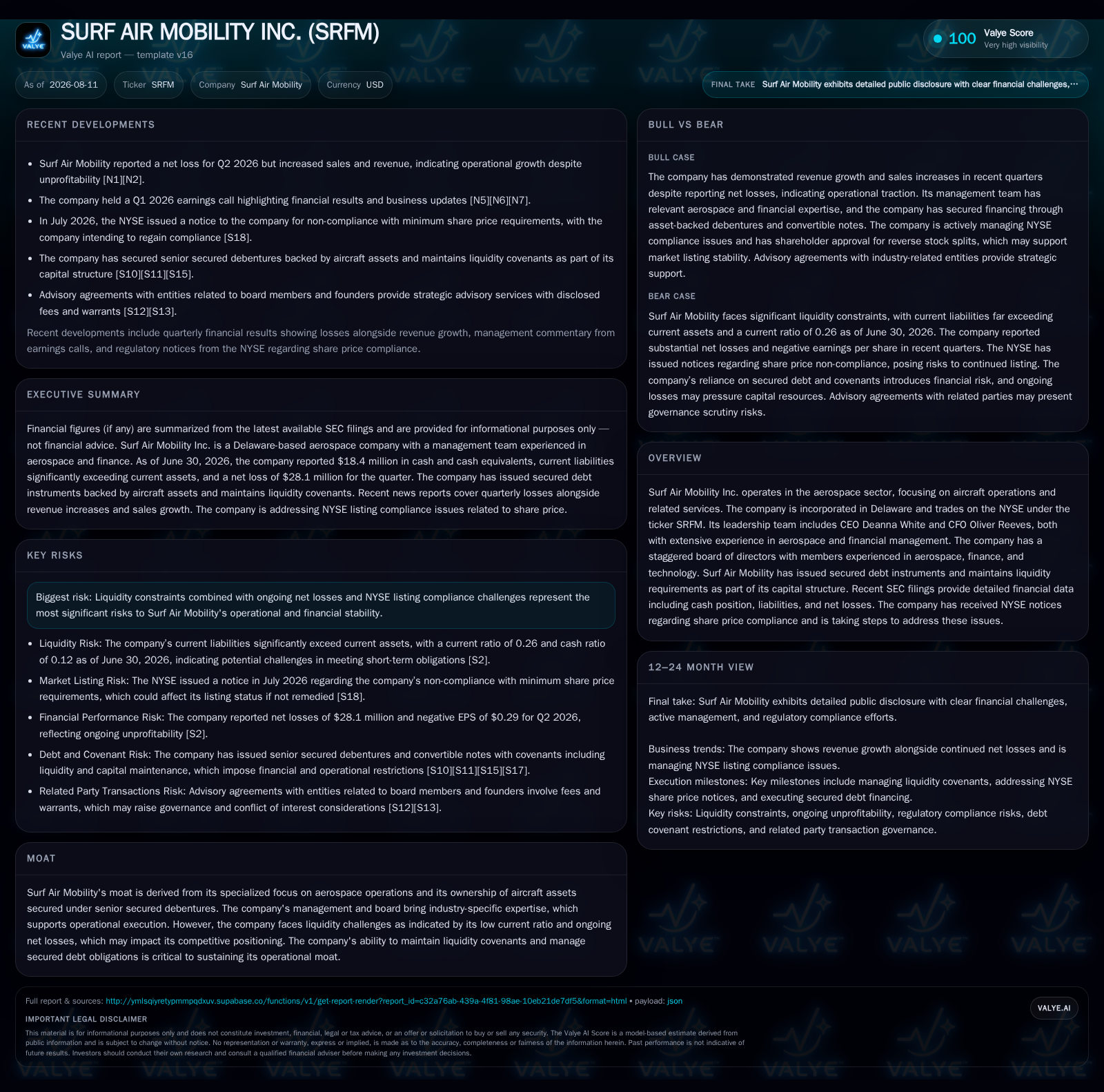
In its latest quarterly filing, Surf Air Mobility reported modest revenue gains but continued to post significant net losses, reflecting the ongoing difficulty of balancing fleet utilization with high fixed costs. The company faces heightened financial scrutiny due to a very low current ratio of approximately 0.26, raised by current liabilities far exceeding current assets, alongside substantial secured convertible debt. These factors underline pressing liquidity and covenant compliance risks despite incremental operational progress. Surf Air Mobility’s niche positioning in aerospace aircraft operations offers some strategic strengths, but its execution depends heavily on managing secured debt maturities and improving fleet efficiency metrics amid capital-intensive demands.
Material Shifts in Q2 Operational Performance Reflect Mixed Progress Amid Ongoing Losses
Surf Air Mobility’s latest quarterly filing dated August 10, 2026, reports a modest revenue beat against consensus estimates for Q2 but continues to incur significant operating losses indicative of ongoing structural cost challenges [S2][N1]. Despite incremental top-line growth, the firm recorded continued negative operating income without clear signs of near-term profitability recovery. This pattern reflects the industry complexity where scaling flight hours and seat utilization must overcome elevated fixed costs associated with owning and operating an aircraft fleet. The combination of incremental revenue growth yet persistent losses requires the company to enhance operational efficiency while navigating capital-intensive fleet expenditures.
Fleet Management Dynamics: Balancing Utilization with High Fixed Costs
Surf Air Mobility operates primarily through managing an owned and leased aircraft fleet engaged in specialized aerospace operations rather than broad commercial airline services [S1]. This model demands intensive fleet maintenance, repair, and overhaul cycles (MRO), which create unavoidable high fixed costs impacting margins during scale-up phases [S2]. Load factor management remains critical—high seat occupancy rates need to be achieved consistently to improve yields per passenger mile. The reliance on aviation regulatory compliance further adds cost layers and operational complexity around flight hours optimization and maintenance turnaround time. In this context, maximizing fleet utilization rates while controlling flight-hour related operating expenses shapes the company’s business model economics.
Capital Structure Realities: Secured Debt Risks Limit Fiscal Flexibility
A central theme constraining Surf Air Mobility’s near-term prospects is its capital structure centered on senior secured convertible promissory notes backed by company assets and subsidiaries [S1][S23]. The existence of these secured notes implies stringent servicing requirements with covenants designed to protect noteholders, increasing the risk of operational disruption if liquidity breaches occur. Recent amendments extended maturities but underlying refinancing pressures remain acute given limited cash resources relative to financial obligations. Such asset-backed lending structures position the company vulnerably should revenue or cash flow improvements not materialize swiftly enough to meet debt servicing needs.
Competitive Landscape Contextualizes Emerging Niche Strategies Versus Large Carriers and Leasing Firms
Surf Air Mobility occupies a distinct niche within aerospace aircraft operations compared to mega-scale commercial airlines like United Airlines (UAL) or leisure-focused carriers such as Allegiant Travel (ALGT) [S1]. Unlike aircraft leasing companies primarily focused on asset financing and less on flight operations' direct economics, Surf Air runs active fleet services with attendant operational complexities. Similarly, business jet operators share analogous challenges in fleet utilization but operate at different scales and customer bases. This positioning requires specialized management expertise in balancing high fixed operating costs with demand-sensitive flight scheduling while contending with competitive pressures from larger players offering broader route networks or pricing advantages.
Growth Catalysts: Fleet Renewal, Market Expansion, and Service Diversification Potential
While operating under tight financial conditions, Surf Air Mobility outlines potential growth pathways through fleet renewal investments targeting more efficient aircraft models potentially yielding lower fuel burn and regulatory compliance benefits [S1][N1]. Expansion into underserved regional or niche air travel markets could leverage these upgraded assets to improve load factors and revenues passenger miles (RPM). Diversification into ancillary aviation services may also augment revenue streams beyond core flight operations. However, practical execution depends heavily on securing adequate capital for planned capital expenditure (CapEx) programs amid prevailing liquidity constraints.
Liquidity Watchpoints: Addressing Covenant Compliance While Funding Operations
The company’s liquidity profile reveals severe stress markers highlighted by a current ratio near 0.26 — factoring $41.3 million in current assets versus $157.8 million in current liabilities at quarter-end June 30, 2026 — underscoring an imbalance that threatens short-term solvency [F1]. Cash balances totaled approximately $18.4 million at that date, restricting maneuverability to cushion operating losses or meet sudden financial obligations. Maintaining this delicate balance will require either immediate operational cash flow turnarounds or successful capital raises/refinancings.
"Next in Focus": Key Milestones to Validate Execution Trajectory and Financial Health Prospects
Investors and stakeholders should closely monitor upcoming critical events including the commencement of partial redemption payments on convertible notes starting August 1, 2026, which involves monthly cash or equity payments potentially up to $3 million per tranche depending on stock trading volumes [S24]. These payments reduce principal but may also impact share dilution if paid in stock. Operationally, data on improved fleet utilization rates or customer load factors would signal improving revenue-generating capabilities crucial for abating cash burn trends.
Financial Profile Discussion: Synthesizing Current Assets, Debt, and Cash Flow Constraints
Surf Air Mobility ended Q2 2026 with approximately $18.4 million in cash and equivalents against reported total debt estimated around $48.3 million (last detailed figure from September 2024) suggesting a net debt burden north of $29 million after adjusting for cash buffers [F1]. Total current liabilities spike significantly higher at about $157.8 million referencing short-term obligations including accrued interest or payables likely tied to secured debentures and other financing arrangements [F1]. The extremely low current ratio of roughly 0.26 reflects intense near-term liquidity risk making covenant compliance a paramount priority for maintaining NYSE listing status and creditor confidence [F1][S23][S26]. This financial snapshot highlights how deeply operational performance and capital structure management must be integrated for survival.
Disclaimer: This analysis is based exclusively on evidence derived from Surf Air Mobility Inc.’s SEC filings through August 2026 and publicly available market disclosures. It does not constitute investment advice nor express any endorsement of the company's securities or prospects beyond factual interpretation rooted solely in provided data sources.
Disclaimer: This is research-only, informational analysis and not investment advice. It may include AI-generated interpretation and general industry context. Always verify important details using primary sources.

Comments