
Sound Financial Bancorp’s Regional Focus and Interest Rate Risk Shape 2026 Trajectory
Sound Financial Bancorp reported stable profitability and maintained solid capital metrics in Q2 2026, emphasizing tight asset/liability management amid Seattle’s evolving economic landscape.
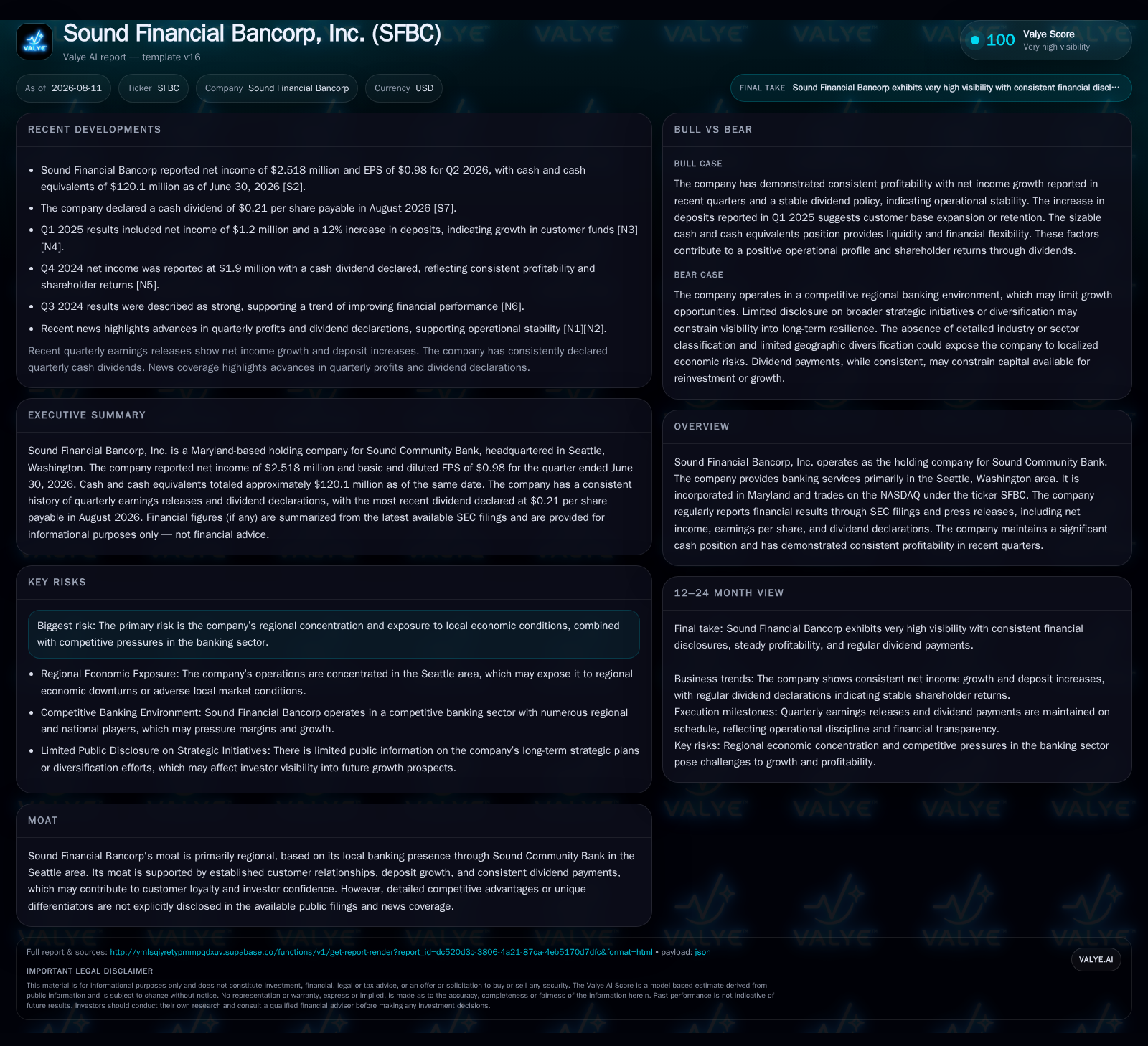
In its latest quarterly filing, Sound Financial Bancorp, Inc. delivered steady earnings supported by disciplined asset/liability and credit risk management centered on its Seattle-area footprint. The company’s regional banking model relies on net interest margin optimization through stable deposit growth and cautious lending practices. While regulatory compliance remains stringent, risks stem primarily from local economic conditions and interest rate sensitivity. Sound Financial sustained its dividend policy and well-capitalized status during Q2 2026, reflecting a cautious but consistent approach in a moderately challenging operating environment.
Recent Operating Update
Sound Financial Bancorp’s latest quarterly report covering the period ended June 30, 2026, confirms a stable operating environment highlighted by ongoing profitability and sound capital management [S2]. The company announced a cash dividend of $0.21 per share payable in August 2026, continuing its trend of regular shareholder returns [S3]. Though no explicit forward guidance was provided, this payout level versus prior quarters suggests manageable earnings quality and confidence in near-term cash flow stability.
The firm holds over $120 million in cash and equivalents as of June 30, 2026 [F1], a robust liquidity position relative to balance-sheet size that supports both regulatory requirements and operational flexibility. Despite total debt figures being dated from earlier years, the company’s negative net debt position (cash exceeding debt) indicates limited leverage pressure [F1]. This relationship aligns with an emphasis on conservatism typical among mid-sized regional banks navigating uncertain interest rate environments.
Business Model Analysis
Sound Financial Bancorp operates as the holding company for Sound Community Bank focused on retail and commercial banking within the Seattle metropolitan area [N#, S1]. Its business model predominantly generates revenue through net interest income—the margin between interest earned on loans (commercial real estate, multifamily housing, construction, land, consumer loans) and interest paid on deposits or other liabilities [S1]
Fee-based income supplements but remains modest compared to core lending activity; typical services include payment processing and loan servicing fees consistent with many comparably sized community banks. Customer deposits form the primary funding base and are nurtured through long-term relationships underpinned by branch presence and local-market trust [S1]. This deposit-centric funding mitigates liquidity risk but requires ongoing efforts to retain customers against competition from larger banks offering extensive digital platforms.
Key vulnerabilities revolve around net interest margin compression driven by fluctuating market rates combined with credit risk from localized economic shocks affecting borrowers [S1]. Implementation of CECL accounting since early 2023 has led to more proactive loan loss provisioning across the balance sheet. The bank carries out conservative underwriting for higher-risk construction or land development loans while maintaining residential mortgage exposures that tend to exhibit lower default rates.
Industry Structure and Competitive Position
Within the broader regional banking landscape that includes players like Regions Financial Corporation, Zions Bancorporation, and Umpqua Holdings Corporation, Sound Financial Bancorp occupies a niche local role. Its competitive edge arises primarily from proximity to customers in Seattle coupled with regulatory compliance credentials evidenced by its satisfactory CRA rating [S1].
This geographic focus offers advantages for relationship banking but also concentrates exposure to regional economic cycles—particularly impactful given Seattle’s technology-driven economy which can be volatile. The bank must continually calibrate pricing strategies against larger institutions with scale economies and financial technology firms presenting digitally native alternatives.
Regulatory scrutiny is ongoing but comparatively moderate due to the company’s asset size below $3 billion. Sound Financial Bancorp meets "well-capitalized" status under prompt corrective action standards with capital buffers that safeguard against stress scenarios [S1]. The Board-approved asset/liability management policy emphasizes earnings stability over full interest rate cycles, seeking to align repricing schedules of assets (loans) with liabilities (deposits/FHLB advances), thereby dampening earnings volatility [S1].
Growth Drivers
Growth prospects hinge on several interrelated factors: first, expansion of the deposit base through customer acquisition or retention enhances funding capacity; second, selective loan portfolio growth—balanced between commercial real estate and diversified consumer lending—can drive net interest income upward if credit quality remains robust [S1]
Seattle’s economic outlook notably influences loan demand; increases in local business activity or population could bolster credit origination opportunities while rising home prices support mortgage loan growth. The current favorable interest rate environment provides net interest margin tailwinds subject to prudent asset/liability re-pricing tactics.
Fee income cross-selling such as wealth management or digital payment solutions could diversify revenue streams gradually but appears secondary at present given the company's size [S1]. Technology adoption initiatives highlighted in management reports aim to improve operational efficiency and client experience—a potential medium-term growth enabler though capital investment is cautiously incremental given capital constraints
Risks and Constraints
Primary risks continue to concentrate in geographic exposure to Seattle’s economy. Any local economic downturn could pressure loan performance metrics like non-performing loans or elevate provision for credit losses impacting profitability disproportionately due to limited geographic diversification [S1]. Interest rate risk remains paramount; rapid shifts could compress net interest margin if liability repricing outpaces asset yields despite tactical asset/liability committee oversight.
Competition from large national banks offering cutting-edge digital products poses challenges for deposit growth. Meanwhile, financial technology companies increasingly threaten traditional bank fee income channels through payment innovation or alternative lending platforms.
Regulatory uncertainties persist especially after recent shifts in CFPB enforcement tone leading to unclear oversight landscapes regarding consumer protection laws—potentially increasing compliance costs or litigation exposure without corresponding revenue benefit [S1]. Cybersecurity requirements necessitate ongoing investments in information security infrastructures supervised by a dedicated board committee structure to mitigate reputational risk.
Finally, leadership changes including promotion of Wesley Ochs as President alongside CEO Laura Lee Stewart reflect an organizational evolution phase requiring stable execution to maintain strategic momentum [S24].
What to Watch Next
Investors should monitor quarterly loan growth rates alongside changes in net interest margin figures reported periodically as barometers of core business health amid prevailing market conditions. Credit quality markers such as non-performing loan ratios and loan loss provisioning will reveal whether underwriting discipline withstands any local economic dips.
Dividend consistency signals management confidence in sustainable earnings power; any deviation would merit scrutiny especially in light of sector pressures.
Regulatory developments—particularly regarding CECL impact phase-ins or CRA rules—should be watched for their influence on capital ratios or required monitoring/reporting burdens influencing operational cost structures.
Technology deployment progress will likely impact future efficiency ratios; announcements related to platform upgrades or expanded digital offerings may indicate competitive positioning improvements.
Finally, macroeconomic factors specific to Seattle including employment trends in key industries like technology can provide early signals affecting borrowing patterns and deposit inflows.
Financial Profile Discussion
As of June 30, 2026, Sound Financial Bancorp held cash and equivalents totaling approximately $120 million—a substantial liquidity buffer relative to its overall operations endorsing prudent liquidity risk management [F1]. Although total debt data is dated back several years indicating a $40 million figure primarily reflective of past financing structures [F1], the effective net debt position is negative due to cash holdings exceeding liabilities considerably.
Net income last reported at year-end December 31, 2025 totaled about $7.16 million illustrating steady profitability that supports dividend payouts maintained into mid-2026 [F1]. While detailed quarterly net income was not cited explicitly for Q2 2026 within available disclosures, continued dividend declarations at $0.21 per share underscore sustained free cash flow generation compatible with regional peers maintaining similar payout ratios.
Regulatory capital ratios remain comfortably above mandated thresholds ensuring flexible capacity for organic growth or opportunistic investments pending market conditions [S1]. Expense control aligned to operational scale coupled with proactive credit loss provisioning under CECL accounting standards further stabilize bottom-line results amidst cyclical pressures.
In sum, the company exhibits a solid financial foundation characterized by strong liquidity reserves, disciplined leverage policies, earning stability driven by core banking functions focused regionally, complemented by a conservative dividend stance anchored in reliable cash flow patterns.
This analysis integrates recent quarterly filings alongside contextual industry knowledge without offering investment research views. It highlights Sound Financial Bancorp’s operational characteristics rooted in regional banking dynamics within Seattle's market environment while identifying pertinent financial indicators shaping near-term prospects.
Disclaimer: This is research-only, informational analysis and not investment advice. It may include AI-generated interpretation and general industry context. Always verify important details using primary sources.

Comments