
CECO Environmental Navigates Integration and Inflation in Engineered Systems Growth
CECO Environmental reported Q2 2026 results highlighting operating challenges amid acquisition integration and inflationary pressures.
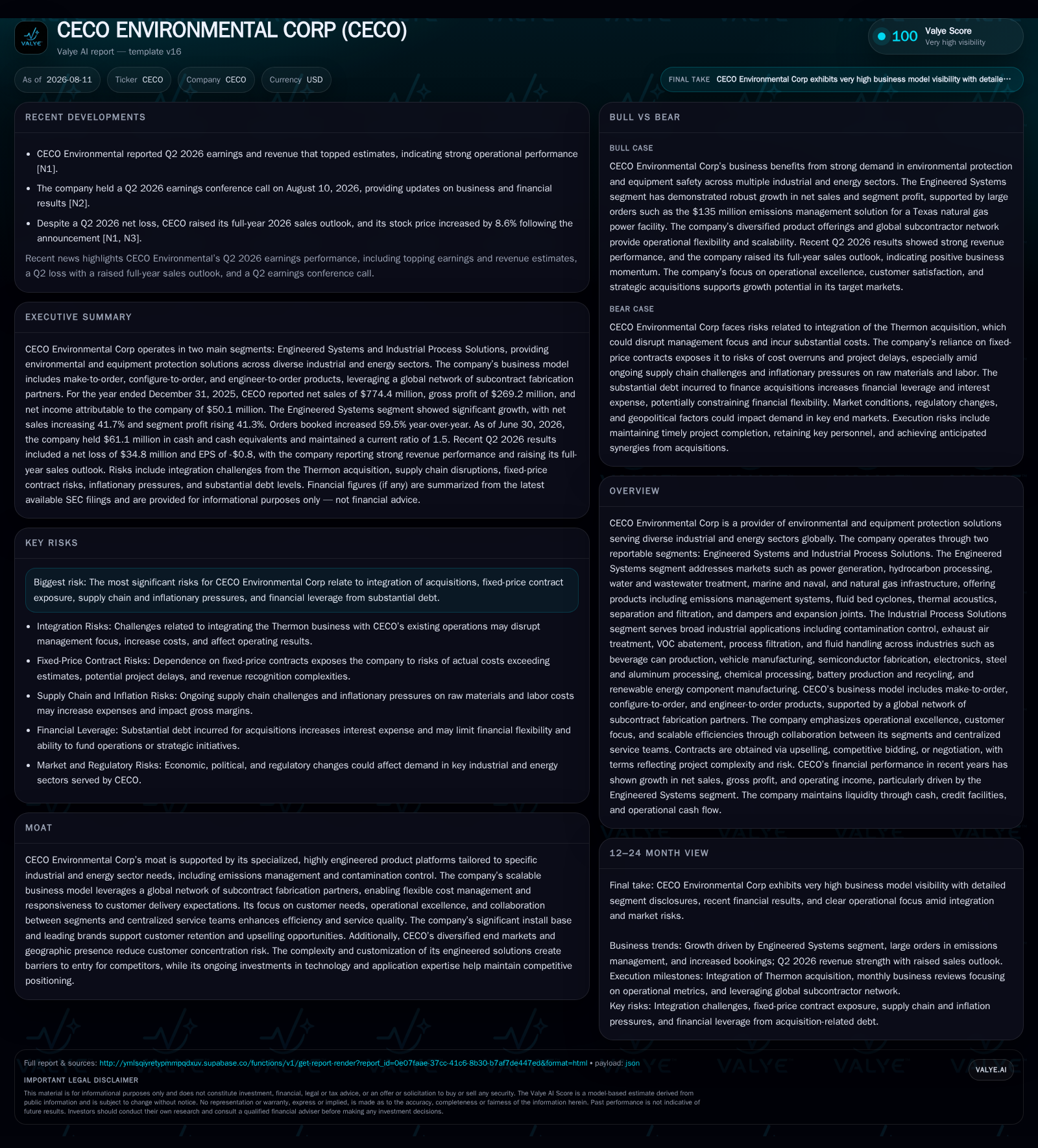
CECO Environmental Corp’s latest quarterly filings reveal a complex operating environment characterized by ongoing integration of the Thermon acquisition, inflation-driven cost pressures, and focus on improving operating margins through project management efficiency. The company’s two-segment structure—Engineered Systems and Industrial Process Solutions—provides diversified exposure to heavily regulated industrial and energy markets requiring customized environmental solutions. While revenue growth benefits from expansion initiatives and a sizable install base, margin compression from fixed-price contracts and supply chain inflation remains a key challenge. CECO’s substantial leverage underscores the importance of cash flow management amid capital-intensive project execution.
Recent Operating Update
CECO Environmental Corp’s second quarter 2026 results [S2][S3] reaffirm a transition phase dominated by integration activities related to its transformative Thermon acquisition. Management disclosed that significant executive attention is focused on this integration, which may temporarily divert resources from organic growth initiatives [S2]. Despite this, CECO continues to benefit from robust demand for its engineered pollution control solutions across industrial end markets.
The company faces typical post-acquisition risks including realization of synergies, retention of key personnel, maintaining supplier relationships, and managing transaction-related expenses [S2]. Concurrently, ongoing inflationary pressures in raw materials and labor have increased cost burdens. While CECO endeavors to mitigate these through price adjustments in contracts, the fixed-price nature of many projects constrains immediate margin recovery [S2]. This dynamic underpins recent margin compression despite revenue gains.
Business Model Analysis
CECO operates primarily through two reportable segments: Engineered Systems and Industrial Process Solutions [S1][S13]. The Engineered Systems segment targets power generation, hydrocarbon processing, water/wastewater treatment, marine, natural gas infrastructure, and related markets. Its product platforms include advanced emissions management equipment, fluid bed cyclones, thermal acoustics solutions, separation/filtration systems, dampers, and expansion joints—highly tailored engineering offerings meeting stringent environmental compliance [S1][S13].
The Industrial Process Solutions segment serves a wide array of industrial applications such as contamination control, exhaust air treatment, VOC abatement, process filtration, and fluid handling. End markets span aluminum beverage cans, automotive manufacturing, semiconductor fabrication, steel/aluminum processing, chemical manufacturing, battery recycling, and clean energy components [S1][S13]. This segment addresses operational efficiency needs including employee safety enhancement and energy consumption reduction in accordance with evolving regulatory standards.
Revenue is primarily generated via engineer-to-order or configure-to-order projects involving customized design specifications [S1][S24]. CECO monetizes through project contracts that range from negotiated pricing to competitive bidding processes. A notable feature is the extensive reliance on a global subcontract fabrication network which enables scalability without maintaining excessive fixed plant costs—a strategic advantage in managing lead times and delivery expectations across geographies
Margins are sensitive to project mix dynamics where material costs (especially metals), subcontract services (electrical/concrete works), labor availability, and factory overhead impact gross profit margins materially. Fixed-price contracts heighten exposure to cost overruns during inflationary episodes; however price escalation mechanisms provide partial relief subject to contract terms [S24]. Sales leverage comes from customer upselling via a significant installed equipment base enhanced by brand reputation.
Industry Structure & Competitive Position
The environmental equipment sector is characterized by high engineering complexity coupled with stringent regulatory drivers from agencies targeting emissions reductions and workplace safety. CECO competes as a specialized solution provider within the midstream environmental control value chain—designing integrated systems rather than commoditized equipment. Key competitive attributes include product customization capability, engineering expertise, supply chain flexibility via subcontractors, compliance track record, and after-market support services.
Peer groups loosely comprise diversified industrial firms with environmental product lines (e.g., Donaldson Company Inc., Camfil AB), though CECO’s dual-segment structure emphasizing both energy/infrastructure markets and broad industrial contamination control gives it balanced sector exposure.
Operational excellence with rigorous monthly business reviews focusing on quality metrics such as on-time delivery rate, lead time fulfillment efficiency, backlog growth velocity, project margin adherence, and customer satisfaction underpin competitive differentiation [S1]. Successful implementation of digital project management tools could further strengthen margin resilience versus peers.
Growth Drivers
CECO’s growth prospects are structurally supported by expanding environmental regulations globally tightening emissions thresholds across power generation units, petrochemical facilities, semiconductor fabs, battery recycling operations, and automotive plants requiring VOC abatement systems.
Capital expenditure cycles within industrial sectors aiming to upgrade pollution controls or meet new compliance rules underpin a durable order backlog pipeline. Furthermore, increasing emphasis on energy efficiency and sustainable production practices enhances demand for integrated air handling filtration solutions offered predominantly under the Industrial Process Solutions platform.
Geographic diversification into emerging markets coupled with aftermarket services including maintenance contracts for existing installations provides recurring revenue streams mitigating cyclical capital spending volatility.
Recent acquisitions like Verantis and WK broaden technological portfolio breadth accelerating entry into new sub-markets while enhancing cross-sell opportunities—although realization of these benefits remains contingent upon effective integration execution [S16].
Risks & Watchpoints
The foremost risks rest on execution complexity surrounding the Thermon acquisition integration: potential delays may disrupt customer deliveries or elevate transaction-related expenses beyond preliminary estimates [S2]. Customer retention challenges could arise if operational disruptions affect service levels.
Fixed-price contract exposure poses margin risk amidst commodity inflation spikes where material cost increases outpace contractual escalations [S2][S24]. Supply chain instability remains a variable threat influencing lead times crucial for time-sensitive projects.
Financial leverage is considerable; net debt stood near $667 million at quarter-end June 2026 against cash reserves of approximately $61 million resulting in a current ratio of 1.5x reflecting moderate liquidity buffer but limited room for protracted downturns or opportunistic investments without disciplined cash flow conversion [F1]
Finally, regulatory changes could alter product demand patterns unpredictably; geopolitical tensions escalating regional supply constraints or cost surges are relevant external vulnerability factors [S2][S22].
What To Watch Next
Upcoming milestones include tracking quarterly order backlog trends especially as Thermon-related projects ramp up or stabilize confirming synergy realizations. Key demand markers will be signs of price normalization after inflation shocks plus improvements in on-time delivery rates signaling operational stabilization [S2][N1]. Margin trajectory in subsequent quarters relative to prior performance will indicate success managing fixed contract risks and subcontractor capacity utilization.
Monitoring quarterly updates on integration progress including retention statistics for critical engineering talent will shed light on long-term strategic coherence post-merger [S2][S11]. Additionally evaluating any revised financial covenants under credit agreements following large acquisitions could inform capital structure flexibility outlooks
Technological innovation announcements advancing proprietary emissions management or process filtration solutions could offer expansion catalysts beyond base regulatory demand.^
Financial Profile Discussion
CECO Environmental reported total debt approximating $728 million as of June 30, 2026 with cash balances around $61 million yielding net debt near $667 million complemented by a current asset base of $980 million versus current liabilities of $652 million yielding a current ratio close to 1.5x—indicating modest yet adequate short-term liquidity coverage [F1]
The company's strategy emphasizes working capital self-funding large jobs through initial down payments and progress billing thereby improving cash flow conversion rates critical under high leverage conditions. Effective utilization of subcontract fabrication capacity can reduce working capital intensity by avoiding fixed manufacturing asset burdens during fluctuating order cycles—a positive contributor to return on invested capital [S24][F1]. Nevertheless overall capital expenditure intensity is non-trivial given engineering-led product customization requirements paired with ongoing maintenance investments supporting installed systems longevity.
Disclaimer: This is research-only, informational analysis and not investment advice. It may include AI-generated interpretation and general industry context. Always verify important details using primary sources.

Comments