
Microvast’s Vertical Integration Fuels Growth but Pressure Mounts on Liquidity
Microvast’s Q2 results illustrate expanding Western sales and deepening OEM ties amid intensifying cash flow pressures and margin compression.
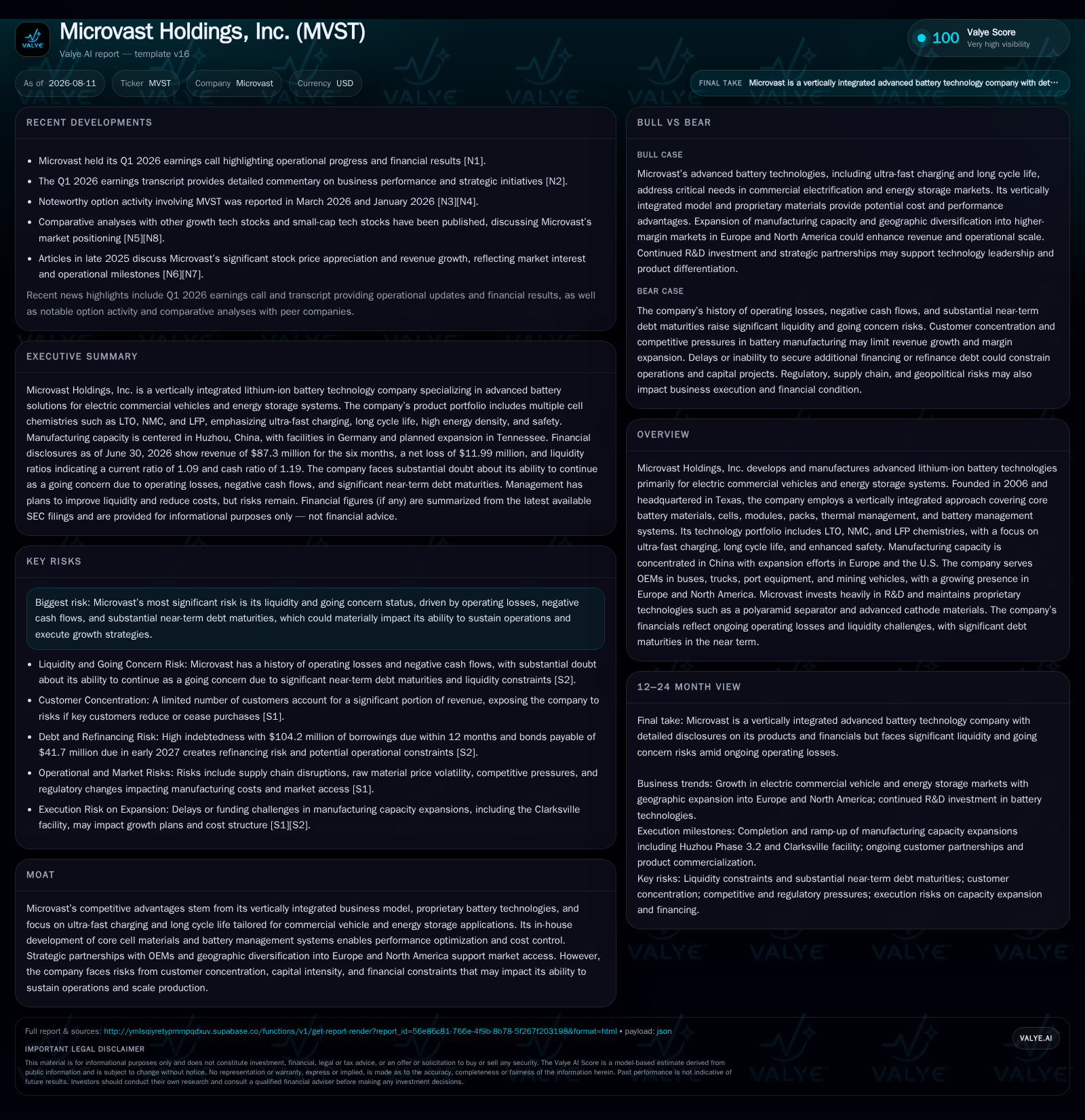
Microvast Holdings’ latest quarterly filing reveals a nuanced operational picture: while revenue declined overall by nearly 29%, robust double-digit growth in North America and Europe underscores successful geographic diversification. The company’s vertically integrated lithium-ion battery model and proprietary technologies underpin product differentiation, particularly in ultra-fast charging and cycle life tailored for commercial electric vehicles and energy storage systems. However, gross margins contracted from 36% to just over 30%, driven by cost pressures and competitive dynamics. With significant near-term debt maturities exceeding $100 million and operating cash burn intensifying, liquidity risks remain the dominant concern. The balance between scaling manufacturing – including its Clarksville expansion – and securing refinancing will be determinative for Microvast’s sustainability going forward.
Q2 Revenue Divergence: Growth in Americas & EMEA Offsets Overall Decline
This geographic revenue diversification is critical because it reflects both growing acceptance among OEM customers outside Asia and entry into markets with stronger regulatory tailwinds supporting electrification mandates. It further mitigates single-region dependency, which has historically exposed battery manufacturers to localized demand shocks or geopolitical trade restrictions. This regional growth momentum thus acts as a leading indicator of healthier future order books if sustained.
Vertical Integration Elevates Product Differentiation but Caps Margin Upside
At the core of Microvast's business model is its vertically integrated approach spanning key battery components—cathode, anode, electrolyte, separator—as well as cell assembly through module and pack integration combined with sophisticated thermal management and battery management systems (BMS) [S1]. This end-to-end control enables proprietary innovations such as polyaramid separators that contribute to claims of ultra-fast charging capabilities along with extended cycle life tailored specifically for demanding commercial vehicle applications.
As such, while vertical integration supports product quality leadership essential for winning OEM design contracts, it concurrently limits near-term margin scalability until consistent production yields improve and scale economies are realized across manufacturing facilities.
Scaling Manufacturing Footprint Confronts Capital Intensity Challenges
Microvast continues actively expanding its manufacturing footprint with notable emphasis on its Clarksville, Tennessee facility intended to produce lithium iron phosphate (LFP) cells targeting energy storage system (ESS) deployments [S1], [S2]. This represents a strategic effort to localize production in the U.S., enhancing supply chain security and complying with domestic content requirements increasingly demanded by American OEMs.
However, this capacity build-out faces execution risks given capital intensity inherent in building advanced battery plants. Construction delays have impacted timelines and cash burn rates. Additionally, $104 million of borrowings mature within twelve months alongside bonds repayable by January 2027 issued through Microvast’s Chinese subsidiary [S2], [S5]. Coupled with restricted access to overseas subsidiary cash reserves for repatriation due to regulatory limitations [S5], these factors heighten liquidity risk.
Capital expenditures remain necessary but must be judiciously managed against constrained financial resources. The company’s ability to refinance debt or secure alternative financing will be critical to maintain operational continuity during this scaling phase.
OEM Partnerships Fuel Geographic Revenue Diversification Momentum
Microvast primarily serves OEMs producing electric commercial vehicles—including buses, trucks, port equipment, and mining vehicles—leveraging close co-development partnerships that help tailor battery solutions precisely for end-market demands [S1]. Such relationships underpin design wins that form the base for recurring revenues via direct supply agreements.
Although these partnerships facilitate entry into diverse international markets contributing to recent regional revenue growth trends especially in North America and Europe, they also concentrate revenue risk; dependence on a limited set of large customers could lead to volatility stemming from order fluctuations or contract renegotiations. The company's filings explicitly acknowledge customer concentration as a material risk factor affecting financial stability [S1], [S2]. Nonetheless, expanding geographic reach partially alleviates this concentration by broadening exposure across multiple regulatory regimes and OEM ecosystems.
R&D Investment Priorities Underpin Ultra-Fast Charging Leadership Claims
Research and development remain pivotal for Microvast’s strategy aiming at sustaining competitive technological advantage within the highly innovative lithium-ion battery space. The company invests heavily not only in core cell chemistry innovations (such as advanced cathode materials) but also in integration improvements spanning thermal management systems and intelligent BMS analytics [S1].
This persistent focus has allowed Microvast to claim leadership positions in ultra-fast charging capabilities—a feature increasingly requisite among fleet operators seeking minimized charging downtime—and extended cycle life essential for total cost of ownership reduction in commercial fleets.
R&D intensity as a percentage of revenue remains elevated relative to many industry peers who might focus predominantly on commoditized battery cells rather than fully integrated solutions combined with system intelligence. While such investment heightens short-term expenditure burdens contributing indirectly to margin pressure observed recently [S2], it is indispensable for sustaining technological differentiation over longer innovation cycles extending beyond typical competitor upgrade windows.
Liquidity Pressures Heighten As Operating Losses Persist — What It Means for Sustainability
Liquidity constraints represent Microvast’s foremost existential risk at present. The six-month period ending June 30, 2026 saw operating cash flow decline sharply into negative territory at $33.3 million used compared to positive $44.3 million generated in the prior year period—an unfavorable swing driven largely by the nearly 29% revenue drop compounded by gross margin contraction from 36% to just above 30% [S2], [F1].
Simultaneously, short-term debt obligations totaling approximately $104 million come due within twelve months alongside convertible bonds aggregating $41.7 million issued via its Chinese subsidiary repayable early next year raise refinancing urgency [S2], [S5]. Despite holding approximately $128 million in consolidated cash balances as of end-Q2—with caveats related to restricted subsidiary cash—their current ratio stands modestly above 1 at 1.09 indicating tight working capital headroom [F1].
This configuration magnifies risks associated with lender negotiations given cross-default clauses embedded within borrowing agreements; failure or delay in refinancing could trigger acceleration events jeopardizing solvency status [S5]. Market perception challenges linked to going concern doubts also pose downstream repercussions including supplier tightened credit terms or diminished customer confidence potentially exacerbating liquidity erosion cascades [S7], [S12].
What Comes Next: Milestones Around Capacity Expansion, Customer Wins, and Refinancing
Going forward several key indicators will crystallize Microvast's trajectory toward either stabilization or further deterioration:
- Completion progress at Clarksville plant along with early production yield improvement serve as tangible signs of operational scalability prospects.
- New OEM contract announcements particularly within North America or Europe would signal expanding market acceptance validating R&D investments.
- Successful refinancing or extension agreements addressing imminent debt maturities will provide vital liquidity relief allowing continuation of growth plans without distress asset sales or equity dilution under weak terms.
- Operating margin trajectories reflecting ability to curb cost inflation against pricing power will function as barometers for sustainable profitability prospects.
Monitoring these milestones alongside evolving macroeconomic conditions influencing raw material availability/pricing and regulatory incentives shaping sector demand will offer valuable foresight into Microvast’s medium-term viability.
This analysis synthesizes information derived from Microvast Holdings’ latest quarterly Form 10-Q filed August 10, 2026 ([S2]), supplemental filings ([S3]), their most recent annual Form 10-K dated March 16, 2026 ([S1]) complemented by financial snapshot data ([F1]). All interpretations herein are intended for informational insight without constituting investment advice.
Disclaimer: This is research-only, informational analysis and not investment advice. It may include AI-generated interpretation and general industry context. Always verify important details using primary sources.

Comments