
Investors Title Navigates Real Estate Cycles with Steady Underwriting Discipline
Investors Title Company’s latest quarterly filing reveals operational resilience supported by underwriting discipline and regulatory compliance amid fluctuating real estate markets.
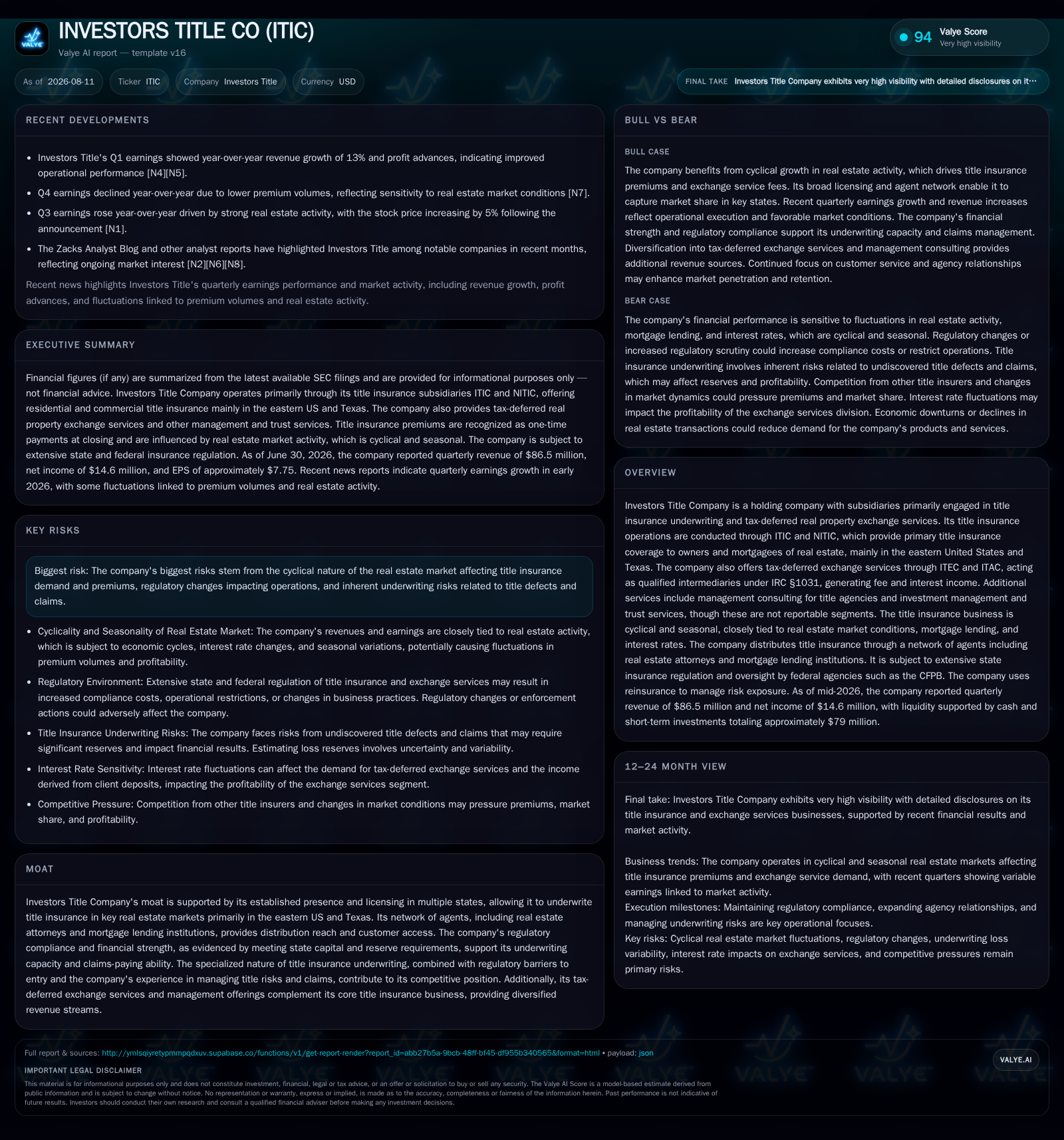
In the August 2026 quarter, Investors Title Company demonstrated stable underwriting performance despite ongoing cyclicality in the real estate market that influences title insurance demand. The company’s revenue primarily derives from title insurance premiums tied to residential and commercial transaction volumes in key states such as North Carolina and Texas, complemented by fee and interest income from its tax-deferred exchange services. Its competitive positioning benefits from an established network of independent agents including real estate attorneys and mortgage lenders, and stringent regulatory capital compliance supports claims-paying ability. Going forward, metrics like premium trends, loss ratios, and capital adequacy will be pivotal indicators of resilience amid macroeconomic pressures.
August Quarter Operating Update Highlights Cyclical Sensitivity Persisting But Underwriting Stable
In its 10-Q filing dated August 10, 2026, Investors Title Company (ITIC) confirmed steady operational performance for the quarter ended June 30 despite cyclical headwinds stemming from prevailing real estate market volatility [S2]. Management reiterated there were no material changes to previously disclosed risk factors [S2], underscoring continued exposure to fluctuations in residential and commercial property transactions. The company’s title insurance premiums—its core revenue driver—remain directly sensitive to real estate activity levels impacted by mortgage rates and pricing dynamics reflective of broader economic conditions. Nonetheless, ITIC’s disciplined underwriting approach remains intact with no reported deterioration in loss trends or expense pressures during the period [S2][S3].
Core Title Insurance: Revenue Drivers Tied to Transaction Volume and Property Values in Key States
Investors Title underwrites primary title insurance coverage through wholly owned subsidiaries ITIC and NITIC, focusing on owners and mortgagees mainly within eastern U.S. states such as North Carolina, Texas, Georgia, South Carolina, and Florida [S1][S12]. Revenue from these operations is driven fundamentally by policy issuance volume linked to residential and commercial real estate transactions as well as average property values. Mortgage lenders’ requirements for title insurance policies on financed properties remain a critical demand enabler [S1]. The business is both cyclical—reacting to economic cycles influencing deal flow—and seasonal with typical peaks during spring/summer quarters tied to housing market patterns [S1][S12].
The company manages risk exposure through comprehensive underwriting practices involving extensive title searches designed to detect pre-existing defects or encumbrances that could generate claims liabilities post-issuance. These standards along with state-mandated capital reserves bolster claims-paying ability critical to client confidence [S1][S4]. Regulatory scrutiny governs premium form approvals and reserve adequacy thresholds across jurisdictions imposing disciplined pricing power while limiting abrupt rate adjustments despite inflationary or cost pressures [S1][S15].
Tax-Deferred Exchange Services Complement Title Insurance With Fee & Interest Income Mix
ITIC enhances its core title business with tax-deferred exchange services conducted by subsidiaries ITEC and ITAC acting as qualified intermediaries under IRS Code §1031 [S1]. These offerings facilitate investors’ deferral of capital gains taxes on like-kind property exchanges by handling intermediary functions including property holding arrangements via exchange accommodation titleholders [S1][S4].
This segment generates fee revenues supplemented by interest income on funds held temporarily during exchange transactions. Unlike the inherently cyclical title insurance premiums tied to property sale volumes, exchange services deliver comparatively stable revenue streams less affected by real estate seasonality or transactional lulls [S1][S4]. The cross-selling potential embedded through ITIC’s Commercial Services Division marketing these services to their existing client base adds strategic synergy enhancing customer retention [S4].
Competitive Position Supported by Experienced Agent Network and Regulatory Compliance Burden
Distribution is conducted primarily through a network of independent title agents comprising real estate attorneys, brokers, independent agencies, and subsidiaries of community or regional mortgage lenders operating under contractual agreements [S1][S12]. These agents carry substantial autonomy performing policy issuance activities while adhering to quality standards imposed by ITIC.
Although this agent independence extends operational reach across multiple states without direct overhead expansion for the insurer, it also introduces risks from potential fraud or negligence which can translate into costly claims or reputational damage [S1][S11]. Regulatory frameworks impose rigorous oversight demands including license requirements for insurers and agents; minimum capital & surplus; reserve maintenance; policy form approval; investment restrictions; reporting obligations; and solvency examinations [S1][S4][S27].
Meeting these extensive regulatory compliance demands constitutes a high barrier to entry protecting established players like ITIC from disruptive competition while assuring policyholder protection through solid claims-paying ability [S1][S15]. ITIC currently meets all applicable state-mandated capital requirements supporting financial strength ratings that influence competitive standing in securing new business relationships [S1][S25].
Growth Pathways Include Market Expansion, Mortgage Lending Trends, and Distribution Enhancement
Looking ahead, potential growth avenues include capturing incremental market share from recovering residential/commercial real estate transaction volumes driven by easing interest rate environments or improving consumer confidence that stimulate home sales [S1][S4]. Rising property valuations further amplify premium bases enhancing top-line growth beyond volume alone.
The company may pursue deeper penetration in existing core state markets where demographic trends support sustained housing demand alongside exploration of strategic geographic markets providing regulatory alignment feasibility [S1]. Mortgage lending momentum also presents tailwinds since financed purchases tend to require title insurance policies mandated by lenders.
Enhancements in agent recruitment strategies coupled with investments in technology improving digital title searches or streamlined closing processes can elevate efficiency margins contributing to better expense ratios once scaled sufficiently [S4]. These initiatives align with industry trends emphasizing faster turnaround times and client service quality differentiation.
Risks: Economic Cyclicality, Regulatory Changes, Underwriting Risk, And Geographic Concentration Exposure
The principal risks that remain relevant stem from the cyclicality inherent in title insurance linked directly to unpredictable real estate transaction volumes susceptible to shifts in macroeconomic variables such as elevated mortgage rates which dampen refinancing or buying activity [S1][S11]. Rising interest rates continue representing a headwind suppressing purchase demand which would curtail premium inflows.
Regulatory uncertainties including evolving state insurance regulations alongside federal oversight modifications (notably CFPB activities around RESPA compliance) could impose additional operational burdens raising costs or constraining pricing flexibility [S11][S27]. Moreover, ITIC faces underwriting risks originating from undisclosed title defects or fraudulent acts perpetrated within its network of independent settlement providers potentially resulting in significant claim obligations impairing profitability [S11].
Geographic concentration—with significant premium contributions derived principally from five states—subjects earnings volatility due to localized economic downturns or regulatory reforms adversely affecting those markets disproportionately compared with more diversified peers [S1][S12].
Key Milestones Ahead: Metrics To Watch Including Premium Trends, Loss Ratios And Capital Levels
Investors should monitor upcoming quarterly reports focusing on net premiums written reflecting transaction volume recovery or deterioration signals aligned with housing market activity patterns [S2][S5]. Claims loss ratio trajectories offer insights into underwriting effectiveness amid fluctuating market conditions while combined ratio analysis provides perspective on overall underwriting profitability relative to earned premiums.
Expense management efficacy evident through operating ratios combined with reserve adequacy measurements will signal whether latent liabilities or capital buffers remain sufficient especially under stress scenarios. Maintaining robust surplus positions consistent with regulatory minimums safeguards financial flexibility enabling competitive price adjustments versus peers navigating similar cycle troughs.
Financial Profile Discussion: Solid Capital Base And Investment Income Buffer Against Market Swing
As of June 30, 2026, the company held approximately $20.5 million in cash and cash equivalents providing liquidity cushioning against near-term operating volatility [F1]. Its investment portfolio focuses on high-quality municipal bonds, federal government securities, and investment-grade corporates ensuring preservation of capital aligned with regulatory mandates enforced upon its insurance subsidiaries [S1]. This conservative approach limits risk case while generating steady investment income streams that partially offset underwriting profit cyclicality.
No material debt obligations were disclosed impairing balance sheet strength [F1][S1]. The favorable claims-paying ability reflected through adequate reserve levels buttresses credit metrics supporting insurer financial strength ratings crucial for sustaining broker/agent confidence.
Together these financial characteristics complement operational discipline enabling ITIC to absorb transient shocks characteristic of real estate cycles while maintaining service continuity for policyholders.
Disclaimer: This analysis is based solely on publicly available SEC filings dated up to August 10, 2026. It does not constitute investment advice but aims to provide an informed industry-focused assessment of Investors Title Company’s business profile and operating context.
Disclaimer: This is research-only, informational analysis and not investment advice. It may include AI-generated interpretation and general industry context. Always verify important details using primary sources.

Comments