
FirstSun Capital’s Acquisition Spurs Strategic Market and Balance Sheet Transformation
The April 2026 acquisition of First Foundation significantly reshaped FirstSun Capital’s footprint and financial structure, with Q2 results reflecting integration costs but positioning for diversified growth.
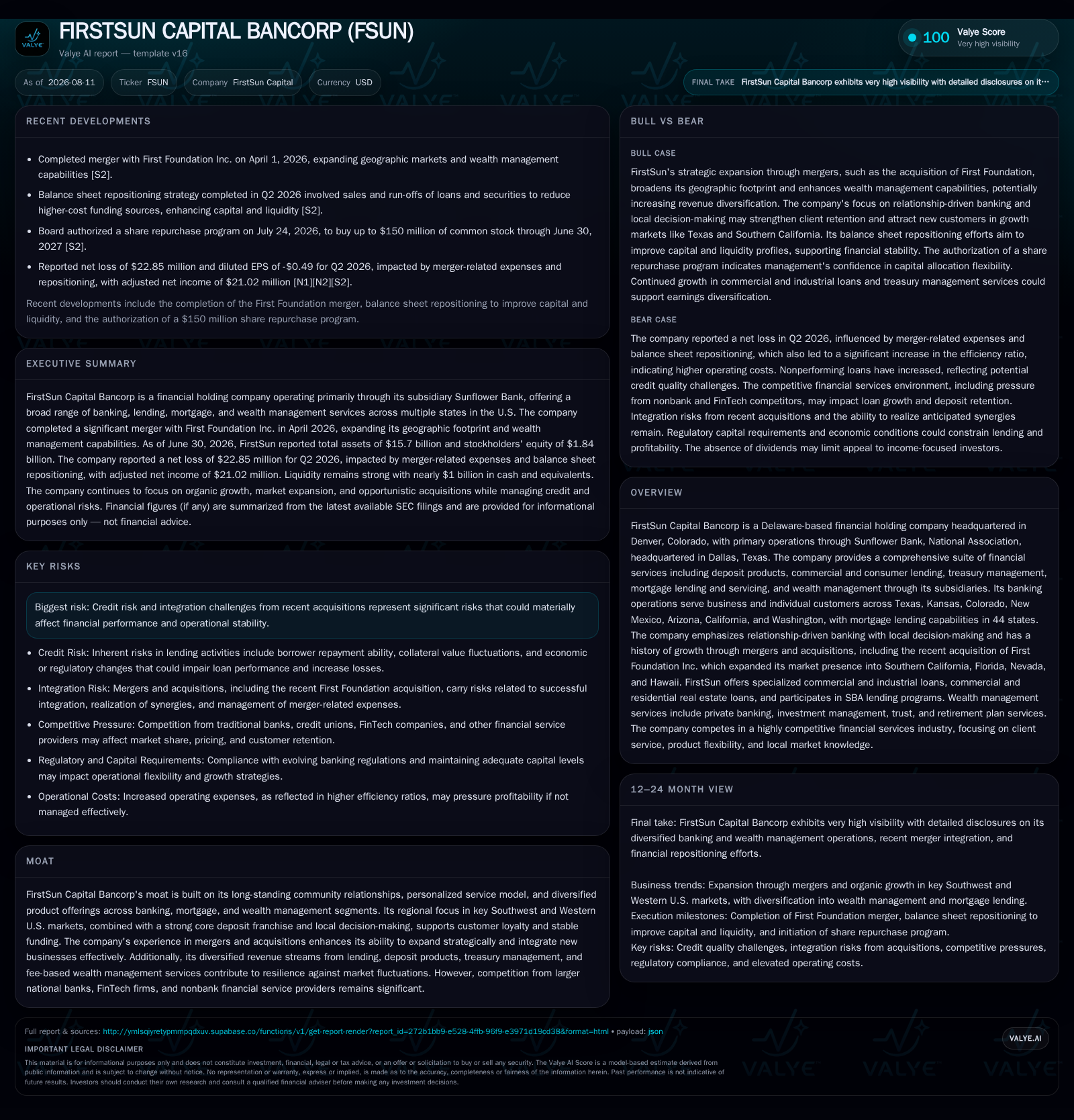
FirstSun Capital Bancorp completed the First Foundation acquisition in April 2026, doubling assets to $15.7 billion and expanding into Southern California, Florida, Nevada, and Hawaii. The company executed a balance sheet repositioning that reduced loan-to-deposit ratio from 93.9% to 86.2%, enhancing liquidity and credit profile. While merger-related costs pressured GAAP earnings in Q2, adjusted profitability remained solid. The broadened wealth management platform alongside core banking operations supports revenue diversification. Integration risks and credit quality warrant close monitoring as the company navigates post-merger execution.
Q2 Operating Update Reflects Full Integration of First Foundation Acquisition
FirstSun Capital Bancorp’s second quarter 2026 results fully incorporate the April 1st acquisition of First Foundation Inc., which nearly doubled consolidated assets from $8.5 billion to $15.7 billion by June 30, 2026 [S2]. This material expansion extended FirstSun’s geographic reach beyond its entrenched Southwest base into new markets including Southern California, Florida, Nevada, and Hawaii—regions critical for diversified revenue streams and customer acquisition channels given their robust demographic and economic growth profiles [S1], [S2]. The acquisition added approximately $6.0 billion of net loans alongside $8.8 billion in deposits, substantially enlarging the bank’s credit and funding portfolios.
Significantly, FirstSun completed a large-scale balance sheet repositioning during the quarter designed to optimize capital structure and credit profile following this rapid scale-up. This entailed liquidating $1.2 billion in cash equivalents, $1.4 billion in securities, and running off roughly $1.3 billion in loans originally acquired from First Foundation [S14]. Proceeds funded reductions of $2.5 billion in deposits—targeting higher-cost liabilities—and $1.4 billion in borrowings aimed at lowering funding expenses and increasing liquidity resilience [S2]. The effect was a notable decline in the loan-to-deposit ratio from 93.9% at YE2025 to 86.2% by Q2 end—a prudent deleveraging step signaling conservative risk management amid integration complexity [S2], [S19].
Though GAAP net income swung negative to a loss of $22.9 million for the quarter attributable largely to $57.6 million in merger-related expenses including severance, professional fees, and facility costs incurred during integration, adjusted net income held firm at $21 million (non-GAAP) signaling ongoing operational profitability underlying the transaction expenses [S18], [S19]. The efficiency ratio ballooned to over 93% under GAAP primarily because merger costs are expensed immediately; adjusted measures highlight a more normalized cost structure drifting toward peer norms post-acquisition [S18].
Capitalizing on Relationship Banking: Business Model Anchored in Diversified Regional Services
FirstSun operates a full-service regional banking franchise focused on relationship-driven business across seven key Western states prior to acquisition: Texas, Kansas, Colorado, New Mexico, Arizona, California, and Washington—as well as mortgage origination capabilities extending into 44 states via its expanded platform [S1]. The integration of First Foundation brings enhanced wealth management offerings through First Foundation Advisors (renamed Private Wealth Banking segment), complementing existing deposit products, commercial lending—including commercial real estate loans—and treasury management services forming diversified revenue streams less sensitive to interest rate fluctuations alone [S18], [S1].
This multi-segment model is well-aligned with contemporary regional banking trends where fee income from wealth management advisory (which carries higher margins) serves as an important stabilizer against cyclical pressures on lending margins caused by fluctuating rates or competitive pricing actions [S18]. Customer preference for localized decision-making anchored in community relationships remains a strategic asset enabling cross-selling across small business clients and private individuals within overlapping service geographies—a competitive edge difficult for larger national banks or FinTech disruptors without localized presence to replicate easily.
Southwest Expansion Meets Regional Banking Competitive Pressures
With the addition of markets like Southern California and Florida via the First Foundation deal—both dense financial hubs but intensely competitive landscapes—FirstSun faces mounting pressure typical for regional banks operating beyond traditional territories [S1]. Peers such as Regions Financial Corporation (RF) and Western Alliance Bancorporation (WAL) have similarly expanded via M&A into new spaces where achieving scale benefits must be balanced against integration risks.
FirstSun’s approach emphasizes measured organic lending growth combined with selective acquisitions that broaden product breadth and deepen local client ties while leveraging technology-enabled treasury management platforms that enhance customer stickiness without eroding margins through commoditized pricing models common among large national players or online mortgage providers competing aggressively on cost alone.
Growth Drivers Fuelling Demand Expansion Post-Acquisition
Organic loan growth is expected across newly penetrated markets driven by vibrant economic activity in California’s coastal metro areas as well as growing capital needs within Florida’s dynamic businesses. In parallel, wealth management fee income should benefit materially from blending Sunflower Bank's advisory expertise with the institutionalized asset management infrastructure brought by First Foundation Advisors—offering higher-margin recurring fees tied less closely to interest rate cycles than lending revenue alone [N1], [N2], [S18]. Treasury management service fees and deposit account service charges also contribute incremental diversity enabling more predictable noninterest income streams.
The Company recently authorized a share repurchase program capped at $150 million through mid-2027—an indicator of capital confidence supporting shareholder value amid transitional earnings volatility following the merger announcement timeline concluding earlier this year [S14], [S23].
Integration Risks, Credit Watchpoints and Compliance Constraints After Merger Sign-off
While FirstSun exhibits strategic intent for growth diversification post-merger, it faces elevated credit risk given inherited loan portfolios from First Foundation with looser underwriting standards or concentration exposures that demand rigorous monitoring post-close [S19]. Net charge-offs spiked to 1.45% compared with 0.83% last year’s second quarter while nonperforming loans nearly doubled to around 1.64%, underscoring emerging stress points necessitating vigilant provisioning strategies aligned with evolving local economic conditions.
Moreover, regulatory scrutiny intensifies following such significant M&A activities requiring sustained capital adequacy maintenance—regulated closely via tier 1 risk-based capital ratios which declined moderately due to goodwill intangibles resulting from purchase accounting yet remain within compliance thresholds around ~12% CET1 ratio level—providing some buffer room but necessitating active capital planning going forward [S16], [S19]. Operationally, disciplined control over integration expenses coupled with IT system harmonization will be key success factors behind unlocking synergies without eroding customer experience or incurring protracted transition costs.
Investor Focus: Key Metrics To Monitor In Coming Quarters
Investors should prioritize monitoring quarterly deposit trends focusing on sustainability of the CDARS program which contributed $1.5 billion or over 11% of total deposits by June-end—a substantial source of low-cost core funding providing relative stability during uncertain macro cycles [S12], [N1]. Loan-to-deposit ratio trajectory will signal ongoing balance sheet optimization effectiveness; returning closer to pre-merger levels (~86% vs prior ~94%) indicates prudent liquidity stance balanced against growth ambitions.
Also critical is tracking noninterest income contribution rising steadily above current ~22% share of total revenue which reflects successful expansion within wealth and treasury fee businesses consequential for margin diversification amid net interest margin compression challenges observed post-trade (now at ~3.58%) compared to historical ~4+% range before acquisition completion [S19], [N2]. Lastly, provisions for credit losses versus net charge-off rates will flag evolving portfolio quality dynamics especially related to legacy assets originating outside original core markets.
Financial Profile Discussion: Balance Sheet Repositioning and Capital Fortification
At June 30, 2026, consolidated stockholders’ equity stood at approximately $1.8 billion—a substantial increase from $1.2 billion year-end reflecting issuance of roughly $686 million equity consideration funding the First Foundation merger alongside retained earnings impact adjustments related mainly to transaction costs expensed immediately impacting earnings but not equity directly yet reducing tangible book value slightly after intangible asset recognition related to goodwill ($9 million) and core deposit intangibles ($90 million) recorded during purchase accounting processes [S4], [S14], [F1].
Liquidity improved due partly to planned asset sales generated cash inflows strengthening unrestricted cash balances near $990 million illustrating ample immediate resources available supporting both operational needs and regulated liquidity buffers per internal policies factoring Federal Home Loan Bank (FHLB) borrowing capacity now exceeding $4 billion plus Federal Reserve repo lines effectively increasing overall funding flexibility with secured collateral pledges spanning loans and investment securities portfolios now heavily utilized reflecting conservative risk posture against potential market disruptions typical for regional banking post M&A transitions [S16], [F1].
In sum, FirstSun Capital’s recent transformational acquisition expands its regional banking footprint significantly while balancing scale gains with rigorous portfolio quality vigilance and cautious deleveraging replacing higher-cost liabilities with stable core deposits augmented by a robust treasury management platform favorably positioning it against peers pursuing similar Southwestern US banking consolidation strategies.
This analysis does not provide investment advice but serves as an independent examination grounded in recently filed financial disclosures combined with industry knowledge relevant for regional banking professionals monitoring competitive expansion via mergers.
Disclaimer: This is research-only, informational analysis and not investment advice. It may include AI-generated interpretation and general industry context. Always verify important details using primary sources.

Comments