
Pangaea Logistics: Leveraging Ice-Class Fleet and Logistics Integration for Growth
Pangaea’s Q2 2026 results highlight improved vessel utilization and a diversified contract mix underpinned by its specialized fleet and integrated logistics capabilities.
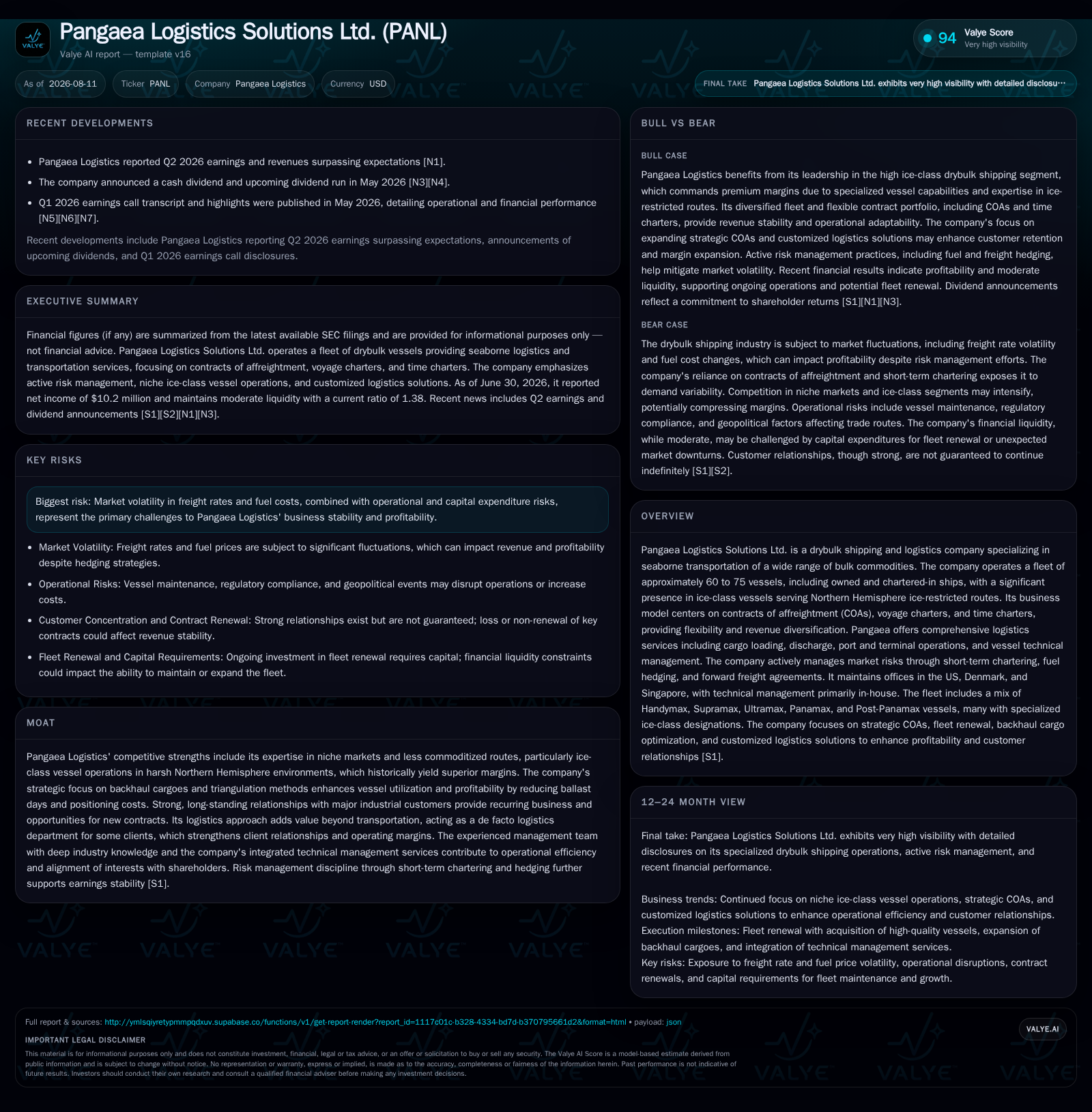
Pangaea Logistics Solutions demonstrated operational resilience in Q2 2026 with elevated vessel utilization rates and a balanced charter portfolio that mitigates exposure to freight rate volatility. Its leadership in ice-class dry bulk vessels enables access to higher-margin Northern Hemisphere routes, while integrated logistics services strengthen customer relationships and revenue stability. Risk factors remain centered on the cyclical nature of dry bulk shipping rates and regulatory compliance costs. Looking ahead, backhaul cargo strategies and scheduled drydockings will be key milestones to watch alongside the company’s cash flow generation and debt management.
Q2 Operating Momentum Elevated by Utilization Gains and Contract Diversification
This approach aligns with maritime industry best practices where managing a diversified chartering strategy enhances cash flow predictability while retaining flexibility to respond to freight rate cycles. Confirmation of continued gains in vessel employment rates through subsequent quarterly disclosures would further validate this trend.
Specialized Ice-Class Fleet Sustains Competitive Edge in Challenging Trade Routes
At the core of Pangaea's strategic moat is its specialization in ice-class dry bulk vessels—specifically Ice-Class 1A rated ships exceeding 60,000 deadweight tons (dwt). The company's fleet includes nine Panamax vessels (six Ice Class 1A), four Post-Panamax Ice Class 1A vessels, and Ultramax units with Ice Class 1C designations [S1]. This high ice-class certification enables Pangaea to operate in demanding Northern Hemisphere ice-restricted routes such as the Baltic Sea during winter months.
Such niche route access is significant because it faces limited competition due to stringent technical vessel requirements. Consequently, these ice-class operations often command premium charter rates relative to conventional dry bulk segments. The ability to serve these markets reliably yields enhanced margins compared to more commoditized trade lanes serviced by generalist peers like Diana Shipping or Star Bulk Carriers.
Furthermore, ice navigation demands extensive technical expertise in vessel maintenance and crew management—areas where Pangaea's partly vertically integrated model with primarily in-house technical management adds operational control advantages.
Integrated Logistics Amplify Customer Stickiness and Vessel Profitability
Beyond transportation services, Pangaea provides comprehensive logistics solutions encompassing cargo loading and discharge operations alongside port terminal services. Acting as a de facto ocean logistics department for select industrial clients extends the value proposition beyond pure shipping. This integration deepens customer relationships through expanded service delivery that improves scheduling efficiency, reduces delays, and enhances supply chain coordination.
Such logistic capabilities create tangible switching costs which contribute to improved retention metrics — critical factors given the high capital intensity underlying fleet ownership. By embedding within customers’ broader transportation workflows, Pangaea enhances margin capture potential due to additional fee-based services while simultaneously optimizing its own asset utilization.
Market Volatility Managed Through Flexible Chartering Mix and Hedging Strategies
Given inherent cyclicality in dry bulk shipping rates heavily influenced by global economic activity and commodity demand patterns, Pangaea employs risk management via a measured charter mix combined with financial hedging techniques. Time charters provide steady income streams insulated from short-term market swings whereas voyage charters allow leveraging favorable spot conditions when present.
The company also utilizes forward freight agreements (FFAs) as derivative instruments to hedge anticipated freight rate movements alongside fuel hedges aimed at stabilizing bunker costs [S2], [S13]. These mechanisms collectively mitigate earnings volatility—a crucial factor for maintaining operating cash flows sufficient for scheduled capital expenditures including dry docking.
Tracking shifts in charter type proportions and disclosed FFA hedge volumes will offer insights into the company's evolving risk profile against sector-wide rate gyrations.
Growth Prospects Focused on Niche Vessel Expansion, Backhaul Optimization
Pangaea's growth strategy leans on augmenting its fleet within high-value specialized segments such as ice-class vessels complemented by logistics diversification. A noted operational practice highlighted is backhaul cargo contracting—the securing of return trip cargoes that offset ballast voyages where ships otherwise sail empty post-discharge.
By triangulating cargo routes across interlinked geographical corridors, Pangaea reduces ballast days meaningfully thereby increasing revenue generating voyage days per ship per year—a vital KPI driving profitability in dry bulk shipping economics [S1]
Capital expenditure plans prioritize funding scheduled dry dockings necessary for compliance with international safety standards and environmental regulation adherence rather than aggressive new build acquisitions currently. Planned drydocking outlays aggregate roughly $18.7 million for thirteen special surveys plus two intermediate surveys projected during calendar year 2026 [S1]. Successful timing execution here minimizes offhire risk which directly relates to revenue interruption.
Risks Stem from Freight Rate Cyclicality and Regulatory Compliance Costs
The business operates within a volatile environment characterized by sharply fluctuating freight rates tied strongly to global macroeconomic conditions including industrial production cycles impacting dry bulk commodity demand. Notably, rising inflationary pressures and geopolitical tensions—including sanctions regimes—could disrupt trade flows affecting revenue predictability [S11], [S13].
Fuel price shocks remain a material operating cost risk due both to direct consumption expense as well as pass-through lag effects under certain contract structures. Additionally, mounting environmental regulation costs from IMO mandates on sulfur oxides emissions necessitate incremental investment or operational adjustments which may compress margins further if unrecouped through pricing mechanisms.
Counterparty credit risks also exist given concentration among several large industrial customers upon which a significant portion of revenues depend—defaults or renegotiations there could have outsized impacts relative to typical peer exposures.
Catalysts to Monitor: Charter Book Updates, Dry Dock Schedules, Demand Signals
Near-term focus should track changes in contract backlog lengthening or renewal patterns especially regarding COAs which provide multi-voyage revenue visibility versus spot exposure dominated tonnage. Upcoming announcements concerning scheduled dry dock completions will indicate when previously offhire vessels re-enter productive service aiding utilization metrics.
Additionally monitoring FFA hedge positions or fuel procurement strategies announced will clarify corporate risk posture amidst uncertain global energy prices. Demand signals from key regional bulk commodity producers—particularly those reliant on Northern Hemisphere icy trade lanes—may underline volume growth potential in subsequent quarters.
Financial Profile Discussion: Stable Liquidity Supports Planned Capital Maintenance
As of June 30, 2026, Pangaea held approximately $105.7 million in cash and equivalents paired against total debt near $129.6 million as of December 31, 2025, resulting in a modest net debt position around $23.8 million, indicating manageable leverage relative to operating cash flow capacity [F1]
The current ratio stands at approximately 1.38, providing acceptable short-term liquidity coverage for working capital needs including scheduled dry docking capex intended for mid-to-late calendar year execution [F1], [S1].
Operational cash generation remains a critical enabler for covering interest obligations while funding maintenance capex within a capital-intensive industry heavily reliant on asset quality preservation for long-term viability.
This analysis synthesizes publicly available filings as of August 10–11, 2026 without extrapolation beyond cited data points or offering investment guidance. It reflects on how Pangaea Logistics leverages its specialized fleet composition coupled with integrated logistics services within the cyclical but strategically nuanced dry bulk shipping sector.
Disclaimer: This is research-only, informational analysis and not investment advice. It may include AI-generated interpretation and general industry context. Always verify important details using primary sources.

Comments