
i-80 Gold Advances Nevada Projects Amid Ramp-Up Costs and Balance Sheet Strength
Strong capital raises support multi-asset development plan while rising expenses pressure near-term profitability.
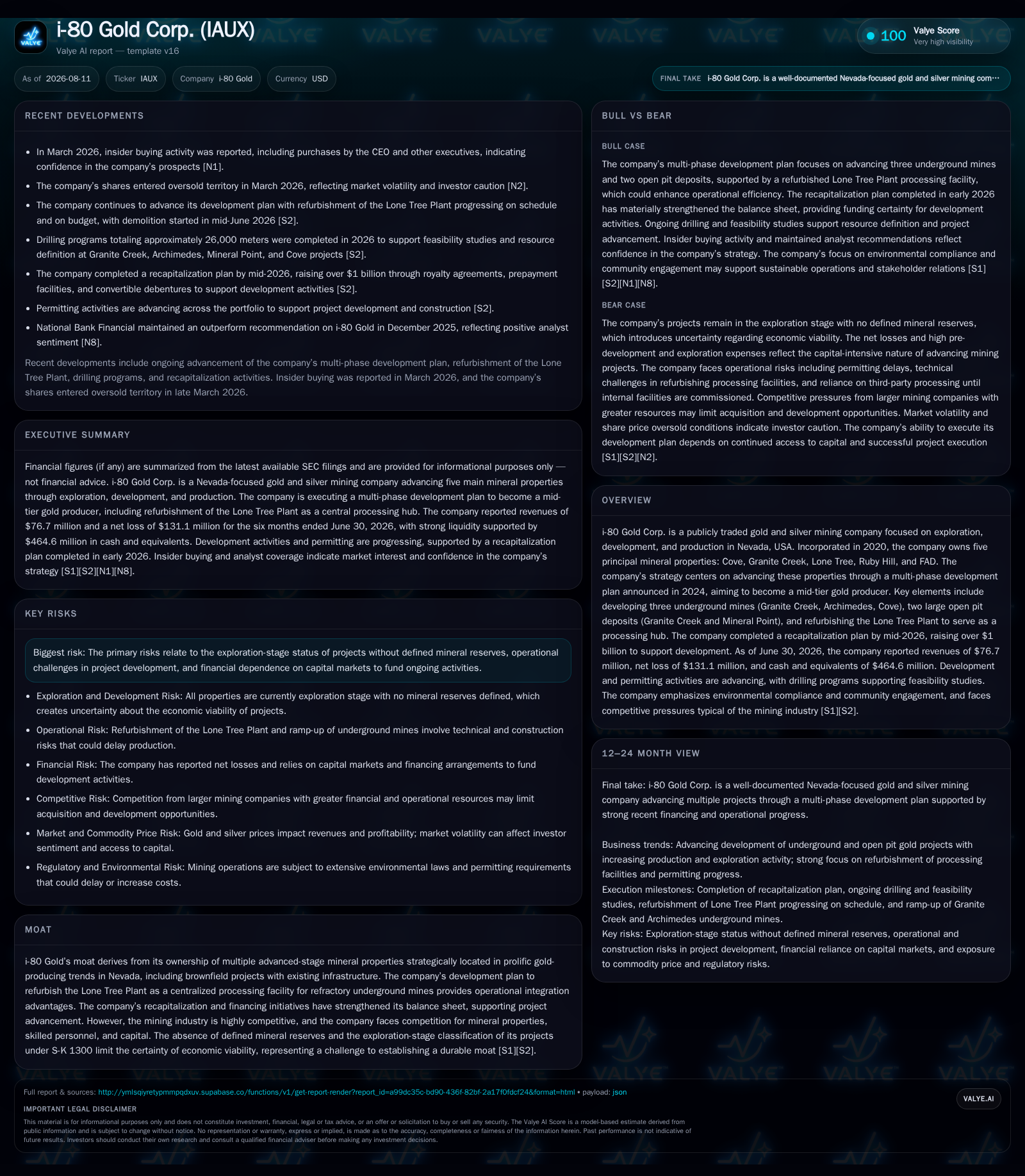
i-80 Gold Corp. is progressing on its multi-phase plan to become a mid-tier gold producer in Nevada through advancing five core mineral properties. The latest quarter shows higher gold production and gross profit driven by rising realized prices, but operating cash outflows and net losses increased from elevated pre-development, evaluation, and exploration expenses. Significant capital commitments are underway for refurbishing the Lone Tree Plant and expanding underground mining infrastructure, funded by over $1 billion raised in recent recapitalizations. While the absence of defined mineral reserves leaves economic viability uncertain, the company's strong liquidity position provides runway to advance project feasibility and construction milestones.
Recent Operating Update
Gross profit improved sharply to $8.6 million driven mostly by higher metal prices while unit economics remain pressured by elevated operating expenses; the adjusted net loss increased significantly to $41.2 million from $26.5 million year-over-year owing chiefly to a surge in pre-development costs including drilling programs at Ruby Hill aimed at advancing resource definition [S2]. Operating cash outflow expanded markedly to $49.6 million attributable to working capital changes involving inventory growth related to third-party processing limitations and intensified exploration spending necessary for advancing technical studies [S2].
Capital investment accelerated in support of project advancement with expenditures totaling approximately $21.5 million focused on commencing Lone Tree Plant refurbishment—comprising early works and pre-construction activities—and infrastructure development such as water treatment facilities at Granite Creek underground operation [S2]. As of June 30, initiations like demolition work ahead of major construction signal progression toward commissioning what is envisioned as a central refractory ore autoclave processing hub for multiple underground mines.
Business Model
i-80 Gold operates across several stages typical of upstream precious metals miners combining exploration drilling campaigns with substantial capital deployment for mine development and processing asset refurbishment under a centralized model targeted at refractory ores prevalent in its Nevada properties. Revenue is predominantly generated through the sale of refined gold ounces extracted either by direct mining or mineralized material sales subject to payable factors (~56%-59%) reflecting ore grade variability and recoveries from third-party toll processing arrangements before Lone Tree Plant commissioning.
Since the company has not yet declared mineral reserves compliant with S-K 1300 reporting standards, current accounting policies expense pre-development and evaluation costs; these may capitalize upon reserves declaration consistent with industry practice altering future earnings profiles dynamically. Net revenues hinge critically on production volumes and realized metal prices while incremental exploration success can materially improve valuation through delineation of economically viable resources enhancing capital efficiency.
The multi-asset portfolio strategy encompassing three underground mines (Granite Creek, Archimedes at Ruby Hill, Cove) plus two open pit projects (Granite Creek open pit & Mineral Point) alongside refurbishment of the Lone Tree autoclave/barrel carbon-in-leach processing facility offers operational integration benefits compared with standalone development efforts seen among peers in Nevada’s prolific mining districts.
Industry Structure and Competitive Position
i-80 Gold competes within the mid-tier gold producer segment focused strategically on Nevada, a jurisdiction recognized globally for its gold endowment but also characterized by intense competition for acquisition opportunities, skilled workforce access, rigorous permitting requirements, and capital-intensive project development cycles. Peers typically include other public miners listed on NYSE American or TSX such as Hecla Mining Company or Coeur Mining which operate diverse portfolios balancing brownfield expansions with greenfield exploration.
Ownership of multiple advanced-stage deposits combined with existing infrastructure assets like the Lone Tree Plant potentially enhances i-80 Gold's competitive moat by enabling cost synergies in refractory ore processing—a process often marked by higher complexity requiring autoclave or pressure oxidation technologies uncommon among smaller operators focused solely on free-milling ores.
At this stage, i-80’s lack of certified mineral reserves positions it more akin to exploration-stage mineral resource developers rather than fully producing entities generating stable cash flow—a factor broadening risk exposure compared with peers possessing reserve-backed production where valuation discounts may apply accordingly.
Growth Drivers
The primary growth vectors underpinning i-80 Gold’s trajectory encompass:
Resource Definition Through Exploration Drilling: Ongoing drilling meters completed at Ruby Hill and Granite Creek aim to upgrade mineral resource classifications essential for transitioning into proven reserves vital for financing mine construction.
Advancement from Exploration to Production: Successful ramp-up at Granite Creek underground (incrementing production volumes), initiation of mining activity at Archimedes underground alongside phased commissioning of the Lone Tree Plant as a centralized processing center supports scaling output.
Refurbishment & Expansion of Processing Facilities: Lone Tree Autoclave refurbishment represents pivotal infrastructure increasing processing capacity tailored for refractory deposits limiting reliance on third-party toll processors thereby improving margins.
Capital Structure Strengthening: Recent recapitalization activities generating significant gross proceeds via NSR royalty agreements, convertible debentures, gold prepay facilities, and equity financings provide funding liquidity necessary for sustained development capex execution.
Favorable Metals Market Environment: Rising average realized prices evidenced recently provide revenue upside potential contributing directly to gross profit expansions even amid flat or growing cost bases.
Risks and Constraints
Key risks center around:
Absence of Defined Mineral Reserves: All projects remain classified exploratory without proven economic viability assuring future commercial mining; this classification injects uncertainty around timing or scale of mine production ramp-up impacting cash flow generation assumptions.
Operational Challenges: Construction delays or cost overruns—common in autoclave refurbishments—and uncertainties inherent with underground mining (e.g., geotechnical risks) could impair project timelines or elevate sustaining capital requirements.
Capital Market Dependence: Despite recent strong liquidity inflows providing runway well into upcoming phases, long development lead times necessitate sustained access to external funding sources potentially exposed to adverse market conditions affecting refinancing ability.
Commodity Price Volatility: Fluctuations in gold prices materially affect revenue metrics creating earnings volatility complicating planning around operating margins and investment prioritization.
Third-party Processing Dependency Pre-Lone Tree Commissioning: Transitional reliance on external toll processors constrains inventory management flexibility explaining some recent working capital expansions due to stockpiling pending heavier internal throughput capability deployment.
What To Watch Next
Critical upcoming milestones include:
Progression into full-scale construction phase at Lone Tree Plant expected Q4 2026 following initial demolition works signaling significant capex ramp-up commitment.
Quarterly updates on drilling results particularly focusing on advancing preliminary feasibility studies capable of supporting resource conversion from inferred/exploration stage classification into mineral reserves per S-K1300 guidelines.
Achievement of scheduled production targets aligned with guidance (e.g., Granite Creek underground aiming for year-end volumes near upper range estimates).
Monitoring changes in adjusted net losses focusing on rate of increase/decrease driven by operating expense discipline versus operational scaling benefits manifesting in gross margin trends.
Financial covenant compliance associated with convertible debenture structures given material debt outstanding; ongoing liquidity status post major financing activities remains crucial given high capex demands ahead.
Financial Profile Discussion
i-80 Gold strengthened its liquidity position entering H1 2026 through recapitalization initiatives including a prospectus offering of common shares in early 2025 raising approximately $15.6 million (C$22.6 million) and a private placement in mid-2026 generating net proceeds of $12.5 million [S2]. Additionally, the company secured $144.1 million net proceeds from a 2026 Gold Prepay facility with NBC and Macquarie, obligating delivery of nearly 40,000 ounces of gold over 2028-2030 [S2].
As of June 30, 2026, i-80 Gold held $464.6 million in cash and equivalents with current assets of $513.4 million versus current liabilities of $59.5 million, resulting in a strong current ratio of approximately 8.63x [F1]. Total debt was reported near $175.7 million as of December 31, 2025, with net debt effectively negative due to cash balances exceeding debt levels, positioning the company as net cash positive [F1].
Interest expenses for Q2 2026 totaled $9.3 million, primarily driven by costs associated with the 2026 Gold Prepay and convertible debentures, reflecting the company's recent financing activities [S2]. This financial flexibility supports ongoing development spending and project advancement without immediate refinancing pressure.
Disclaimer: This is research-only, informational analysis and not investment advice. It may include AI-generated interpretation and general industry context. Always verify important details using primary sources.

Comments