
American Rebel Holdings Struggles with Liquidity Amid Brand Expansion Efforts
Quarterly filings reveal ongoing financial strain despite strategic moves to grow distribution for American Rebel Light Beer.
American Rebel Holdings Inc. continues to rely on convertible debt and equity transactions to fund its branded light beer business while facing significant liquidity constraints. The latest quarter shows minimal cash on hand against substantial current liabilities, reflecting the company's financial fragility. Although American Rebel has established distribution partnerships in key U.S. markets such as Florida and Virginia, its ability to scale is restricted by a complex capital structure and sustained operating losses. The company’s ownership of subsidiaries in related sectors adds diversification but also ties into secured financing arrangements that may limit flexibility.
Recent Operating Update
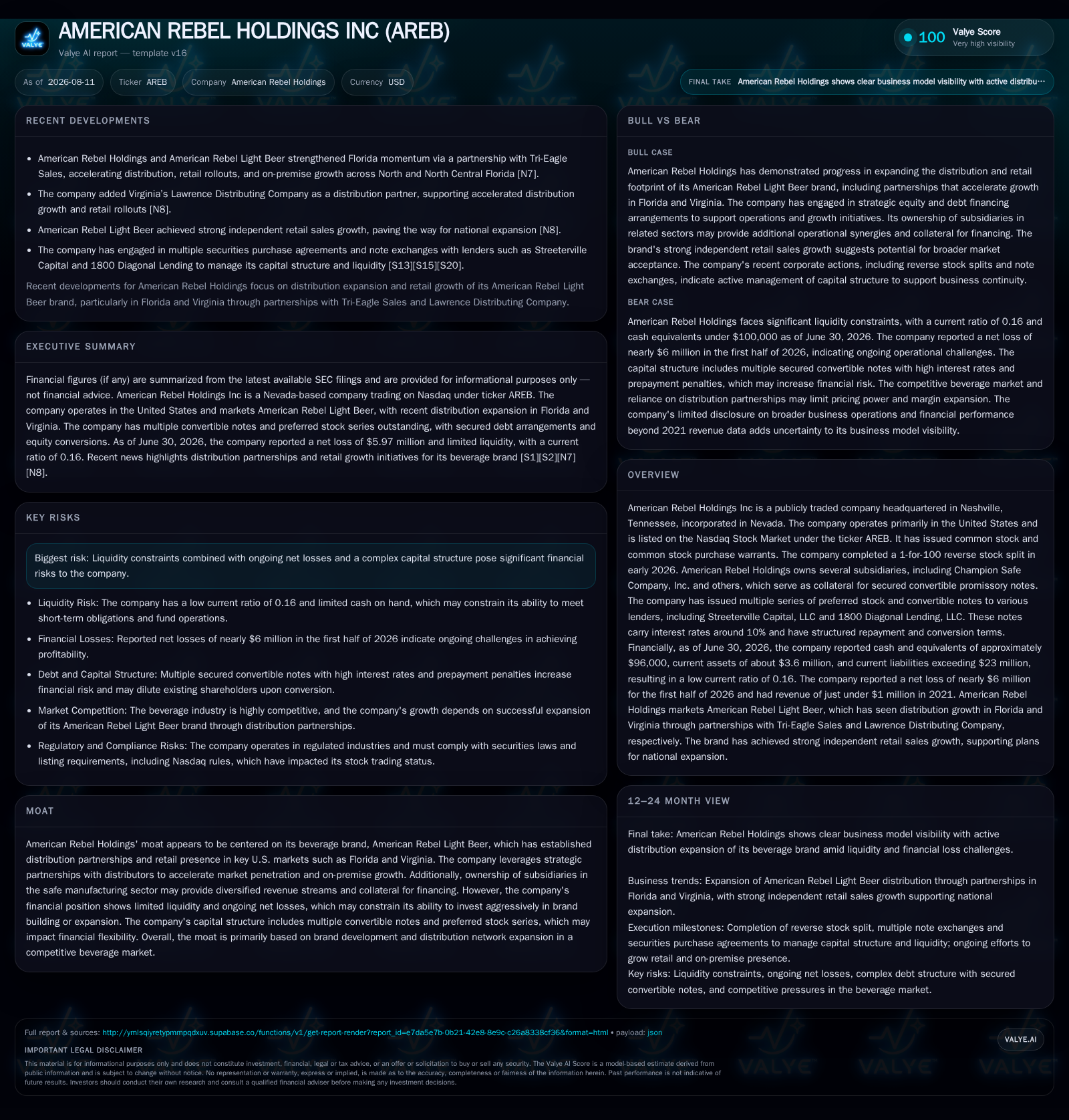
American Rebel Holdings’ latest quarterly filing dated August 10, 2026, confirms heightened liquidity challenges underpinning the company's near-term operational profile [S2]. The latest reported cash and equivalents stood at approximately $96,455 as of June 30, 2026, starkly contrasted by current liabilities exceeding $23 million, resulting in a severely depressed current ratio of 0.16 [F1]. This ratio indicates an acute mismatch between short-term obligations and liquid assets that could affect day-to-day operations and capital expenditure plans.
Alongside tight liquidity metrics, American Rebel has continued to manage its capital structure actively. Recent filings reveal multiple share issuances tied to the conversion or exchange of secured promissory notes held by institutional lenders like Streeterville Capital LLC and other parties such as 1800 Diagonal Lending LLC [S3][S7][S18]. These transactions often involve issuing common stock at discounted prices below market rates, reflecting efforts to deleverage while balancing dilution risks. The issuance pattern underscores continued dependence on convertible debt instruments rather than stable operational cash flow for funding.
Moreover, earlier in the year, the company conducted a reverse stock split at a ratio of 1-for-100 to maintain Nasdaq listing standards after facing delisting threats due to prolonged low share price performance [S1][S11]. This corrective action showcases the ongoing struggle with market perception and investor confidence alongside fundamental liquidity issues.
Business Model Analysis
American Rebel Holdings predominantly operates in the alcoholic beverage segment through its branded product American Rebel Light Beer. This product is marketed primarily within select U.S. regions including Florida and Virginia, leveraging strategic partnerships with distributors to secure retail shelf space and facilitate both off-premise (retail) and on-premise (bars, restaurants) sales channels. Such distribution partnerships are critical because direct access to consumers is limited at scale; wholesalers serve as essential intermediaries handling logistics, inventory turnover, and retailer relationships.
The company’s monetization involves wholesale revenue where distributors purchase inventory under contractual or negotiated terms. Revenue growth mechanics hinge on expanding case volumes sold via increased distribution reach—the number of retail accounts stocking the beer—and enhancing brand equity to support pricing power over competitors.
Besides alcoholic beverages, American Rebel also owns subsidiaries like Champion Safe Company that operate outside the core drink business but serve as collateral securing some convertible promissory notes. While this diversification can stabilize revenue streams somewhat, it also complicates the financial structure because noteholders hold liens on subsidiary assets, potentially restricting operational flexibility across business units.
The operation is further characterized by ongoing net losses reflected in historical annual losses approaching $34 million and negative operating income exceeding $14 million in the last fiscal year ending December 2025 [F1]. This loss profile indicates reliance on external financing over organic cash flow generation.
Industry Structure and Competitive Position
Operating within the alcoholic beverage industry places American Rebel amidst a highly competitive environment dominated by large multinational producers alongside numerous craft breweries. The market thrives on robust brand portfolios coupled with extensive geographic distribution networks. Against this backdrop, American Rebel’s scale remains modest with focused regional presence rather than nationwide penetration.
The company’s position depends significantly on building brand awareness through marketing spend efficiency and leveraging distributor relationships to widen market penetration—a standard growth playbook in this sector. However, limited disclosed data regarding volume sold or gross margins makes it difficult to benchmark performance precisely versus peers. Distribution partnerships form the backbone of commercial operations but also introduce dependency risks if partners shift focus or terms unfavorable to American Rebel’s growth ambitions.
Confirmation of these growth levers can come from public disclosures detailing increases in distribution reach (number of accounts), improvements in sales volume figures (cases/barrels sold), rising gross margins reflecting better pricing/mix, or positive shifts in operating income trends over future periods.
Risks and Watchpoints
Liquidity constraints remain the most salient risk factor affecting all aspects of American Rebel's strategy execution [F1][S2]
Further complexity arises from a layered capital structure featuring multiple series of convertible preferred stock alongside convertible notes issued at various discount rates [S1][S7]. This structure heightens dilution risk that can erode shareholder value if conversions accelerate amid persistent losses.
Dependence on third-party distributors introduces concentration risks; any loss or weakening of these partnerships could impair market access given limited direct sales capability. Regulatory considerations around alcoholic beverage production, labeling, interstate distribution laws, and local licensing add layers of compliance costs that may fluctuate regionally or change abruptly.
Additional industry-specific threats include shifting consumer preferences towards craft or premium brands potentially outpacing American Rebel’s value proposition. Raw material inflation or packaging supply chain instability could pressure margins further if not passed through effectively.
What to Watch Next
Key milestones for monitoring involve:
- Quarterly disclosures providing updated liquidity figures including cash burn rate relative to new financing events.
- Announcements regarding expansions into new geographic territories or enhanced distributor agreements signaling effective market penetration.
- Metrics on volume shipped or net revenue growth as indicators of market traction beyond anecdotal claims.
- Progress on deleveraging efforts including convertible note exchanges or preferred stock conversions impacting share count dynamics.
- Marketing campaigns or product innovation launch details revealing attempts to build brand equity sustainably.
- Regulatory filings regarding licensing status which can foreshadow potential expansion barriers or cost shocks.
Attention also should focus on management commentary during earnings calls if available and investor presentation updates such as those referenced recently [S7], which sometimes shed light on strategic messaging vs tangible results.
Financial Profile Discussion
American Rebel's financial position highlights significant imbalances typical among smaller players seeking scale in capital-intensive branded consumer sectors. As of June 30, 2026, cash stands just below $100K while current liabilities vastly exceed $23 million resulting in a distressed current ratio of roughly 0.16 indicating very limited short-term liquidity cushion [F1][S2]. Such scarcity constrains investment capacity especially for marketing spend crucial to brand building in beverages.
Recent financing activity involves continual issuing shares against note conversions often at deep discounts (~11-18 cents per share recently) underscoring capital raising challenges amid diluted equity bases [S3][S7][S18]. This mechanism enables temporary relief from interest accruals but escalates shareholder dilution risks over time without profitability turnaround.
Persistent negative operating income exceeding $14 million annually coupled with a net loss trend above $34 million means external financing remains indispensable absent transformational operational improvements [F1]
This article does not constitute investment advice but offers an analytical perspective grounded strictly in documented disclosures and sector knowledge layering per Valye News standards.
Disclaimer: This is research-only, informational analysis and not investment advice. It may include AI-generated interpretation and general industry context. Always verify important details using primary sources.

Comments