
Green Dot Corp Faces Partner Concentration and Financial Leverage Pressure Amid Merger Uncertainty
Green Dot's recent quarter highlights material risks from concentrated revenues, regulatory challenges, and significant leverage during a critical merger phase.
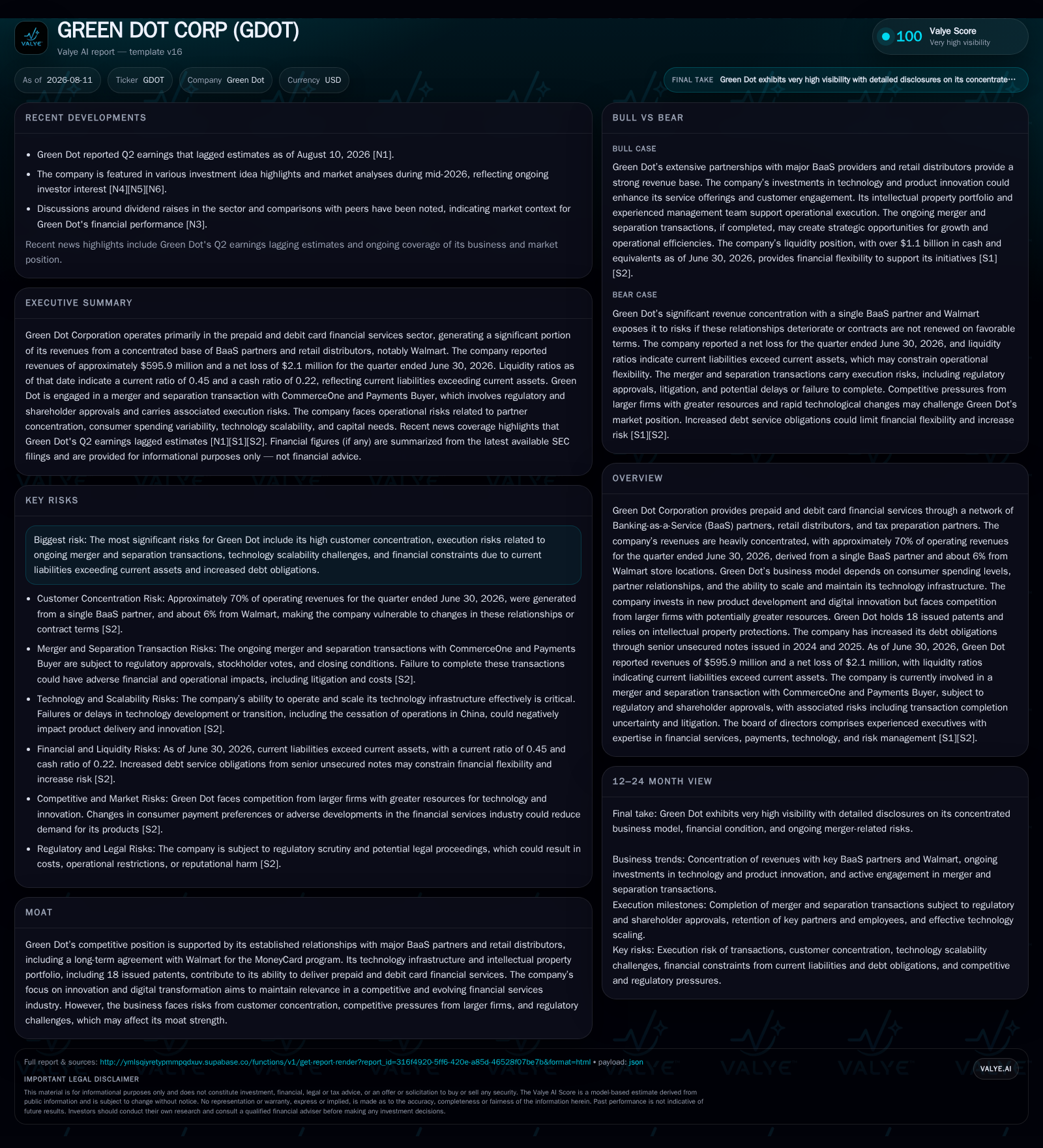
Green Dot Corporation's Q2 2026 operating results reveal enduring revenue dependence on a single Banking-as-a-Service (BaaS) partner contributing around 70% of operating revenues, underscoring revenue concentration risk. The company is navigating a complex merger transaction amid increased debt service obligations from senior notes issued in 2024 and 2025. Regulatory pressures continue to impact operational flexibility, while technology scalability and partner retention remain key challenges. Growth hinges on expanding BaaS partnerships and retail distribution, but margin expansion appears constrained by elevated financial costs and ongoing compliance expenditures.
Recent Operating Update
Green Dot Corporation reported its Q2 2026 results highlighting persistent revenue concentration risks with approximately 70% of operating revenues attributable to one primary BaaS partner during the quarter ended June 30, 2026 [S2]. Walmart stores contributed an additional approximately 6% via their MoneyCard program. This concentration underscores a vulnerability in revenue stability if the partnership dynamics shift or if the primary partner’s volume declines. The company's dependency on this dominant BaaS integration illustrates typical fintech scaling challenges where a few large partners drive outsized portions of demand.
The quarter coincided with critical merger-related transactions under a Merger Agreement and Separation Agreement announced previously. These transactions impose operational restrictions as Green Dot maintains business in "ordinary course" to satisfy closing conditions. Management disclosed significant risks that merger delays or failures could adversely affect stock price, employee morale, and customer relationships by creating uncertainty during the transition period [S2]. Execution risks tied to these corporate developments add stress during an already challenging operating environment.
Business Model Analysis
Green Dot operates primarily as a financial technology intermediary offering prepaid debit card services through its Banking-as-a-Service (BaaS) model to partners who then distribute cards under their own brand or affiliations. Revenue is generated through multiple channels: interchange fees charged on card transactions; account maintenance fees; reload fees; and partnerships with retail distributors such as Walmart for physical card sales. The integration with banking institutions—via its subsidiary Green Dot Bank—enables FDIC-insured account offerings necessary for regulatory compliance.
Revenue is heavily usage-dependent, tied directly to consumer spending activity on prepaid cards. This creates inherent cyclicality as transaction volumes fluctuate with economic conditions and consumer confidence. Pricing power is limited because interchange fee revenues are subject to regulations which have tightened in recent years. To compensate, Green Dot charges ancillary fees, but competitive pressures limit these increases [S28]. Additionally, product innovation like digital wallets adds incremental revenue streams but demands continuous investment in technology infrastructure.
The company’s strategic advantage lies partly in maintaining long-term contract partnerships—especially with large retailers like Walmart—that provide broad distribution reach. However, this also raises risks from high partner concentration ratios observed industry-wide among comparable fintech peers such as Marqeta or Payoneer. The necessity of strong partner integration capabilities amplifies complexity and technology demands.
Intellectual property offers defensive benefits; Green Dot holds 18 issued patents related to its technology platforms. This portfolio supports some differentiation in digital banking services but competes against generally deeper IP resources held by larger fintech incumbents like Square (Block) [S1], indicating a limited moat scenario.
Industry Structure and Competitive Position
The prepaid card and BaaS sector is characterized by integration between fintech technology providers, banks offering charters for accounts, and retailers facilitating distribution. Competition arises from direct fintech rivals offering similar card issuance platforms, traditional banks deploying prepaid programs digitally, payment networks dictating interchange fee structures, and increasingly from digital wallet/mobile payment app providers encroaching on consumer wallet share.
Green Dot fits into this value chain as both a platform provider via its banking-chartered entity and an issuer servicing end consumers indirectly through partners. Its reliance on dominant BaaS partners aligns with peer dynamics seen at companies like Marqeta but contrasts with firms having more diversified client portfolios or broader direct-to-consumer engagement.
Maintaining effective regulatory compliance is crucial given oversight over banking operations and payment processing. Green Dot’s prior settlement involving a $44 million civil penalty post-Consent Order illustrates heightened regulatory scrutiny relative to less-regulated pure technology players [S8]. This elevates operational risk versus rivals absent bank holding status.
Growth Drivers
Future growth opportunity stems primarily from expanding the BaaS partnership network beyond the singular major client contributing substantial current revenues. By onboarding new financial institutions or fintechs needing prepaid card solutions, Green Dot can reduce concentration risk while growing transaction volume—a key driver of its interchange fee revenues.
Simultaneously, reinforcing retail distribution agreements beyond Walmart offers incremental points-of-sale for physical cards targeting underserved segments reliant on prepaid products. Digital innovation including mobile wallets integrated into existing platforms promises cross-selling opportunities for ancillary financial products such as tax preparation services—a current channel within the company’s portfolio.
Regulatory tailwinds around financial inclusion initiatives potentially extend the addressable market by encouraging non-traditional banking customers to adopt prepaid debit solutions instead of traditional checking accounts.
Investment in scalable technology infrastructure is vital to handle increasing transaction volumes without degradation in uptime or customer experience metrics—an area management emphasizes but where proof points remain pending maturity due to ongoing digital transformation efforts [S1], [S2]. Emerging KPIs critical here include platform uptime percentages, cost per transaction improvements driven by infrastructure efficiency, and fraud rate containment.
Risks and Constraints
Foremost among risks is the extreme revenue concentration due to dependency on one major BaaS partner generating nearly three-quarters of total operating revenue. A deterioration in this relationship or volume could materially depress top-line performance unless mitigated rapidly through diversification [[S2]].
Financial leverage has increased substantially following a $65 million issuance of senior unsecured notes maturing in September 2029. Debt service obligations limit free cash flow flexibility while ongoing compliance expenses tied to regulatory settlements constrain profitability expansion potential [[S5]], [[S10]]. The current ratio at only 0.45 indicates working capital deficits—a clear liquidity constraint while executing complex merger transactions [[F1]].
The protracted merger process itself introduces uncertainty affecting employee retention—especially among key management personnel—and may reduce attractiveness for future hires given compensation volatility tied to stock price swings [[S2]], [[S21]]. Customer contracts might be re-evaluated amid transition risk as well.
Further regulatory changes affecting interchange fee structures or expanded oversight could pressure margins extensively given Green Dot’s reliance on these fees for core earning power [[S28]]. Fraud risks inherent in prepaid models require persistent monitoring; failure can lead to elevated charge-offs harming bottom-line results.
Technological scalability challenges must be addressed continuously; any disruption would negatively affect consumer trust in card usability—a critical competitive factor amid growing challenger fintech ecosystems threatening market share gains.
What To Watch Next
Key milestones include timely completion of the pending merger transactions without costly delays or terminations that could trigger fees or litigation penalties [[S2]]. Monitoring announcements regarding new BaaS partnerships or retail distribution expansions will provide indicators of strategic progress toward diversification goals.
Tracking quarterly trends in active account counts, total transaction volumes, interchange fee levels, and ARPU metrics will reveal momentum behind core operating drivers []. Technology investment outcomes should manifest as margin improvements via lower cost per transaction or reduced downtime incidents.
Financially, watch debt servicing ratios alongside liquidity developments given current working capital imbalances; any refinancing or capital raise announcements would signal management’s approach to ameliorating leverage constraints [[F1]], [[S10]]. Regulatory newsflow regarding consent order modifications or new enforcement actions must be monitored closely for potential business impacts.
Financial Profile Discussion
As of June 30, 2026, Green Dot holds $1.14 billion in cash and equivalents against current liabilities exceeding $5.18 billion leading to a weak current ratio at approximately 0.45 [[F1]]. This imbalance signals short-term liquidity pressure likely related to timing mismatches between receivables and payables plus significant accrued obligations associated with debt service.
Senior unsecured notes totaling $65 million issued over 2024-25 carry interest payments reducing available distributions that might otherwise support growth investments [[S5]], [[S10]]. Regulatory dividend restrictions on Green Dot Bank further constrain cash remittances upstream impacting corporate liquidity management options.
Net income for recent reported periods remains negative reflecting elevated expense base inclusive of interest costs, compliance-related charges from prior regulatory penalties ($44 million civil money penalty), technology investments, and operational integration costs related to ongoing mergers [[F1]], [[S8]]. Operating income thinly positive suggests narrow margin buffers requiring careful cost control amidst volatile revenue profiles.
In sum, while cash reserves appear ample nominally, liabilities far exceed short-term assets underscoring vulnerability that intensifies execution risk for strategic initiatives including mergers or new partnership rollouts.
This analysis synthesizes Green Dot Corporation's most recent publicly filed information without extrapolating unreleased guidance or speculative forecasting. All financial figures are sourced directly from SEC filings dated through August 10, 2026 ([F1], [S1], [S2], [S3], et al.). Industry context is applied based on typical dynamics observed among Banking-as-a-Service fintech providers supporting prepaid debit products.
Disclaimer: This is research-only, informational analysis and not investment advice. It may include AI-generated interpretation and general industry context. Always verify important details using primary sources.

Comments