
HireQuest Expands Multi-Brand Franchise Network, Navigates Cyclical Staffing Demand with Acquisition Strategy
HireQuest’s latest quarter highlights strength in franchise royalties and adjusted EBITDA amid economic sensitivity in the staffing sector.
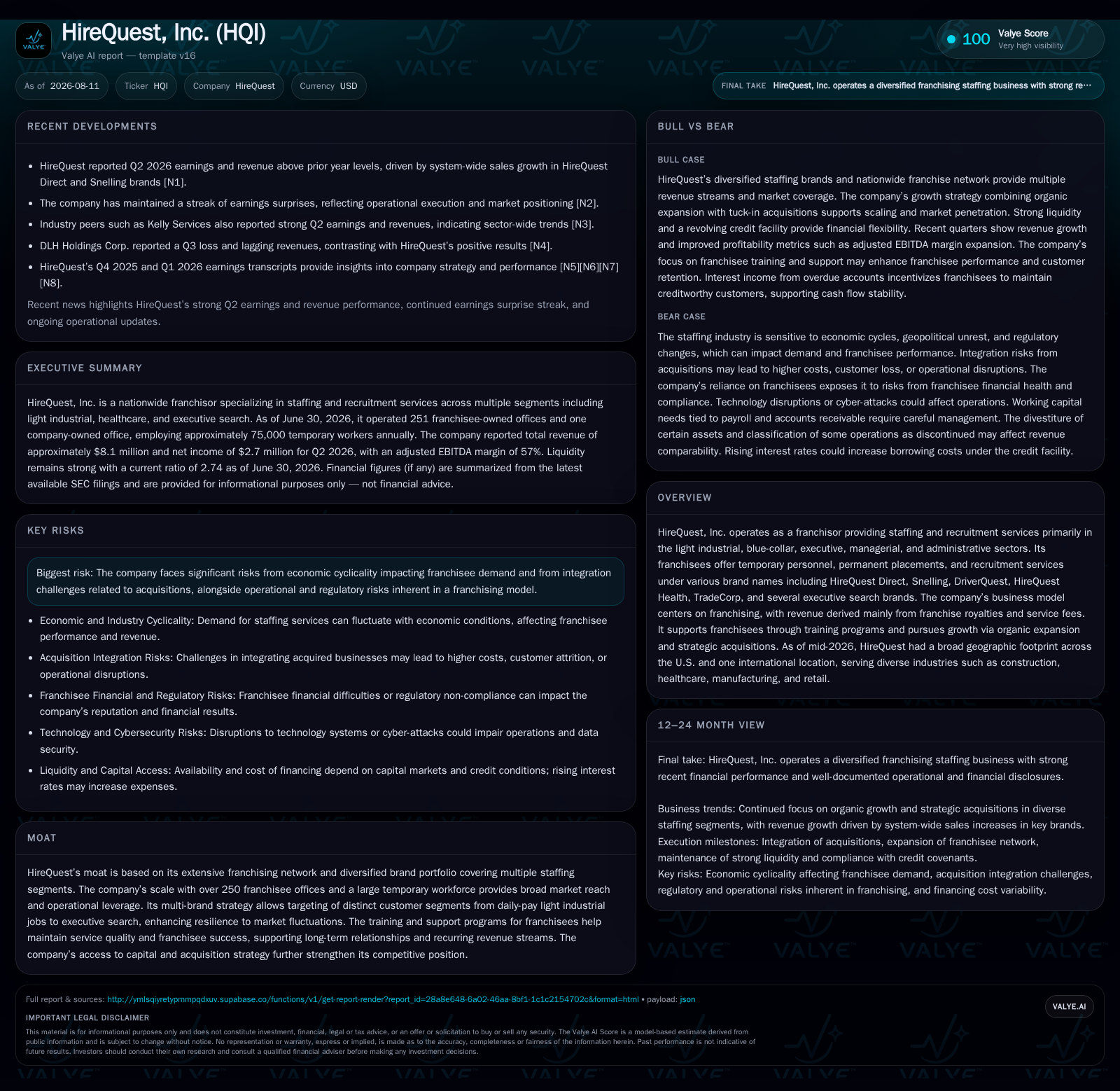
HireQuest, Inc. reported solid operating results for Q2 2026, driven by growth in system-wide sales from its franchised staffing network. The company leverages a diverse multi-brand strategy across light industrial, executive search, and healthcare staffing segments to mitigate industry cyclicality. Continued investment in franchisee training and targeted acquisitions supports its dual growth model. Working capital remains manageable despite payroll funding requirements tied to cash collection cycles. Risks persist from economic volatility and integration demands but robust adjusted EBITDA margins and healthy liquidity position HireQuest well for ongoing expansion.
Recent Operating Update: Q2 2026 Earnings Highlight
HireQuest, Inc.’s fiscal Q2 ended June 30, 2026 demonstrated robust financial performance marked by net income from continuing operations of $2.75 million, more than doubling the prior-year period's $1.07 million figure. Adjusted EBITDA surged to $4.61 million representing a margin of 57% compared to 42.6% in Q2 2025 [S24]. This substantial margin expansion suggests improved operating leverage as system-wide sales grow through both existing franchise operations and recent acquisitions.
Revenue drivers remain closely linked to franchise royalties generated from the network’s billings for temporary staffing placements across the light industrial, executive search, healthcare, and administrative segments—a testament to HireQuest's diversified brand portfolio and broad market footprint [S2][S10]. The multi-brand strategy supports resilience against economic fluctuations inherent in the cyclical staffing industry.
Business Model Overview: Multi-Brand Franchising Focused on Staffing Services
HireQuest operates primarily as a franchisor rather than a direct staffing firm, deriving most revenue from royalties assessed on franchisees’ aggregate sales (“system-wide sales”). Its portfolio spans several brand names such as HireQuest Direct (light industrial), Snelling (specialized staffing), DriverQuest (commercial drivers), HireQuest Health (healthcare personnel), TradeCorp (skilled trades), alongside executive search brands offering permanent placement services [S1]. This segmentation enables targeting distinct customer groups with tailored service offerings under proven local operators.
Revenue mechanics hinge on franchise royalties—a percentage of local revenues billed by franchisees—and fees linked to franchise support services including training programs aimed at operational excellence and scale efficiency [S10][S29]. Franchisees hold responsibility for hiring and managing the workforce servicing thousands of client companies in industries like construction, manufacturing, healthcare, retail, logistics, and dental sectors
The franchisor model provides HireQuest with relatively stable recurring revenue streams less directly sensitive to labor market wage inflation or overhead costs compared with direct staffing agencies that operate on billable labor hours. Growth in system-wide sales translates into incremental royalty revenue without commensurate increases in corporate SG&A expenses beyond support functions.
Industry Structure and Competitive Position
The staffing and recruitment services industry is highly cyclical but fragmented between direct placement agencies (e.g., Kelly Services, Robert Half) and franchised business models like HireQuest’s. Franchisors leverage scale advantages inherent in managing networks of empowered local operators who better understand regional labor markets.
HireQuest’s competitive moat stems from its diversified brand portfolio covering temporary staffing niches from daily-pay industrial jobs to high-margin executive searches [S10][S29]. Over 250 franchised offices spread across 39 states plus international presence give it geographic breadth uncommon among mid-sized competitors while enabling targeted responses to localized labor demand variations
Its expansive training curriculum strengthens franchisee capability in client acquisition/retention metrics critical to maintaining fill rates and reducing time-to-fill vacant positions—key KPIs in the industry reflecting service quality and operational efficiency. This emphasis on franchisee success helps foster stability amid variable macroeconomic conditions.
Peer firms like TrueBlue specialize primarily in industrial segments whereas ManpowerGroup and Randstad offer broader global workforce solutions including HR consulting; HireQuest occupies a hybrid niche focused predominantly on U.S.-based franchised staffing with selective acquisitions enhancing segment-specific capabilities.
Growth Drivers: Organic Expansion Paired with Strategic Acquisitions
HireQuest’s management explicitly pursues a dual growth path combining organic client base expansion—via deeper penetration within existing franchises and exploration of national/global accounts—with accretive acquisitions designed as tuck-in deals enhancing brand reach or entry into new geographic or sector markets [S10].
System-wide sales growth fuels royalty revenue leverage; enhancing franchise networks through targeted marketing and improved operational tools also helps improve average fill rates per location while shortening time-to-fill vacancies—a critical parameter influencing client satisfaction and repeat business.
Strategic acquisitions diversify HireQuest's service verticals while increasing scale economies; these deals are financed primarily through available credit lines supplemented by occasional seller financing or equity issuance when warranted.
With an estimated annual deployment of approximately 75,000 temporary workers spanning many industries ranging from healthcare professionals to warehouse operatives [S10], growing demand for flexible workforce solutions amidst shifting employer preferences toward outsourcing HR functions further bolsters medium-term opportunity.
Risks and Growth Constraints
Despite promising financials, HireQuest remains exposed to several material risks typical for a franchised staffing company:
- Economic Cyclicality: Demand for blue-collar temporary labor contracts during downturns directly impacts franchisee sales volumes hence royalty generation.
- Acquisition Integration Challenges: The company faces execution risk integrating acquired businesses into its multi-brand network efficiently without eroding margins or client relationships [S1][S15].
- Labor Market Tightness & Wage Inflation: Persistent labor shortages could pressure franchisees’ ability to fill orders rapidly or increase cost structures reducing profitability.
- Regulatory Environment: Changes in employment laws or franchise regulations may impose additional compliance costs or operational restrictions.
- Dependence on Franchisee Performance: Success hinges on local operators maintaining client retention rates and achieving optimal fill rates; variability adversely affects consolidated financial outcomes.
- Financing Cost Volatility: Rising interest rates could elevate borrowing costs impacting acquisition finance economics.
What to Watch Next
Key upcoming indicators include quarterly system-wide sales trends reflecting end-market demand fluctuations across staffed sectors. Monitoring adjusted EBITDA margins will reveal operating leverage sustainability amidst revenue changes. Management commentary around pipeline progress for new franchises and closing acquisition deals will illuminate the pace of network growth initiatives. Additionally, insights into client retention improvements or challenges provide early signals about service quality trajectory. Liquidity metrics are also important; continued strong working capital management ensuring cash coverage over payroll funding requirements will underpin dividend capacity stability and acquisition spending flexibility.
Financial Profile Discussion
As of June 30, 2026, HireQuest reported a current ratio of approximately 2.74 supported by current assets near $55.3 million against liabilities of $20.2 million fostering sufficient short-term liquidity for operational needs including payroll settlements tied closely to temporary worker hours billed but paid subsequently via accounts receivable collections [F1][S9]. Cash balances stood around $7.5 million complemented by sizeable accounts receivable reflecting franchised billing activities.
Long-term liquidity benefits from a $50 million senior revolving credit facility maturing in early 2028 with roughly $41 million available borrowing capacity after reserves; the variable interest rate resets daily around SOFR plus a margin averaging 1%–1.75% [S5][S13]. This flexible facility underpins working capital funding as well as strategic acquisition financing plans.
Adjusted EBITDA conversion remains strong at nearly half of total revenues reflecting operating efficiencies related largely to the franchising model’s scalable expense base measured relative to growing system-wide sales volumes [S24]. Management’s effective control of SG&A costs despite expanding footprints adds defensibility against margin erosions common among direct staffers exposed more acutely to wage inflation pressures.
Disclaimer: This analysis is intended solely for informational purposes based on publicly available filings and does not constitute investment advice or research views.
Disclaimer: This is research-only, informational analysis and not investment advice. It may include AI-generated interpretation and general industry context. Always verify important details using primary sources.

Comments