
Viant Technology Advances AI-Autonomous DSP with Proprietary Identity Amid AdTech Shifts
Viant’s latest quarter underscores the strategic importance of its AI-driven platform and Household ID as programmatic advertising evolves toward cookieless, omnichannel targeting.
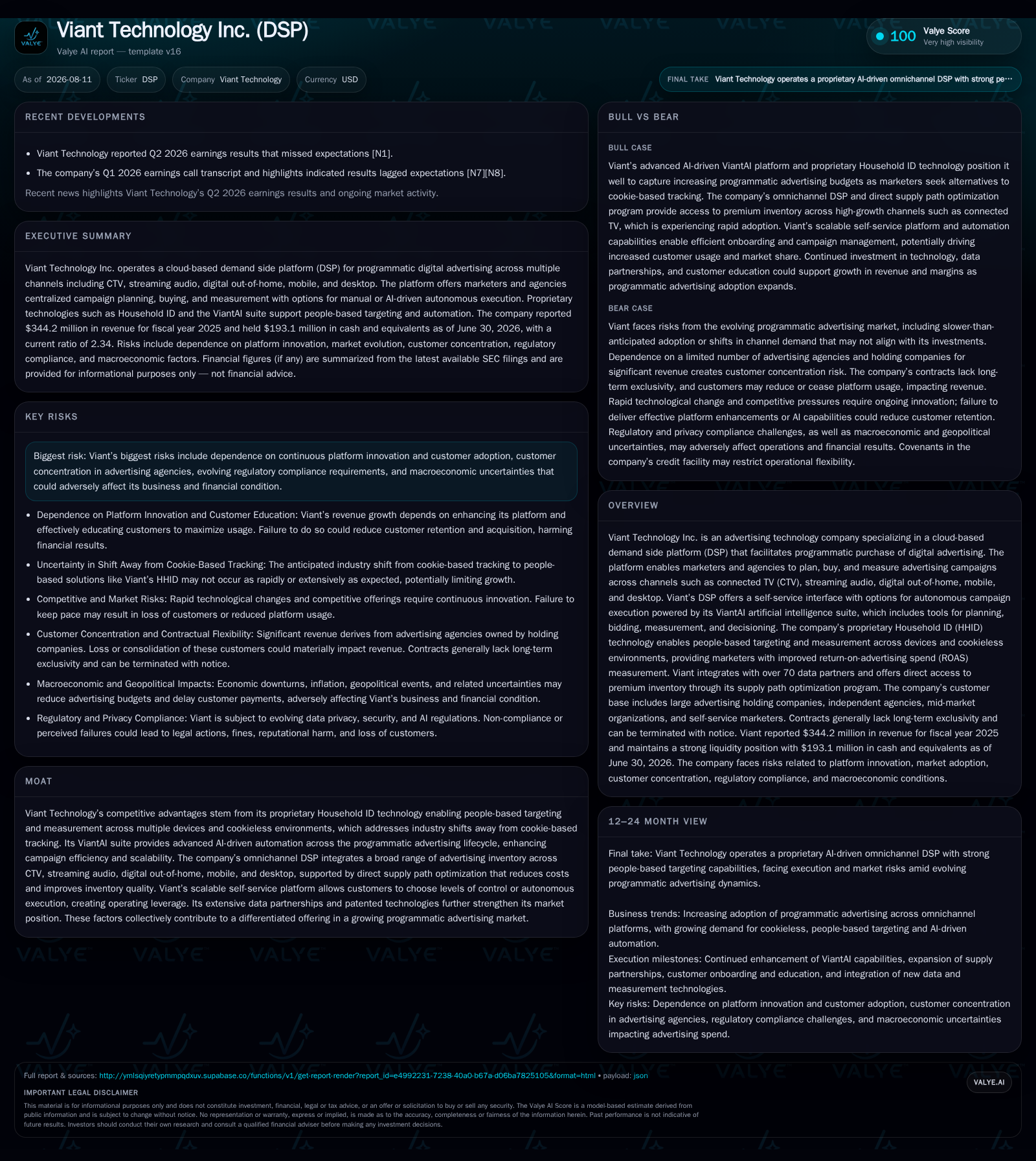
In its Q2 2026 report, Viant Technology reported continuing investment in AI-powered autonomous campaign execution and proprietary identity resolution technology that underpins its cloud-based demand side platform (DSP). The company’s Household ID (HHID) enables cross-device, cookieless targeting crucial amid industry privacy shifts. While facing intensifying competition from large tech-backed DSPs and macroeconomic pressures impacting ad spend, Viant leverages scalable, self-service automation and a broad inventory base spanning CTV, streaming audio, DOOH, mobile, and desktop. Further growth depends on expanding advertiser adoption of its ViantAI capabilities, maintaining data partnerships, and navigating regulatory complexities.
Recent Operating Update: Q2 2026 Performance Highlights
Notably, Viant reaffirmed efforts to leverage its patented Household ID (HHID) technology which enables cookieless people-based targeting across devices—a critical differentiator as the industry faces an accelerated departure from third-party cookies. Integration with over 70 data partners supports verticalized audience targeting across automotive, retail, healthcare and entertainment sectors [S1]. The company also expanded inventory supply through its Direct Access program to bring buyers closer to premium ad inventory sources across channels including connected TV (CTV), streaming audio, digital out-of-home (DOOH), mobile, and desktop.
Augmenting this update was an 8-K filing announcing board changes effective August 10 [S3], potentially signaling corporate governance adjustments aligned with scaling operations.
Business Model Specifics: Autonomous Omnichannel Programmatic Advertising
Viant operates as a cloud-based DSP that facilitates programmatic purchase of digital ads by marketers and agencies. Unlike traditional direct ad buying channels reliant on manual negotiation and limited transparency, Viant’s platform automates the entire media buying lifecycle—from planning through bidding to post-campaign analytics—with self-service control or fully autonomous execution powered by AI.
Revenue primarily flows through either transaction-based fees (a percentage of the advertising spend transacted) or fixed CPM fees depending on customer contract structure. This aligns incentives with increasing advertising volume passing through the platform. Critical levers driving revenue include:
- Advertising spend volume transacted
- Number of active advertiser accounts—large agencies and mid-sized marketers using self-service models
- Adoption rate of autonomous features reducing manual labor
- Supply path optimization enhancing access to high-quality premium inventory at lower cost
The ViantAI suite improves operational efficiency by automating thousands of campaign changes using machine learning algorithms—distinct from legacy DSPs requiring hands-on manual adjustments. This creates operating leverage by increasing campaign scale without proportionate increases in personnel costs [S1].
Proprietary HHID technology establishes a persistent identity graph linking 125 million households to ~1 billion devices enabling accurate cross-device attribution and targeting in a cookieless environment—a crucial advantage under evolving privacy regulations [S1]
Customers span from major global advertising agencies that control significant media budgets to independent firms and direct brand marketers employing self-service models. Offering flexible customer engagement choices preserves Viant’s appeal across market segments requiring different levels of control versus automation.
Industry Structure & Competitive Positioning
The AdTech landscape is dominated by several powerful competitors including The Trade Desk—a public standalone DSP with strong omnichannel reach—and large tech conglomerate divisions like Google DV360 and Amazon Advertising that benefit from deep e-commerce or platform integration [S4],[S15]. These players often have extensive financial resources allowing aggressive pricing strategies or bundling that smaller independents like Viant find challenging.
Despite these pressures, Viant stakes competitive differentiation on several fronts:
- Advanced AI-driven autonomous campaign execution reducing manual complexity and scaling more efficiently than legacy DSPs dependent on manual controls [S24],[S15]
- Proprietary identity resolution through its HHID that circumvents third-party cookie loss better than many peers reliant on less robust identity frameworks [S4]
- Broad omnichannel inventory exposure including emerging channels like DOOH combined with direct supply access validating premium inventory quality [S19]
- Extensive integrations with over 70 data partners providing precise audience segmentation capability across key verticals enhancing advertiser ROAS measurement [S1]
- Scalable self-service platform architecture that allows flexible customer control encouraging wider adoption among digital marketing teams [S24]
Nonetheless, barriers remain given the concentrated agency clientele—loss or reduction of spend among large agency holding companies could materially impact revenue—as well as long sales cycles typical in enterprise software platforms slowing predictable revenue ramp [S2]
Growth Drivers for Viant Technology
Several secular trends support growth potential for Viant’s offering:
- Continued migration of advertising budgets towards programmatic digital channels driven by efficiency gains versus traditional media buying methods.
- Rapidly rising connected TV (CTV) and streaming audio ad consumption creating demand for scalable omnichannel DSP solutions able to reach audiences seamlessly.
- Regulatory changes accelerating moves away from cookie-based tracking towards people-based identity solutions directly addressed by Viant’s HHID technology.
- Increasing adoption of AI-enabled automation for media planning and execution helping advertisers maximize return-on-ad-spend (ROAS) with fewer manual interventions.
- Expansion of premium inventory supply through direct access deals improving campaign outcomes while delivering cost savings versus open auction paths.
- Growing demand for transparent performance measurement tools bolstering customer reliance on platforms offering robust multi-touch attribution analytics.
- Investment in sales/marketing teams to boost awareness among agencies & brands allied with acquisitions designed to broaden product suite.
Execution against these drivers correlates closely with KPIs such as rise in transaction volumes processed through the DSP, uptick in advertisers using full autonomous features within ViantAI suite, improved campaign win rates in RTB auctions facilitated by supply path optimization programs, and customer retention levels reflecting satisfaction with outcomes.
Risks & Constraints Facing Viant Technology
Challenges remain material:
- Platform innovation pace must be maintained; failure risks losing customers to better-funded competitors or emerging technologies [S2],[S26].
- Customer concentration risk: significant revenue reliance on a handful of large ad agencies amplifies exposure if those clients reduce ad spend or switch platforms [S19].
- Evolving data privacy regulations raise compliance burdens; inability to adapt rapidly can trigger investigations or restrict data usage integral to targeting efficacy [S20],[S26].
- Macroeconomic uncertainty including inflationary pressures or geopolitical tensions may depress overall marketing budgets adversely impacting revenue growth visibility.[S2]
- Competitors with vertical integration or massive scale can undercut pricing or bundle offerings making it difficult for independent DSPs like Viant to compete solely on features.[S15]
- Platform adoption risk exists regarding the newer AI-driven autonomous features; customers must effectively use them for the promised operating leverage gains to materialize.[S1]
- Long sales cycles typical in enterprise software add unpredictability between prospecting and revenue recognition delays business growth.
- Legal risks related to intellectual property disputes inherited via acquisitions (e.g., ongoing patent litigation related to TVision acquisition) could divert resources.[S25]
What To Watch Next
Key future milestones include:
- Monitoring quarterly subscriber metrics for increased autonomous feature adoption rates indicating growing confidence in AI-driven campaign management tools.
- Expansion of supply path optimization programs confirming enhanced fill rates and inventory quality contributing to improved campaign win rates.
- Progress in broadening data partner ecosystem beyond current counts around 70 reflecting efforts to deepen vertical coverage crucial for differentiated audience targeting.
- Customer concentration metrics showing diversification beyond top agencies reduces single-client dependencies.
- Regulatory developments impacting digital privacy laws influencing operating practices; compliance costs or constraints will be pivotal watchpoints.[S2][S20]
- Financial results including revenue progression vis-à-vis sell-side expectations after recent Q2 miss; cash flow generation focused due to ongoing reinvestments into sales & R&D.[N1][F1]
Financial Profile Discussion
As of June 30, 2026, Viant held $193 million in cash and equivalents against no recorded debt as per latest available data [F1]. This strong liquidity position provides buffer for ongoing investments into platform development along with sales/marketing expansions. Current assets stand at $350 million compared with current liabilities of $150 million yielding a stable current ratio of approximately 2.34—a signal of healthy short-term financial flexibility [F1]. This balance-sheet strength supports continued strategic spending while mitigating refinancing risks amid uncertain macro conditions.
The company remains subject to covenants under an asset-based revolving credit facility limiting indebtedness levels but there is no current draw noted indicating conservative balance sheet management likely intended to preserve flexibility [S9].
Conclusion
Viant Technology occupies a niche within a fast-evolving advertising technology landscape emphasizing AI-enabled automation combined with robust cross-device identity resolution via its proprietary Household ID. The strategy addresses pressing industry shifts away from cookie-reliance toward transparent omnichannel programmatic buying. While competitive pressures from large integrated platforms persist alongside regulatory complexities affecting data usage norms, Viant’s emphasis on scalable self-service capability allied with patented technology offers durable differentiation.
Recent operating disclosures reveal focused investments in expanding client onboarding effectiveness plus reinforcing premium supply relationships—initiatives central for amplifying advertising spend transacted through the platform. Success will depend on accelerating market adoption of autonomous mode campaigns enabled by ViantAI plus sustaining growth amidst macroeconomic headwinds impacting overall advertising demand. The strong liquidity position further equips the company to pursue strategic acquisitions or product enhancements essential for staying abreast within an intensely competitive ecosystem.
This analysis synthesizes information publicly filed by Viant Technology Inc., industry context surrounding programmatic advertising platforms, and sector dynamics shaping investment-grade understanding without providing investment advice.
Disclaimer: This is research-only, informational analysis and not investment advice. It may include AI-generated interpretation and general industry context. Always verify important details using primary sources.

Comments