
Community West Bancshares Preserves $206 Million Cash Cushion Amid Variable Loan Earnings
By mid-2026, Community West Bancshares sustains strong liquidity and diversified loans despite earnings variability and ongoing credit and interest rate risks.
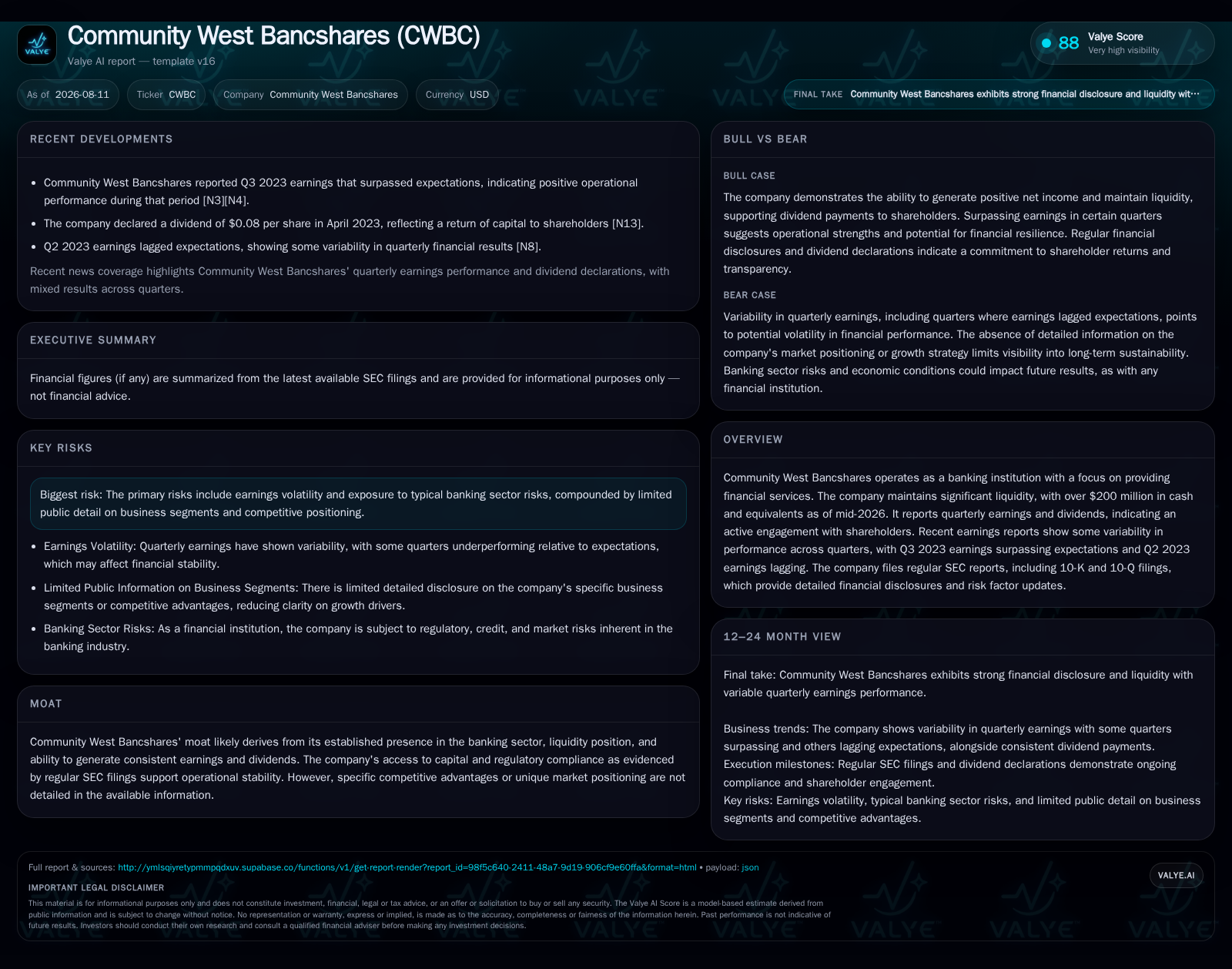
Community West Bancshares maintains a strong cash position of over $200 million as of mid-2026, underpinning operational flexibility in a variable earnings environment. Its diversified loan book spans commercial, real estate, agricultural, and consumer segments, reflecting typical regional banking breadth but exposing the firm to cyclical credit and interest rate risks. Recent quarterly results confirm some earnings volatility, though dividend activity showcases ongoing shareholder engagement. The company faces standard regional bank challenges including credit risk, margin pressure from interest rate shifts, and competitive dynamics within California's regional banking sector.
Recent Operating Update: Strong Liquidity during Earnings Variability
Business Model: Diversified Lending Fuels Net Interest Income
Community West Bancshares functions as a traditional regional bank focused on intermediation between depositors and borrowers within California’s local markets. At December 31, 2025, the bank’s loan portfolio totaled approximately $2.54 billion net of deferred fees [S1]. This portfolio is diversified with real estate loans dominating at roughly $1.93 billion—typically including residential mortgage lending backed by collateral that tends to be less volatile over cycles than unsecured loans. Commercial loans account for about $157 million including business lines of credit and investment financing; consumer loans stand at $415 million largely driven by automotive or personal installment lending; while agricultural loans make up around $34 million reflecting regional land or production financing needs [S1]. This spread helps moderate concentration risk but still links earnings closely to real estate market cycles.
Revenue generation pivots chiefly on net interest income derived from the spread between lending yields and deposit or other funding costs. Fee income from deposit accounts and ancillary financial services complements core lending revenue but generally comprises a smaller fraction—typical for a regional bank with a community focus. Loan-to-deposit management remains critical: optimizing this ratio supports margin expansion but excess deployment risks credit quality deterioration. The banking model thus demands disciplined underwriting coupled with proactive interest rate risk management.
Industry Structure and Competitive Position
Within California’s competitive regional banking landscape, Community West Bancshares sits among mid-sized peers serving localized commercial clients and retail consumers. Peers include other community banks with similar branch footprints but also larger regional banks that benefit from scale advantages in technology investment and capital access. Credit unions compete aggressively for deposit share through lower fees or better rates. Fintech platforms increasingly challenge traditional lenders by targeting specialized credit niches or enhancing digital engagement.
Compared to these peers, Community West’s sizable cash reserves suggest prudent liquidity management which can be advantageous during tightening monetary conditions. However, without disclosed scale metrics like branch count or customer segments breakdowns beyond loan classification detail [S1], it is difficult to precisely benchmark market share or operational efficiency ratios relative to larger regional players. The reliance on real estate loans highlights exposure embedded in cyclical housing markets characteristic of California’s economy.
Growth Drivers
Several factors underpin potential growth for Community West Bancshares. First, steady economic conditions in their key markets support loan demand especially within commercial real estate and consumer segments. Expansion of their deposit base through targeted customer acquisition drives funding capacity enabling incremental lending growth.
Second, recent Federal Reserve policies favoring higher interest rates can enhance net interest margins if managed carefully—deposit repricing often lags loan yield adjustments allowing margin expansion temporarily across quarters. Third, incremental fee income opportunities exist through wealth management services or treasury products which usually present higher margins than traditional lending.
Additionally, participation in industry forums like the July 2026 KBW Summer Bank Conference signals management’s intent to actively engage investors potentially reflecting strategic initiatives including digital adoption or branch network optimization [S3]. Such initiatives can improve customer retention and cross-selling effectiveness critical for revenue diversification.
Risks and Watchpoints
Community West Bancshares confronts typical challenges facing regional banks with notable exposure to:
- Credit Risk: Despite diversification efforts, non-performing assets particularly in the sizable real estate loan segment can impair earnings during economic slowdowns or housing downturns.
- Interest Rate Risk: Fluctuating rates impact net interest income volatility; rapid hikes may reduce loan demand or induce payment stresses impacting loss provisions.
- Regulatory Compliance: As a publicly traded institution under banking supervision, ongoing adherence to capital adequacy requirements (e.g., tier 1 ratios) restricts leverage expansion.
- Competitive Dynamics: Pressure from larger banks and agile fintech lenders may compress margins or erode deposit bases.
Monitoring trends in provision for loan losses alongside any shifts in non-performing loan ratios will provide early warning on asset quality trends post current quarter [S2]. Investor attention should also focus on efficiency ratios tracking cost control effectiveness relative to peers given limited scale advantages inherent in community banking models.
What to Watch Next
Upcoming quarters will reveal how effectively Community West controls earnings volatility amidst macroeconomic uncertainties. Indicators include:
- Quarterly updates on net interest margin changes reflecting sensitivity to rate shifts.
- Loan growth rates versus deposit inflows signaling balance sheet deployment.
- Provision for credit losses movements illuminating emerging asset quality issues.
- Dividend declarations confirming capacity for shareholder returns amid profit fluctuations.
- Management commentary following investor events such as KBW conferences outlining strategic priorities or digital transformation progress [S3]
Validation of sustained liquidity buffers with stable or improving credit metrics would boost confidence in resilience against sector cyclicality.
Financial Profile Discussion
As of June 30, 2026, Community West Bancshares held cash and equivalents totaling approximately $206.8 million—indicating conservative liquidity buffers that elevate operational resilience against funding shocks common among regional banks [F1]. Total debt outstanding was about $69.5 million reported at December 31, 2025 [F1], yielding an implied strongly negative net debt position given cash holdings exceed debt significantly by roughly $137 million; this suggests minimal leverage pressure.
In sum, Community West Bancshares maintains solid financial footing characterized by strong liquidity cushions allowing measured expansion within core commercial and consumer finance sectors while navigating inherent regional banking risks tied to economic cycles and competitive pressures.
Disclaimer: This is research-only, informational analysis and not investment advice. It may include AI-generated interpretation and general industry context. Always verify important details using primary sources.

Comments