
AST SpaceMobile Advances Satellite Broadband with Expanding BlueBird Constellation
Q2 filings reveal accelerated satellite launches and deepening MNO partnerships as AST SpaceMobile pushes its direct-to-smartphone broadband network toward commercial scale.
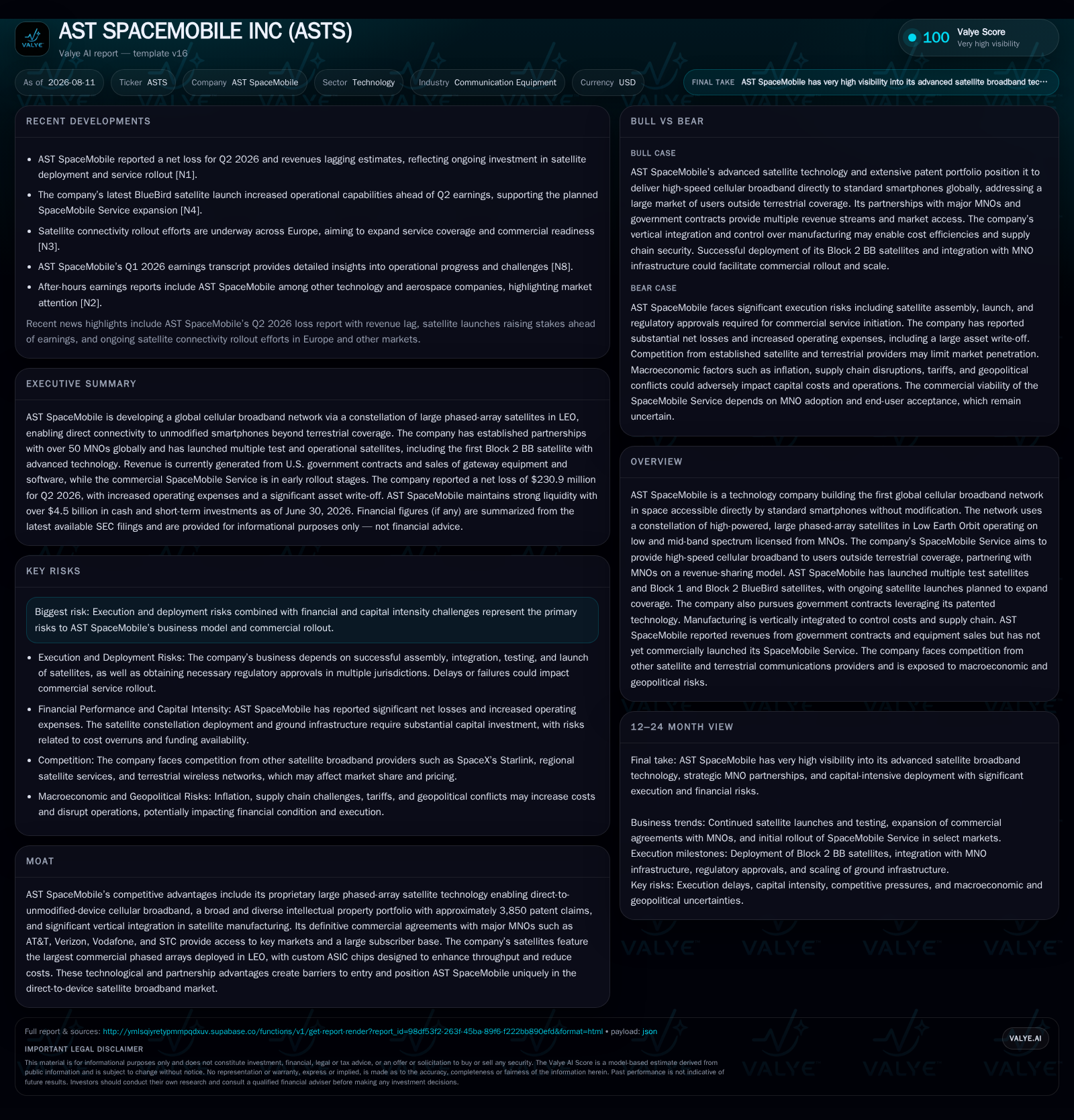
AST SpaceMobile’s August 2026 quarterly disclosure confirms notable constellation growth with new BlueBird satellites launched, expanding network coverage critical for its unique cellular broadband service accessible on unmodified standard smartphones. The company’s vertically integrated satellite manufacturing and extensive spectrum acquisitions underpin its differentiated approach within satellite communications, while commercial agreements with over 50 MNOs provide a broad market footprint. However, persistent capital intensity and execution risks remain significant in the path to sustained revenue traction. Strong liquidity cushions AST’s ongoing deployment phase.
Latest Quarter Satellite Deployment Boosts Coverage Expansion
AST SpaceMobile reported continued ramp-up in its BlueBird constellation during Q2 2026, marked by multiple successful satellite launches as detailed in the August 10, 2026 filing [S2]. These incremental additions increase the density of the Low Earth Orbit (LEO) constellation essential for delivering continuous direct cellular broadband coverage directly to unmodified smartphones. The increasing number of operational satellites aligns with industry KPIs emphasizing constellation scale as a gating factor for meaningful global coverage and customer experience continuity. Given the company’s target of approximately 45 satellites in orbit by the end of 2026 [S1], this quarter’s launch cadence demonstrates steady progress toward that milestone.
Compared to peer LEO operators like Iridium Communications or OneWeb focusing on voice/data terminals or consumer gateways respectively, AST's deployment emphasizes ultra-large phased-array antennas enabling unprecedented direct-to-device connectivity without user-side hardware modifications. This technical differentiation serves as a core competitive edge but also imposes rigorous design and manufacturing challenges addressed through vertical integration.
Direct-to-Device Cellular Broadband Drives Unique MNO Partnership Opportunities
AST SpaceMobile’s business model centers on providing cellular broadband connectivity directly to everyday mobile devices — across existing 2G/4G/5G standards — without requiring specialized terminals or additional equipment [S1]. This approach removes traditional customer adoption friction and empowers mobile network operators (MNOs) to extend their footprint into underserved or remote regions cost-effectively.
The company has secured definitive commercial agreements with over 50 MNOs representing close to 3 billion combined subscribers globally [S1]. These partnerships enable a revenue-sharing paradigm whereby AST monetizes data delivered via its spaceborne broadband infrastructure while allowing operators to enhance their offerings without incremental physical tower buildout or terrestrial infrastructure investment.
This cooperative strategy distinguishes AST from classic satellite broadband services that rely heavily on direct consumer hardware sales or subscriptions, a model historically challenged by slower uptake and higher customer acquisition costs. The collaboration-driven revenue mechanics suggest a sustainable avenue for scaling revenues contingent upon continuous constellation expansion and operator integration.
Vertical Integration Supports Supply Chain Control in Capital-Intensive Deployment
Given the high complexity and capital intensity inherent in building a cutting-edge LEO constellation with large phased-array payloads, AST SpaceMobile emphasizes vertical integration across satellite design, engineering, and manufacturing processes [S1],[S2]. Engineering centers span the United States, India, Scotland, Spain, and Israel — geographic diversity intended both to tap specialized talent pools and mitigate geopolitical or supply chain risks [S1],[S2].
Vertical control allows the company not only to pursue continuous payload optimization targeting unit cost reductions per satellite over time but also to buffer against inflationary pressures currently affecting global aerospace component costs [S2],[N10]. Maintaining this control is critical given estimated average capital costs of $21–$23 million per Block 2 BlueBird satellite [S1], where launch cadence reliability and manufacturing throughput form key operational levers impacting deployment timelines.
Peer equipment suppliers often face lead-time uncertainties amplified by third-party dependencies; AST's integration mitigates such vulnerabilities but requires sustained capital investment during scale-up.
Expanding Spectrum Holdings Enhance Network Capacity Potential
AST’s access to low- and mid-band spectrum licenses is central to service performance since spectrum bandwidth directly influences satellite throughput capacity — a KPI affecting service quality and MNO ARPU potential. The company's ongoing strategic spectrum acquisitions notably include long-term usage rights for up to 45 MHz of lower mid-band spectrum in the U.S. and Canada via Ligado LLC agreements approved in late 2025 [S1], supplemented by international ITU S-Band priority rights covering an additional approximate 60 MHz globally [S1],[S2].
These mid-band holdings substantiate a broader capacity envelope compared to many peers constrained primarily to narrowband or Ku/Ka-band allocations. Such positioning is crucial when competing against established players like Viasat whose throughput capabilities inform customer experience especially where mobile broadband speed expectations are rising.
Robust spectrum breadth enables AST's phased-array equipped satellites to deliver consistent high-throughput cellular broadband directly into smartphones — an essential differentiator for addressing expansive geographic areas including remote regions typically underserved by terrestrial networks.
Commercial Growth Prospects Hinged on Revenue-Sharing Model Success with MNOs
The company's revenue generation remains concentrated on two streams: product revenues primarily from gateway equipment sales to MNOs and services revenues derived principally from performance obligations aligned with commercial contracts [S2]. Notably, direct consumer subscriptions do not materially factor into current monetization given the end-user device agnosticism model employed.
With contractual ties spanning over 50 major MNO partners worldwide encompassing nearly three billion subscribers [S1], AST’s addressable market is substantial though realization depends on operator rollout speed of SpaceMobile Service offerings leveraging their existing customer bases. This indirect subscription approach mitigates traditional customer acquisition cost pressures but builds reliance on ongoing operator investment decisions tied closely to program performance metrics such as service uptime, latency, and geographical coverage expansion.
ARPU uplift potential derives from extending cellular services into hitherto unserved regions without requiring tower infrastructure buildout — presenting a compelling commercial proposition for operators seeking incremental revenues without proportional capital outlays.
Risks Highlight Execution Complexity, Capital Need, and Regulatory Sensitivities
Despite technological promise, AST faces substantial execution risk inherent in deploying complex space infrastructure requiring precision satellite launches, flawless in-orbit operations, rapid scaling of ground support systems, and integration with diverse telecom operators [S1],[S2]. Satellite launch failures or delays present primary operational hazards directly impacting constellation availability timelines.
Regulatory uncertainty particularly around spectrum licensing acquisitions complicates forward visibility. While key U.S. spectrum deals have reached bankruptcy court approval stages [S1], final regulatory clearances remain critical steps subject to political dynamics or spectrum policy changes that could disrupt planned network enhancements.
Supply chain inflationary pressures noted during the latest quarter may increase capital expenditure beyond initial estimates [S2],[N10], exacerbating financial strain amid ongoing net losses reported through year-end 2025 totaling approximately $342 million [F1]. Geopolitical tensions—especially concerning operations located partially in Israel—introduce further risk though currently deemed contained with minimal impact reported so far [S2].
What to Watch: Satellite Launch Cadence, Regulatory Approvals, and Commercial Milestones Ahead
Upcoming quarters will be pivotal in validating AST’s ability to sustain its satellite launch cadence targeting approximately one orbital insertion every one-to-two months throughout 2026 aiming toward about 45 Block 2 BlueBird satellites operational by year-end [S1],[S3],[N1]. Success here underpins network densification required for seamless global coverage critical for user adoption.
Regulatory developments related to full consummation of Ligado-related mid-band spectrum transactions remain key catalysts potentially unlocking enhanced capacity provisioning capabilities [S1],[S2]. Progress on government contracts leveraging patented technology could diversify revenue sources beyond commercial MNO partnerships [S1].
Early commercial service deployment indicators across major partner fleets will provide tangible evidence of market acceptance transforming AST’s long development-cycle investment into recurring revenue streams linked tightly with subscriber growth metrics managed by MNOs rather than end users directly.
Financial Profile Discussion: Robust Liquidity Cushions Operating Losses for Deployment Phase
At June 30, 2026, AST maintained substantial liquidity resources comprising approximately $2.29 billion in cash and equivalents against minimal reported debt (~$4.63 million as of mid-2023) resulting in a net cash position exceeding $2.28 billion—providing significant runway to fund ongoing constellation buildout activities through at least the next twelve months under current operating forecasts [F1],[S2],[S8].
This strong balance sheet contrasts with persistent operating losses fueled by heavy capital expenditure commitments related to satellite manufacture and orbital deployments reflected in multi-hundred-million-dollar net losses reported for full-year 2025 [F1]. Continuing cash burn is consistent with industry norms for early-stage satellite constellation operators where upfront capex must precede scalable revenue generation largely driven by commercial contract maturation.
Debt leverage remains low limiting financing cost burden though future funding needs may arise depending upon capital markets environment stability influenced by macroeconomic factors such as inflation rates or interest trends highlighted in risk disclosures [S2],[N10].
This analysis synthesizes publicly available SEC filings through August 10, 2026 ([S1], [S2], [S3]) alongside validated numeric data ([F1]) and contextual news reporting ([N1], [N2], [N10]). It aims to present an informed assessment of AST SpaceMobile's current operational progress within the capital-intensive emerging space-based cellular broadband sector without providing investment research views or market forecasts.
Disclaimer: This is research-only, informational analysis and not investment advice. It may include AI-generated interpretation and general industry context. Always verify important details using primary sources.

Comments