
Kardigan’s Early Public Phase Challenges Path to Revenue Amid Strong Liquidity
Kardigan reports its first quarterly financial results after IPO, highlighting zero revenue, significant operating losses, and robust cash reserves.
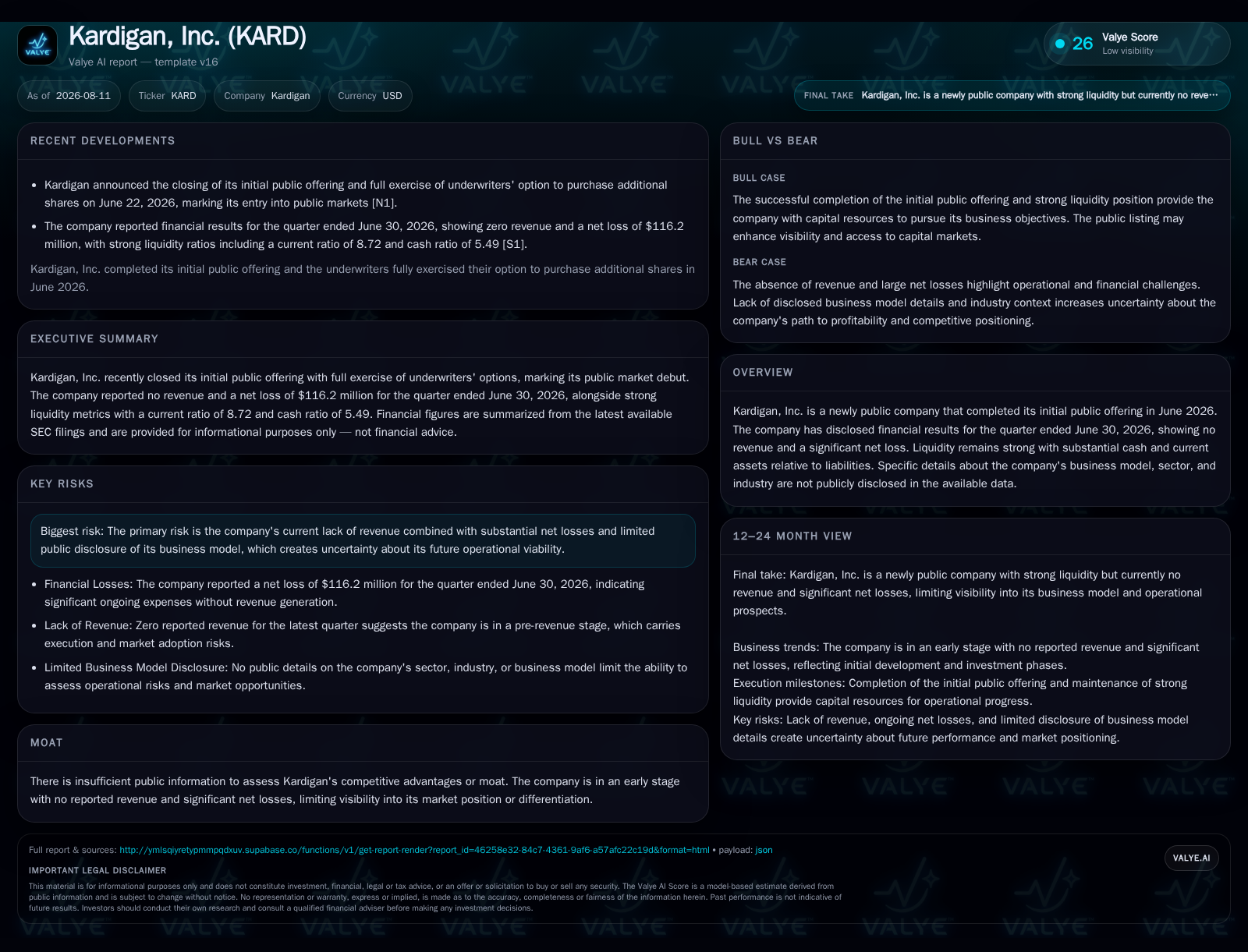
Kardigan, Inc., freshly public with no revenue yet reported, posted a net loss of $116.2 million for Q2 2026 while maintaining strong liquidity, with over $384 million in cash and an 8.72 current ratio. The company remains in an early development phase marked by heavy operating expenses likely tied to ongoing R&D efforts and pre-commercial activities. This financial position provides a substantial runway but underscores the inherent uncertainties of emerging growth entities operating without clear monetization or product visibility. Upcoming milestones around product development and initial revenue generation will be critical to assessing Kardigan's commercial prospects.
Q2 Results Reveal Running Start Without Revenue: What Investors Must Consider
Kardigan’s inaugural quarterly report following its June 2026 IPO reveals a typical early-stage public company profile characterized by zero reported revenue alongside a substantial net loss totaling $116.2 million for the quarter ended June 30, 2026 [F1][S2]
The sharp contrast between persistent losses and abundant cash positions accentuates Kardigan's nascent commercial stage where investments in product development and infrastructure dominate expenditure profiles rather than revenue flows. For investors accustomed to mature operating businesses, this combination heightens risk perception but simultaneously confirms foundational capital strength needed to sustain near-term strategic initiatives.
Unpacking Kardigan’s Pre-Revenue Business Model and Product Development Stage
Detailed disclosures concerning Kardigan's specific products or services remain conspicuously absent across its filings [S2][S3], aligning the company firmly within the archetype of a pre-revenue emerging growth entity. While no segment-level data identify customer bases or monetization mechanics explicitly, the scale of operating expenses—likely dominated by research & development (R&D) outlays—illustrates an investment-first posture focused on advancing proprietary technology or therapeutic candidates prior to any meaningful commercial engagement.
This business model entails considerable uncertainty: revenues depend entirely on future successful commercialization outcomes such as licensing arrangements, direct sales following regulatory approvals (if applicable), or strategic partnerships. These pathways carry inherent timing ambiguity making current valuation hinges heavily contingent on management execution capabilities and milestone achievements rather than recurring income streams.
Understanding Sector Dynamics: Capital Intensiveness and Growth Challenges
Kardigan's financial contours exemplify broader sector dynamics common among early-stage public companies transitioning from private financing into public markets without immediate top-line traction. Such companies occupy upstream positions in their respective value chains—whether biotech discovery platforms or software innovations—and typically endure prolonged development cycles characterized by elevated burn rates before crossing the commercial inflection threshold.
The necessity for repeated capital raises, paired with intensive operating expenses primarily funneling into R&D and general administrative costs, creates a profile marked by negative operating margins and cumulative losses sustained over multiple reporting periods. Successful peers like Moderna during its pre-commercial periods exhibited similar patterns—significant cash cushions counterbalanced steep cash consumption as they pursued regulatory approvals and market introductions.
Growth Potential Hinges on R&D Progress and Commercialization Milestones
For Kardigan’s value proposition to materialize into sustainable growth, it must demonstrate tangible progress along recognized transformational markers such as product development breakthroughs, proof-of-concept validation, patent grants (if relevant), strategic licensing deals, or initial revenue recognition thresholds. In sectors governed by regulatory oversight (e.g., biotech/pharma), timely trial advancements and subsequent marketing authorizations constitute critical de-risking events that often trigger valuation inflection points.
Absent these milestones or credible commercialization signals, the high fixed-cost base sustained by Kardigan limits operating leverage advantages forcing continued reliance on equity injections. Furthermore, scaling commercial operations would require significant organizational investments including salesforce expansion and channel development which depend heavily on validated market potential.
Key Risks Include Capital Sustainability and Absence of Commercial Traction
The foremost risks articulated in Kardigan’s filings emphasize the precarious balance between ambitious R&D agendas funding innovation pipelines and the imperative to secure sufficient capital ahead of revenue generation [S8]. Persistent net losses compound dilution threats tied to future equity offerings while market acceptance challenges loom large because tangible product offerings remain undefined publicly.
Additionally, broad risks customary for emerging firms—such as execution missteps in research programs, regulatory setbacks if applicable, competitive disruption from entrenched incumbents or novel entrants, and volatile stock price dynamics driven by speculative sentiment—remain salient considerations reducing near-term predictability.
Upcoming Catalysts: What Investors Should Monitor Next
Given Kardigan’s developmental stage status as revealed through its latest filings [S2][S3], investors should focus attention on several actionable indicators suggesting progress beyond silent product pipelines. These include forthcoming quarterly disclosures revealing incremental operational expense trends potentially reflecting scaling activities; disclosure of new collaborations or licensing partnerships; announcements relating to intellectual property fortifications; along with any preliminary revenue acknowledgments signaling transition from pure investment phase towards commercialization.
Furthermore, management commentary around evolving strategic priorities during earnings calls or supplemental filings could offer important directional cues that reduce informational opacity about long-term value creation pathways.
Financial Profile Discussion: Robust Liquidity Eases Near-Term Runway Concerns
From a financial health perspective, Kardigan enters public markets with a solid liquidity foundation underscored by over $384 million in cash balances as of June 30, 2026 alongside low short-term liabilities yielding an outstanding current ratio above 8.7 [F1]. This buffer translates into a multi-quarter cash runway capable of sustaining active operations amid ongoing net losses which totaled approximately $116 million in Q2 alone [F1].
While profitability remains elusive given early developmental status reflected in significant negative operating income (~$119 million) also reported for Q2 [F1], the ample capital base mitigates immediate solvency risks associated with burn rate pressures common among peer emerging growth companies transitioning towards commercialization. Maintaining this liquidity cushion is critical since absent material revenue streams or alternative cash sources; operational continuity depends exclusively on preserved working capital until positive free cash flow conversion can be demonstrated.
In sum, Kardigan exemplifies a risk-heavy early-stage public company with strong capital resources offsetting considerable operational outlays while seeking developmental breakthroughs necessary for revenue generation. The company’s immediate investor outlook revolves around monitoring whether planned R&D progress can tangibly translate into viable products within reasonable timelines amid broadly complex industry dynamics characteristic of venture-backed pre-commercial peers.
This analysis synthesizes Kardigan’s most recent SEC disclosures integrated with broader sector insights characteristic of newly public emerging growth companies operating without disclosed revenue streams [F1][S2][S3][S8]. Because Kardigan’s underlying business specifics remain largely confidential in public documents, this article refrains from speculation beyond supported industry archetypes or comparison to illustrative peer phases such as Moderna or Palantir during their initial public market entries.
Disclaimer: This report is for informational purposes only and does not constitute investment advice or research views regarding securities of Kardigan or any other entity.
Disclaimer: This is research-only, informational analysis and not investment advice. It may include AI-generated interpretation and general industry context. Always verify important details using primary sources.

Comments