
Arq, Inc. Confronts Production Challenges and Regulatory Risks in Mercury Removal Consumables
Q2 2026 results highlight ramp-up issues at Arq’s GAC Facility and persistent regulatory and import competition pressures.
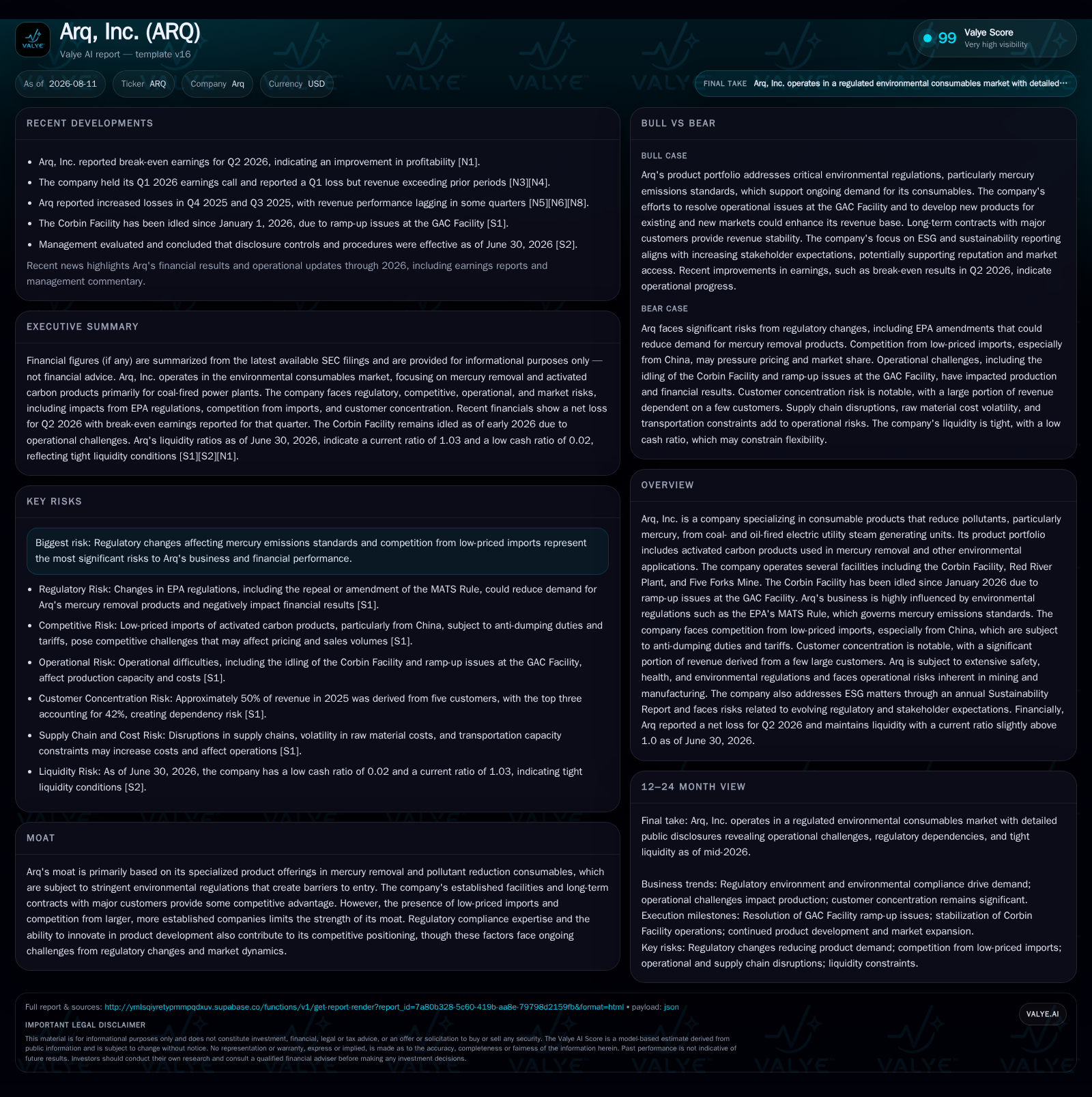
Arq, Inc. operates in the niche environmental consumables sector focused on activated carbon products for mercury removal, primarily serving coal- and oil-fired power plants subject to EPA's MATS Rule. The company’s latest quarterly update confirms ongoing difficulties ramping up production at its new GAC Facility, leading to idling of the Corbin Facility and reliance on engineering reviews to optimize operations. Regulatory rollbacks on mercury emission standards and competitive pressure from low-priced Chinese imports undercut growth prospects. Significant customer concentration and capital-intensive capex requirements further complicate the outlook. Arq’s near-term operating performance will critically depend on successful resolution of manufacturing design flaws and sustaining regulatory-driven demand.
Recent Operating Update
Arq, Inc.'s second quarter of 2026 reaffirmed the critical challenge that has shaped its recent operational narrative: the inability to ramp up production at its Granular Activated Carbon (GAC) Facility to nameplate capacity due to intrinsic design flaws and feedstock variability issues. After achieving initial mechanical completion in January 2025 and early commercial product runs by August 2025, further progress was halted in December 2025 when it became clear that the GAC Facility could not scale under its current design using Corbin Wetcake feedstock. This forced the company to pause production there and idle the older Corbin Facility starting January 2026 as a cost-saving measure amid this bottleneck [S2], [S1].
This operational pause signals a meaningful delay in achieving expected volume-driven revenue growth characteristic of consumable product suppliers like Arq that depend heavily on steady production scale. The current quarter filings indicate that engineering reviews are actively underway to identify modifications to the GAC process architecture which may include transitioning away from Corbin Wetcake toward more consistent bituminous coal feedstock known for proven performance in activated carbon manufacturing. This shift aims to overcome key specification compliance challenges but introduces new dependencies around raw material sourcing and supply-chain stability [S1]. Without a swift resolution leading to resumption of full-scale production, the company risks continued revenue disruption.
Business Model Overview
Arq operates within the environmental consumables sector, supplying specialty activated carbon products used primarily by coal- and oil-fired electric utility steam generating units (EGUs) to comply with stringent mercury emission regulations under the EPA's Mercury and Air Toxic Standards (MATS) Rule. The company’s product monetization hinges on ongoing volume sales of consumable materials integrated by utilities into their pollution control systems.
Revenue drivers stem chiefly from long-term supply contracts tied to regulatory compliance timelines which compel utilities to install or maintain activated carbon injection systems for hazardous air pollutants abatement [S1]. This contract structure provides some revenue predictability; however, customer concentration with a few large buyers exacerbates revenue volatility risks if orders decline or contracts fail to renew
Margins are sensitive to production efficiency, feedstock cost, product quality compliance with specifications mandated by environmental agencies, and tariff impacts given exposure to import competition in activated carbon products. The company’s operational leverage is evident as fixed costs associated with manufacturing infrastructure mean that disruptions in facility ramp-up have outsized impacts on margins.
Industry Structure and Competitive Position
The environmental consumables industry focuses on upstream manufacturing of specialized pollution control materials used predominantly by utilities subjected to emissions regulation. Demand is tightly linked to legislation such as EPA's MATS Rule governing mercury limits in power plant exhaust. As regulations tighten or enforcement intensifies, demand inflates correspondingly; conversely regulatory relaxation can depress consumable requirements.
Competition is bifurcated between domestic manufacturers like Arq—who invest heavily in facility capacity and compliance expertise—and low-priced imports primarily from China [S1]. Despite U.S. anti-dumping duties imposed on Chinese activated carbon products aimed at protecting domestic players, persistent import penetration continues due to price advantages afforded by lower production costs overseas. This dynamic constrains pricing power for U.S.-based producers who must maintain high product purity and specification conformance while managing elevated cost structures
Peer environmental consumable manufacturers include firms such as Calgon Carbon Corporation and Cabot Corporation’s environmental segments which operate with broader scale and diversified product portfolios mitigating risk concentration. In contrast, Arq’s smaller scale combined with concentrated customer exposure limits its competitive moat.
Growth Drivers
Arq's potential growth trajectory depends on several intertwined factors:
- Environmental Regulation Stringency: Enhanced EPA regulation or state-level initiatives mandating lower mercury emissions drive replacement demand for activated carbon consumables.
- Facility Capacity Expansion: Successful execution of GAC Facility modifications enabling ramp-up to full capacity can unlock volume growth essential for scaling revenues.
- Feedstock Optimization: Transitioning from variable Corbin Wetcake feedstock to higher quality bituminous coal may improve consistency and reduce scrap rates improving gross margins.
- Tariff Protections: Continued enforcement of anti-dumping duties provides a defensive buffer against low-cost imports eroding domestic market share.
- Contract Renewals: Securing multi-year supply agreements with major customers ensures baseline order visibility critical for utilization planning.
- Replacement Cycles: Ongoing replacement needs in existing utility pollution control setups support steady consumable usage independent of expansion.
Tracking KPIs such as production capacity utilization rates post-ramp-up, product purity compliance metrics, order backlog levels, customer concentration balance shifts, and tariff impact trends will be instructive in assessing progress against these drivers.
Risks and Constraints
Notable risks constraining Arq's operational outlook include:
- Manufacturing Ramp-Up Uncertainty: Continued delays or failure to rectify design flaws threaten indefinite deferment of full-scale commercial production leading to revenue shortfalls.
- Regulatory Reversals: The 2026 rollback by EPA reverting 2024 MATS amendments lessens mercury emission standards loosened compliance burdens reducing consumable requirements materially [S1].
- Import Competition: Ineffectiveness or expiration of anti-dumping tariffs could allow aggressive pricing by Chinese exporters further compressing margins.
- Customer Concentration Risk: Reliance on a narrow customer base elevates potential financial volatility if any major contract lapses or volumes fall unexpectedly.
- Capital Expense Overruns: Costs associated with facility redesigns could exceed initial projections straining liquidity especially amidst tight cash reserves.
- Supply Chain Constraints: Availability of qualified contractors for modifications alongside raw material supply limitations presents execution bottlenecks uncertain in timing.
- Environmental Compliance Burdens: Complex permitting processes for expansions prolong project schedules increasing time-to-market delays.
Mitigation strategies such as diversifying feedstock sources, pursuing multi-year contracts with customers, maintaining tariff advocacy efforts, and prudent financial management will be crucial moving forward.
What to Watch Next
Key near-term milestones include:
- Timelines for completion of GAC Facility engineering reviews along with public updates on expected modification scope.
- Actual start date for modified facility commissioning including preliminary utilization rates approaching nameplate capacity.
- Progress metrics related to securing bituminous coal supply contracts addressing prior feedstock variability issues.
- Updates regarding contract renewals or additions among top customers affecting revenue visibility.
- EPA regulatory announcements affecting MATS Rule enforcement or issuance of complementary rules impacting pollution control demand.
- Developments concerning anti-dumping duty extensions or trade policy shifts influencing import competitiveness.
- Quarterly operating results signaling changes in production efficiency, inventory levels, or product quality acceptance rates.
Financial Profile Discussion
As of June 30, 2026, Arq reported cash and equivalents totaling $906 thousand versus total debt near $30.9 million resulting in net debt approximating $30 million [F1]. Current assets stand at about $47.2 million offset by current liabilities close behind at $45.9 million yielding a narrow current ratio around 1.03 indicating limited liquidity cushion [F1].
Financial health thus hinges critically upon successful resolution of manufacturing issues enabling a return toward steady-state production leading eventually to stable revenue flows sufficient to service debt obligations comfortably while supporting ongoing capex needs around facility optimization. Working capital efficiency improvements through inventory management tied closely to ramp-up progress will also be important levers going forward.
This analysis reflects Arq's position at a challenging inflection point where emerging from sustained technical setbacks is required just as regulatory headwinds intensify amid growing import competition risks. While its niche focus in activated carbon mercury removal products creates natural barriers anchored by environmental regulations requiring specialized inputs, current operational execution risks coupled with an uncertain regulatory landscape constrain visibility into sustainable growth prospects absent significant operational turnaround success.
Disclaimer: This is research-only, informational analysis and not investment advice. It may include AI-generated interpretation and general industry context. Always verify important details using primary sources.

Comments