
Exodus Movement Expands Payment Processing Amid User Engagement Headwinds
Exodus Movement's latest quarter reflects a strategic pivot through acquisitions expanding payment services amid declining wallet user activity and rising integration costs.
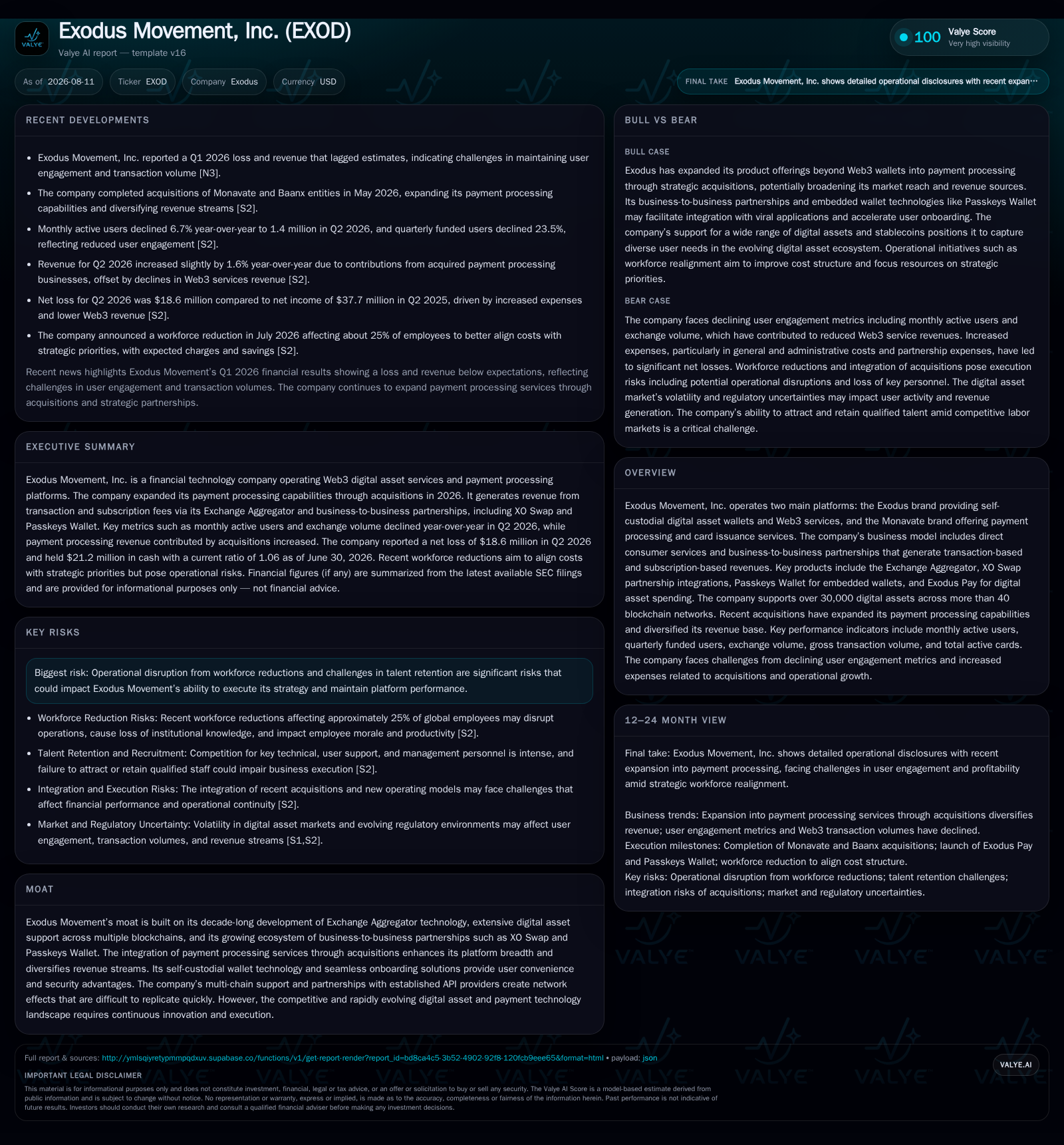
In Q2 2026, Exodus Movement advanced its transformation from a primarily Web3-focused wallet provider to a broader fintech platform by completing key acquisitions that expand its payment processing and card issuance capabilities. However, this pivotal shift coincided with notable declines in user engagement metrics such as monthly active users and quarterly funded users, alongside lower exchange volumes. The company is managing short-term profitability pressure and operational complexity resulting from integration costs and workforce reductions aimed at aligning cost structure with its evolving strategy. Exodus’s dual-platform business model positions it competitively within the fintech digital asset ecosystem, leveraging multi-chain wallet support and API partnerships, but execution risks remain as it scales payment services.
June Quarter User Trends Show Engagement Pressure Despite Platform Expansion
Exodus Movement’s Q2 2026 results reveal a contraction in fundamental user engagement metrics during its ongoing business model transition. Monthly Active Users (MAUs) declined by approximately 6.7% year over year to 1.4 million, while Quarterly Funded Users (QFUs)—a more durable measure representing active wallets maintaining a balance—fell sharply by 23.5% to about 1.3 million [S2][S14]. These trends illustrate weakening consumer activation or retention within the company’s self-custodial Exodus wallet platform despite its support for over 30,000 digital assets spanning more than 40 blockchain networks [S1]. The consequential impact is visible in exchange volume metrics, which decreased by roughly 21.4% to $1.1 billion during the quarter [S2]. This volume drop suggests diminished on-chain swapping activity, a core source of transaction-fee revenue.
The deceleration in core user engagement may reflect broader industry volatility or competitive pressures that often challenge self-custody platforms reliant on voluntary wallet funding and active trading behavior. Revision or enhancement of product features driving wallet funding rates could be essential if Exodus seeks to stabilize or grow its active base.
Dual-Platform Model Fuels Revenue Mix Shift Toward Payments Processing
Exodus operates a bifurcated platform model combining traditional Web3-facing services—the Exodus brand—with complementary payment processing via the Monavate brand acquired in May 2026 [S2][S3]. The Exodus platform centers on self-custodial digital asset wallets integrated with its proprietary Exchange Aggregator technology that facilitates transaction-based fees from user swaps across multiple blockchains [S1]. Complementary subscription revenues stem from business-to-business API partnerships such as XO Swap integrations with third-party providers like Ledger Live [S1].
Monavate and Baanx acquisitions expand the company's footprint into payment processing functions including card issuance and fiat-crypto payment rails servicing traditional commerce channels alongside crypto-native clients [S1][S2]. These acquisitions broaden revenue sources beyond wallet subscriptions and transactional exchange fees toward gross transaction payment volume—a metric that hit approximately $0.6 billion in Q2 despite being nascent [S2], pointing to meaningful traction of the payments segment.
This evolution aligns with fintech peers like Block Inc., which integrate crypto-related payments into established merchant ecosystems to address barriers around everyday cryptocurrency spending. Exodus’s hybrid offering attempts to straddle decentralized custody advantages while embedding conventional payments infrastructure.
Strategic Acquisitions Extend Card Issuance but Increase Operating Complexity
The asset acquisitions completed in May—Monavate Holdings Ltd., Monavate Ltd., Baanx.com Ltd., and Baanx US Corp.—represent strategic leaps expanding card issuance capabilities [S1][S2][S3]. While these moves unlock new customer segments and diversified revenue streams centered on crypto-linked spending cards, they also introduce heightened operational complexity.
Operating expenses related to partnerships jumped materially—as partnership expenses rose by approximately 72% year over year to $3.7 million in Q2—and overall expense discipline remains critical amid integration challenges [S2]. To better align costs with strategic priorities emphasizing full-stack card issuance infrastructure development, Exodus announced a workforce reduction plan impacting roughly one-quarter of its global headcount in July 2026 [S9][S20]. This layoff aims for $9–11 million annualized operating expense savings starting in 2027 but involves upfront one-time charges estimated between $4.6 million and $5.7 million [S8][S9].
Workforce realignment risks include potential knowledge loss affecting platform stability or innovation velocity during this sensitive transition phase. Success will hinge on managing attrition carefully while avoiding customer experience degradation.
Industry Context: Multi-Chain Support and API Partnerships Shape Competitive Dynamics
Within the fintech digital asset industry focused on self-custodial wallets complemented by diversified payments services, Exodus's value proposition draws strength from broad multi-blockchain compatibility and API-driven partnership models. Its Exchange Aggregator consolidates liquidity and execution options across dozens of blockchain networks directly accessible through integrated API providers serving both retail users and institutional clients [S1]
Innovations like the Passkeys Wallet enable developers to embed secure self-custody wallets directly into decentralized applications without burdensome seed phrase management or reliance on browser extensions—addressing onboarding frictions endemic to Web3 adoption [S1]. Such embedded wallet solutions position Exodus distinctively versus peers like Coinbase or Ledger that focus predominantly on standalone client apps.
However, competitive pressures remain significant. Market leaders enjoy scale advantages in acquiring users either via direct marketing or through ecosystem partners offering seamless swap experience embedded within hardware wallets or decentralized finance platforms.
Growth Opportunity: Scaling Payment Services Against Adoption Challenges
Exodus’s recently acquired payment processing services open pathways to tap into expanding markets for digital asset-enabled payments and cross-border remittances facilitated by crypto-linked cards [S1][S2]. With roughly 1.1 million active cards issued by mid-2026, the company signals initial commercial traction beyond pure-Web3 use cases [S2]. Payment volumes tracked via gross transaction payment volume provide early validation of this strategic pivot.
Adoption drivers encompass rising consumer interest in crypto utility beyond investment speculation—including daily spending—supported by growing regulatory clarity easing institutional participation. Yet the lagging wallet funding rates indicate user acquisition economics may differ between Web3-native wallets versus conventional payment card customers.
Leveraging partnerships with hardware wallet firms (e.g., integration with Ledger) could further accelerate scale by expanding distribution channels. Continued innovation in frictionless onboarding (Passkeys) coupled with robust compliance programs addressing KYC/AML concerns will be vital growth enablers.
Operational Realignment Introduces Cost Savings Risks and Execution Watchpoints
While workforce reduction supports cost alignment aiming for sustainable profitability as expense discipline tightens post-acquisition integration, such measures inherently carry disruption risk [S8][S9][S20]. Attrition beyond planned layoffs could erode institutional knowledge critical for managing complex blockchain integrations and payments infrastructure across multiple jurisdictions.
Moreover, morale decline could impact productivity or customer service quality during a period when flawless operational continuity is especially critical given heightened regulatory scrutiny typical for multi-jurisdictional fintech operations handling fiat-to-crypto settlement flows.
Execution risks include managing timing mismatches between realizing cost savings versus absorbing one-time restructuring expenses totaling several millions earlier this fiscal year [S8],[S9]. Policy rigor around surveillance against illicit activity enabled via platform endpoints remains another key operational watchpoint.
What to Watch: Key Metrics, Milestones, and Regulatory Signals Ahead
The near-term performance trajectory will hinge significantly on stabilization or recovery of MAUs and QFUs signaling re-engagement on self-custodial wallet fronts alongside sustained growth in gross transaction payment volumes reflecting expanded card usage dynamics [S2]. Exchange volume rebounds will also serve as barometers of restored user confidence.
Monitoring operating expense trends post-layoffs against expected run-rate savings benchmarks will clarify whether cost rationalization plans translate into improved profitability margins sustainably rather than transient accounting adjustments.
Regulatory developments shaping obligations around unhosted wallets—currently exempt from KYC requirements under FinCEN guidance—and evolving AML frameworks affecting API providers represent critical compliance parameters potentially impacting operational flexibility or requiring accelerated investment in compliance capabilities [S1][S8]
Financial Profile Discussion: Cash Position, Profitability Trends, and Capital Structure
At June-end 2026, Exodus held approximately $21.2 million in cash & equivalents supported by current assets near $397 million balanced against current liabilities close to $375 million yielding a modest current ratio of about 1.06—indicating manageable liquidity positioning though tight near-term working capital coverage given scale of operations [F1][S2]
Net loss expanded markedly to nearly $18.6 million during Q2 compared with net income previously; adjusted EBITDA moved deeper negative at approximately -$6.7 million reflecting combined integration-related costs including stock-based compensation increases along with elevated partnership expenses arising from expanded payments business activities [S2][F1]
Such losses are partially attributable to non-cash impairments alongside ongoing investments aimed at building out scalable card issuance infrastructure aligned with long-term strategic goals rather than short-term profit maximization.
Careful cash management will remain imperative as Exodus balances growth investments against fragile market sentiment affecting digital asset trading behaviors.
Disclaimer: This analysis is based solely on public filings dated up to August 11, 2026; it does not constitute investment advice or research view but aims to provide an operationally grounded perspective for internal industry evaluation purposes.
Disclaimer: This is research-only, informational analysis and not investment advice. It may include AI-generated interpretation and general industry context. Always verify important details using primary sources.

Comments