
Vestis Corp Advances Compliance Amid Regulatory and Cybersecurity Challenges
Vestis’s latest quarterly filing underscores steady operational progress alongside elevated regulatory and cybersecurity risks inherent to environmentally focused waste management services.
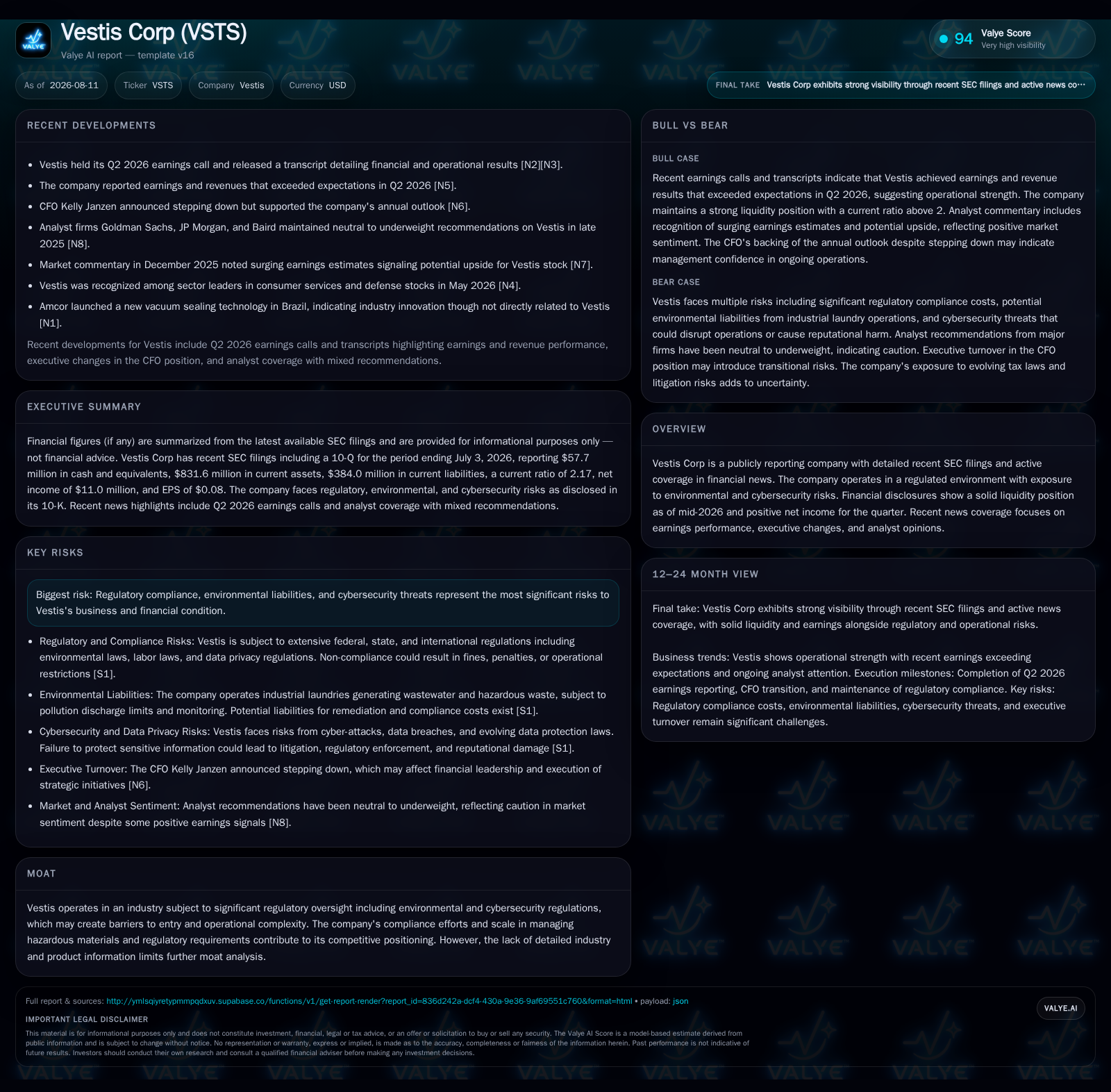
In its August 2026 10-Q, Vestis Corp reported ongoing operational compliance achievements with positive net income contributions despite headwinds from regulatory complexity and cybersecurity threats. The company’s revenue model continues to rely on long-term service contracts managing hazardous and industrial waste under strict regulatory oversight. Capital expenditures remain focused on sustaining treatment facility capacity and compliance upgrades amid rising industrial waste volumes and sustainability demands. Key risks include environmental liabilities, evolving regulations, and cyber-physical system vulnerabilities in operational technology controlling waste treatment. Monitoring contract renewals, incident rates, and regulatory developments will be critical for assessing growth durability.
Q3 Operating Update Highlights Compliance during Headwinds
Vestis Corp’s August 11, 2026 quarterly filing reveals a nuanced operating environment where steady progress in compliance efforts contrasts with growing regulatory and cybersecurity pressures. Despite facing complex environmental regulations that raise operational costs, the company reported positive net income contributions attributed to disciplined cost control and steady service demand [S2]. This suggests that while margin compression risk exists due to regulatory burdens, Vestis’s execution maintains sufficient operational discipline to sustain profitability.
The filing emphasizes ongoing commitments to monitoring compliance incident rates — a critical KPI in this highly regulated sector — highlighting the company’s focus on minimizing environmental incidents that could lead to costly penalties or reputational damage. Meanwhile, contract activity remains stable with no significant erosion in service agreements this quarter, reflecting continuity in its customer base under its long-term contract model [S2].
Revenue Model Anchored in Long-Term Environmental Service Contracts
Vestis operates primarily by providing hazardous waste management, environmental remediation, recycling services, and consulting under long-term contracts with industrial and commercial clients governed by strict regulatory regimes [S1]. This contract-centric model underpins recurring revenue streams and fosters customer retention but also necessitates continuous compliance investment to meet evolving laws.
Such contracts typically extend multiple years and include service-level agreements tied to volume thresholds or environmental performance metrics. The predictability of these agreements supports capital planning but creates exposure to client concentration risk if contract renewals falter or customer needs shift towards alternative providers or internalization. Nonetheless, Vestis benefits from barriers to entry posed by licensing requirements and environmental oversight that limit competition.
Regulatory Complexity Elevates Cost Pressure and Risk Exposure
Environmental regulations constitute both a moat element — due to operational complexity — and a cost driver for Vestis. The company’s filings detail how escalating federal and state rules concerning hazardous material handling compel continuous capital expenditure upgrades for treatment technologies alongside comprehensive reporting obligations [S1][S2].
This sustained regulatory evolution inflates operating expenses via compliance staffing needs, technology investments for monitoring treatment effectiveness, and potential penalties associated with non-compliance. Moreover, legislative initiatives focusing on sustainability enhance the demand for recycling but simultaneously tighten permissible disposal methods.
Capital intensity linked to maintaining permit standards restricts rapid scaling without significant outlays. In this context, operating margins hinge on effective cost management vis-à-vis fluctuating volumes within permitted capacity constraints.
Cybersecurity Controls Add Operational Layer in Treatment Facilities
The increasing reliance on operational technology (OT) systems within waste treatment facilities introduces substantial cybersecurity risks — a theme explicitly discussed within the latest filings [S1][S2]. Such systems control sensitive processes governing hazardous waste handling; any disruption could lead to safety violations or environmental incidents.
Vestis outlines active risk mitigation strategies including multi-layered cyber defenses consistent with industry best practices to manage these threats. Given that regulatory bodies scrutinize cybersecurity measures as part of operational compliance assessments, failure in this area could inflict financial penalties or jeopardize license renewals.
This dimension adds an uncommon but crucial layer of operational complexity in the environmental services sector where physical safety intersects tightly with digital threat vectors.
Capital Allocation Reflects Focus on Capacity Expansion and Compliance Upgrades
Capital expenditure trends reveal strategic prioritization of facility upkeep and incremental capacity expansion aligned with growing industrial waste processing demand [S2][F1]. Investments focus heavily on upgrading treatment equipment to comply with tightening emissions standards and improving uptime metrics — itself a key KPI indicative of service reliability.
Given the capital-intensive nature typical of players like Waste Management Inc. or Clean Harbors Inc., such expenditure is essential not just for regulatory adherence but also for maintaining competitive service quality metrics. Controlling the cost per ton processed while meeting stringent environmental requirements remains a delicate balance.
Expansion Path Via Rising Industrial Waste Streams and Sustainability Demand
Macro tailwinds support Vestis’s growth thesis through increases in commercial, industrial, and municipal waste production fueled by population centers’ expansion and manufacturing activity intensification [S1]. Rising corporate emphasis on sustainability further accelerates outsourcing demand for specialized recycling services that Vestis delivers.
Regulatory incentives aimed at reducing landfill use catalyze investment in recycling infrastructure underpinning longer-term growth visibility for companies positioned as comprehensive waste managers. Outsourcing trends driven by corporations preferring third-party specialists for environmental compliance bolster service contract pipelines.
Risk Factors Centered on Environmental Liabilities and Regulatory Regimens
Key risks continue to concentrate around significant environmental liabilities related to past or current disposal activities which could trigger remediation costs or litigation [S1][S2]. As regulations evolve unpredictably at multiple jurisdictional levels, Vestis must maintain agile compliance frameworks capable of rapid response.
Further complicating risk profiles are potential cybersecurity breaches impacting OT systems highlighted earlier; these could exacerbate incident frequency or severity if compromised. Legal proceedings arising from environmental claims have historically imposed notable financial burdens leading to volatile expense recognition.
The company expressly notes that failure to comply could result not only in fines but also restrictions limiting operations at key sites thereby amplifying fixed-cost absorption challenges within their capital-heavy asset base.
What to Monitor: Contract Renewals, Regulatory Changes, and Incident Trends
Forward-looking analysis should concentrate on several pivotal indicators: - Contract renewal success rates along with new client acquisition signaling commercial momentum; - Volume changes across processed waste streams which directly influence revenue scale; - Compliance incident frequency serving as real-time proxies for operational risk management effectiveness; - Expenditure patterns directed at cybersecurity enhancements evidencing proactive risk mitigation; - Regulatory developments imposing new capital demands or constraining permitted disposal practices [S2][S3]. The company’s current assets of $832 million and current liabilities of $384 million imply a current ratio of 2.17, reflecting solid short-term liquidity buffers amid significant liabilities [F1].
This leverage level is characteristic of capital-intensive environmental services firms whose heavy investments underpin durable asset bases required for licensing conditions. Adequate liquidity helps cushion operational volatility associated with episodic environmental expenditures or unexpected regulatory-driven shutdowns.
Reported net income turnaround this quarter further reinforces operational resiliency yet sustaining profitability will depend heavily on pricing discipline amid rising cost pressures noted above [S2]
Embedded within Vestis Corp’s latest quarterly disclosures is a story emblematic of modern regulated environmental service providers: balancing growth opportunities driven by expanding industrial waste flows and sustainability mandates against escalating costs imposed by stringent regulation and emergent cybersecurity threats affecting core OT systems. The company’s reliance on long-duration contracts provides revenue stability offsetting some cyclical volatility though exposing concentration concerns. Operational KPIs such as processed volume tonnage, contract renewal rates, compliance incident frequencies, capex effectiveness in maintaining uptime, alongside governance around cybersecurity constitute critical monitorables shaping near-term trajectory. Financially vested in measured liquidity preservation despite heavy leverage balances apparent resilience against structural headwinds influencing margins. Industry parallels at integrated operators like Waste Management or specialist peers such as Clean Harbors highlight sector-wide dynamics underscoring Vestis’s strategic challenges ahead.
Disclaimer: This analysis is based solely on publicly available documents cited herein without offering investment advice or research views.
Disclaimer: This is research-only, informational analysis and not investment advice. It may include AI-generated interpretation and general industry context. Always verify important details using primary sources.

Comments