
Upstream Bio Advances Verekitug with Strong Phase 2 Results and Phase 3 Plans for Severe Respiratory Diseases
Upstream Bio reports positive data from Phase 2 trials of verekitug and plans Phase 3 initiation in early 2027, supported by a robust balance sheet.
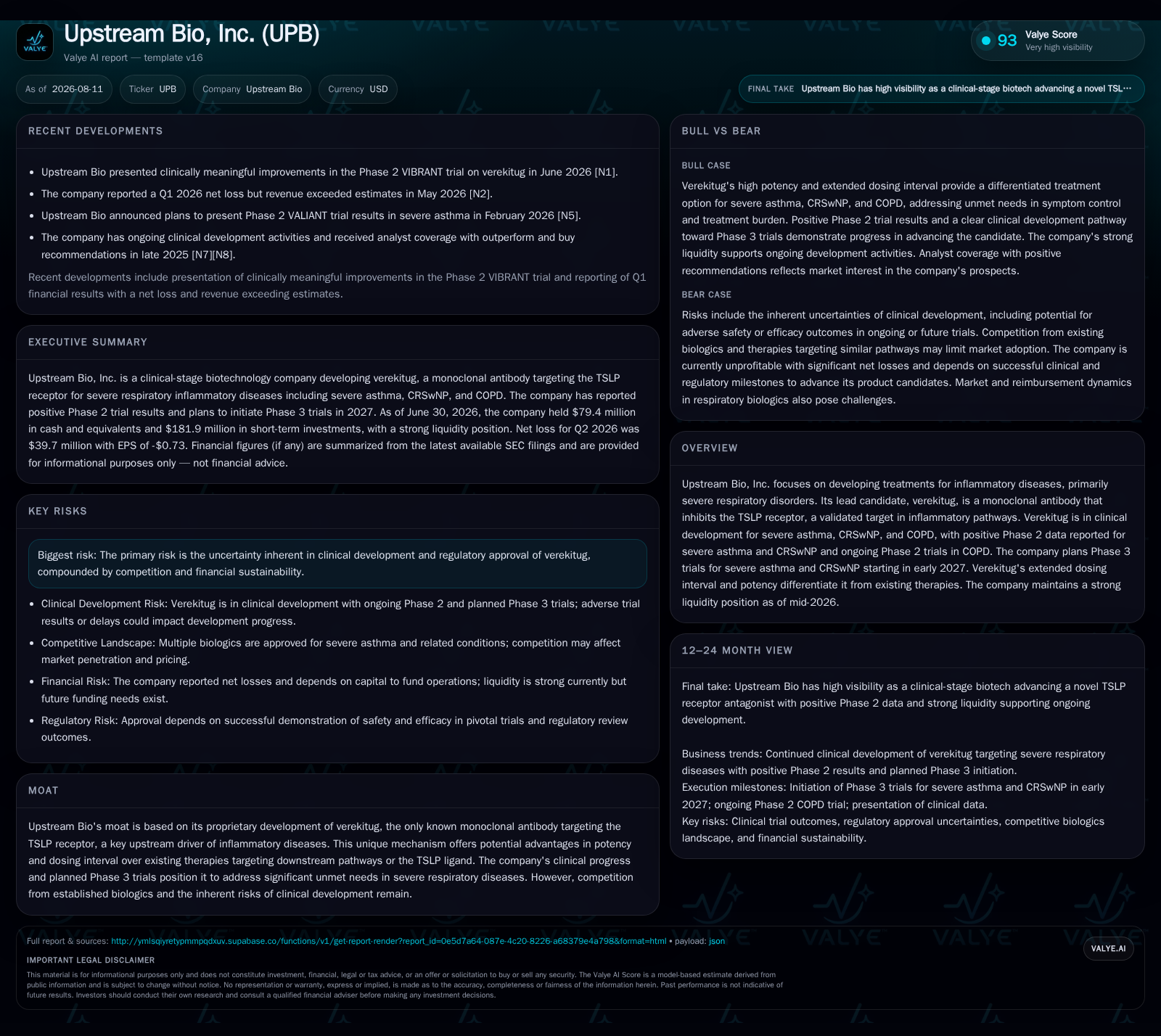
Upstream Bio, a clinical-stage biotech focusing on inflammatory respiratory diseases, recently disclosed encouraging Phase 2 trial results for its lead candidate verekitug in severe asthma and chronic rhinosinusitis with nasal polyps (CRSwNP). The company is advancing to Phase 3 trials slated for early 2027, aiming to leverage verekitug’s unique TSLP receptor antagonism and extended dosing schedule. Despite typical clinical-stage development risks, Upstream Bio commands a strong liquidity position that supports its near-term operational goals. Strategic differentiation centers on targeting the upstream TSLP receptor rather than the ligand, which may provide enhanced efficacy and patient convenience compared to existing biologics.
Recent Operating Update
Upstream Bio’s latest quarterly filing dated August 11, 2026, provides a crucial update on its clinical development progress and financial condition [S2]. The company continues advancing its flagship asset verekitug, a monoclonal antibody antagonist of the thymic stromal lymphopoietin (TSLP) receptor, in multiple indications: severe asthma, chronic rhinosinusitis with nasal polyps (CRSwNP), and chronic obstructive pulmonary disease (COPD). Notable is the forthcoming initiation of Phase 3 studies for both severe asthma and CRSwNP planned for the first quarter of 2027 [S1]. This signals acceleration from positive Phase 2 results delivered earlier — severe asthma data reported in February 2026 and CRSwNP results announced in September 2025 have demonstrated statistically significant efficacy with acceptable safety profiles. Ongoing Phase 2 COPD trials remain underway since their launch in mid-2025.
This quarterly update confirms Upstream Bio’s commitment to target substantial unmet medical needs within serious respiratory inflammatory diseases by leveraging verekitug’s differentiated profile — notably its high potency blocking of the TSLP receptor combined with extended dosing intervals of up to 24 weeks. Such infrequent administration could improve patient adherence compared to existing therapies that require more frequent dosing [S1].
Business Model Specifics
Upstream Bio operates as a clinical-stage biotechnology company specializing in discovery and development of biologic therapies aimed at inflammatory diseases predominantly affecting the respiratory system. Its sole clinical stage product candidate, verekitug, is a monoclonal antibody designed as a cytokine receptor antagonist specifically targeting the TSLP receptor. Unlike currently approved therapies such as tezepelumab (Tezspire®), which inhibit the TSLP ligand itself, verekitug binds directly to the receptor, potentially conferring enhanced blockade upstream within the inflammatory cascade [S1].
The company’s revenue model remains typical for biotech firms at this stage: revenues are minimal or non-existent since no products have received marketing approval yet. Upstream Bio incurs significant R&D expenses supporting clinical trials while maintaining administrative overhead. Monetization possibilities once regulatory approvals are secured include direct commercial sales or licensing agreements with larger pharmaceutical entities. Currently, it focuses primarily on progressing through clinical endpoints necessary for regulatory submissions.
Efficacy demonstration involves achieving primary endpoints such as reduction in nasal polyp size (NPS) and nasal congestion scores (NCS) alongside systemic parameters pertinent to asthma control. Safety profiles must align with regulatory expectations for adverse event rates relative to placebo controls [S1]. The ability to deliver therapy via quarterly or semiannual dosing at home aims to enhance patient convenience and reduce costs borne by payors under reimbursement frameworks.
Industry Structure and Competitive Position
The biotechnology sector focusing on monoclonal antibodies for inflammatory respiratory diseases features both established players like Amgen and AstraZeneca which commercialize agents such as tezepelumab, along with numerous clinical-stage competitors developing various cytokine inhibitors or biologic therapies. The market for severe asthma biologics alone was estimated at $7.5 billion across major geographies in 2023 [S1]
Upstream Bio carves out competitive differentiation by pursuing TSLP receptor antagonism—the only known approach selectively targeting this receptor at present—versus the ligand antagonists available today. Furthermore, delivering therapy at extended intervals up to six months could provide significant advantages in patient adherence compared to more frequent injections required by competing products.
However, competition remains intense. Tezepelumab has rapidly gained share since FDA approval in late 2021 with over 20% of new-to-brand prescriptions reported during its commercial launch year [S1]. Additionally, Tezepelumab is progressing into COPD indications alongside positive Phase 2a data supporting further development; thus Upstream Bio faces both established incumbents and new entrants expanding indications coverage.
The company must also contend with operational challenges typical to biotech: successful enrollment rates for late phase trials, manufacturing scale-up capacity constraints outsourced potentially through contract manufacturing organizations (CMOs), evolving regulatory landscapes including data privacy laws impacting clinical trial conduct particularly outside the U.S., intellectual property defense against rivals, pricing scrutiny amid healthcare cost containment efforts, post-market safety surveillance requirements, and reimbursement negotiation complexities [S4][S5][S6][S8]
Growth Drivers
Key growth drivers hinge on successful execution of several clinical and regulatory milestones:
- Phase 3 Trial Initiation: Launching pivotal trials in early 2027 for severe asthma and CRSwNP constitutes foundational proof points toward market authorization. These trials aim to expand upon promising Phase 2 efficacy data without restricting patient populations based on biomarker stratification—a broad label could increase eligible patient numbers [S1].
- Phase 2 COPD Program Advancement: Ongoing evaluation of efficacy/safety data here may enable extension into a large additional indication poised for high unmet need.
- Clinical Endpoint Achievements: Demonstrating sustained reductions in symptom scores along with favorable safety outcomes will be closely monitored during these phases.
- Regulatory Engagements: Constructive interactions to validate endpoints suitable for drug approval across major markets help de-risk timelines.
- Product Differentiation: Verekitug's longer dosing interval positions it favorably against more frequent competitor regimens potentially enhancing physician preference and reimbursement adherence.
- Expansion Opportunities: Future label expansions into other immune-mediated conditions beyond respiratory diseases represent optionality.
Risks and Growth Constraints
Despite encouraging developments, substantial risk factors complicate Upstream Bio’s outlook:
- Clinical Development Uncertainty: As with all clinical-stage biotechs, success depends heavily on achieving statistically significant endpoints within budgeted timelines; any failures or delays could erode valuation steeply [S26].
- Competitive Dynamics: Established biologics enjoying first-mover advantages may limit market penetration even if regulatory approval is obtained.
- Regulatory Hurdles: FDA and global agencies impose stringent scrutiny including potential clinical holds; compliance failures or safety concerns can derail progress [S27].
- Financial Sustainability: Continued operating losses prior to commercialization necessitate consistent capital raises; dilution risk exists absent partnership or revenue inflows.
- Manufacturing Complexity: Scaling up production while maintaining quality standards involves complex process controls; outsourcing increases dependency risks.
- Pricing Pressures: Payor pushback on biologics pricing coupled with off-label use restrictions can constrain commercial success [S29].
- Data Privacy Compliance: Conducting multinational trials implicates evolving privacy regulations such as GDPR increasing administrative burdens [S6].
What To Watch Next
Investors and analysts should monitor several upcoming indicators that will materially influence Upstream Bio's trajectory:
- Enrollment Progress Reports: Patient recruitment velocity in Phase 3 studies will indicate timeline feasibility.
- Interim Clinical Data Releases: Interim safety/efficacy readouts could provide early confidence or prompt protocol adjustments.
- Regulatory Feedback: Communications regarding acceptability of primary endpoints or requests for additional studies inform approval probability.
- Financing Activities: Capital raises or partnership/licensing deals will shed light on financial health proximal to commercialization phases.
- Manufacturing Updates: Success in developing supply chains capable of supporting launch scale-up remain crucial behind-the-scenes signs.
Overall, successful transition into large-scale late-stage trials represents the immediate focal point given its determinative impact on long-term value creation prospects [N1][S3].
Financial Profile Discussion
As of June 30, 2026, Upstream Bio reported cash and equivalents totaling approximately $79.4 million alongside current assets near $280 million contrasted with modest current liabilities under $10 million—yielding an exceptionally strong current ratio around 28x [F1]. This liquidity buffer reflects prudent balance sheet stewardship typical among clinical-stage biotechs needing substantial cash runways through high-burn development phases before generating revenue streams.
Operating losses remain deep as expected; net income reported negative $143 million as of December end-of-year figures reflecting ongoing heavy R&D investment aligned with clinical advancement priorities [F1]. Operational cash flows continue negative consistent with upfront expense recognition preceding commercialization milestones. Maintaining this capital base reduces imminent financing pressure but does not obviate future capital needs required to complete pivotal studies.
Strategy appears focused on capital preservation combined with planned clinical progression aiming to unlock value catalysts that may appeal to strategic partners or public-market investors aiming at eventual product launches. This measured approach contrasts with smaller firms facing acute liquidity stress influencing trial continuation decisions prematurely.
This analysis synthesizes Upstream Bio's latest SEC disclosures juxtaposed against biotechnology sector context without providing investment research views.
Disclaimer: This is research-only, informational analysis and not investment advice. It may include AI-generated interpretation and general industry context. Always verify important details using primary sources.

Comments