
Hawaiian Electric Industries Balances Grid Modernization with Infrastructure Rebuilding and Capital Challenges
The utility advances infrastructure resilience aided by federal grants and fuel contracts while managing litigation settlements and liquidity pressures.
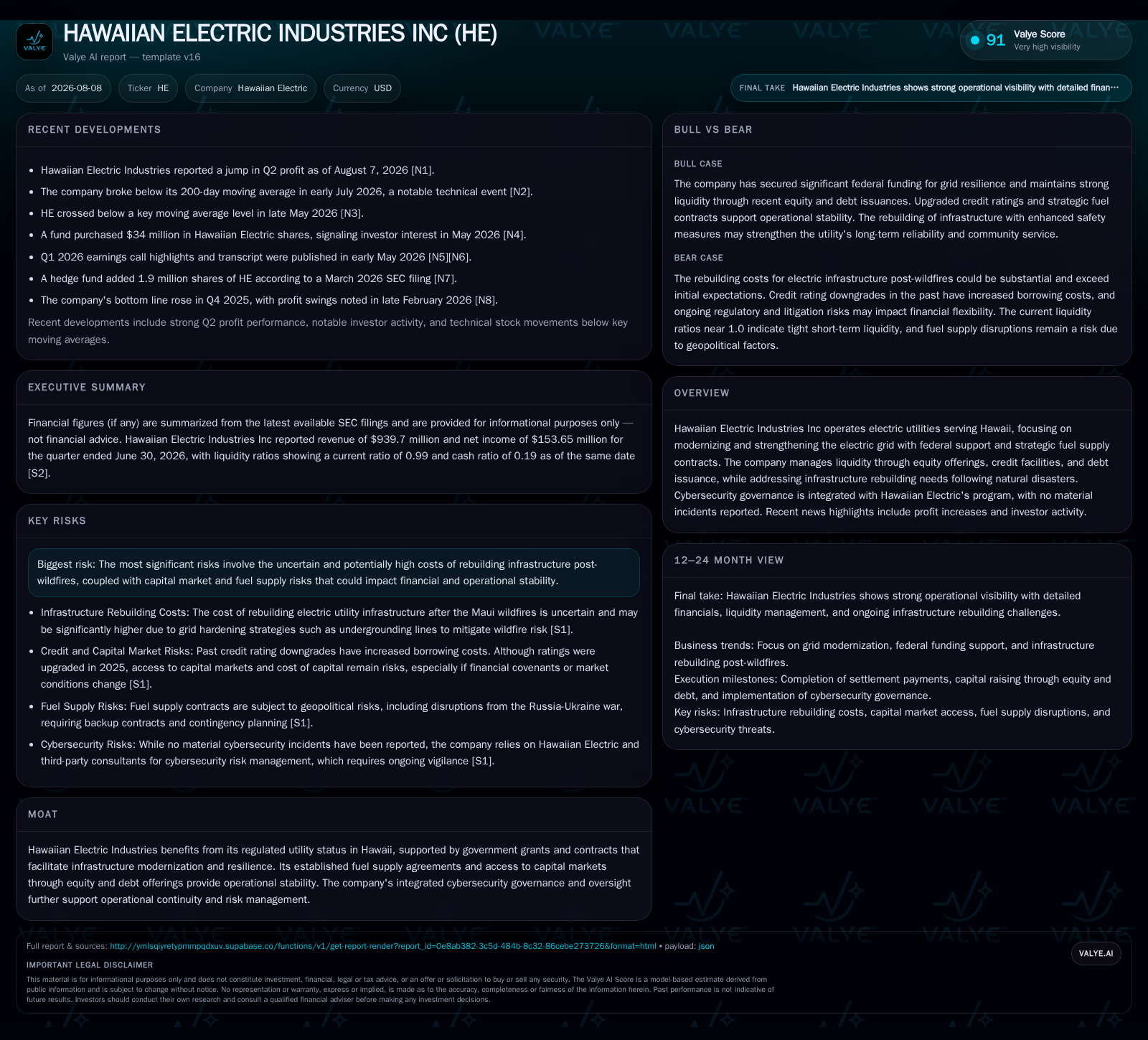
Hawaiian Electric Industries (HEI), a regulated utility serving Hawaii, recently reported improved profitability amid ongoing infrastructure rebuilding following natural disasters. The company is leveraging $95 million in federal grants to modernize its transmission and distribution grid and has extended key fuel supply contracts to stabilize costs amidst global supply uncertainties. While capital expenditures rise to support grid hardening, HEI manages liquidity through equity offerings and credit facilities to fund a $479 million litigation settlement installment. Cybersecurity governance remains robust with no material incidents reported. Key risks include wildfire mitigation costs, credit rating pressure, and regulatory outcomes related to cost recovery.
Recent Operating Update
Hawaiian Electric Industries (HEI) filed its latest quarterly report on August 7, 2026, confirming ongoing strategic execution against multiple operational challenges [S2]. The company continues to recover from the 2023 Maui wildfires, having made the first $479 million installment payment related to the multi-year litigation settlement financed through a sizable equity offering conducted in September 2024 [S1], [S21]. While these legacy liabilities weigh on near-term financial flexibility, HEI's operating results benefit from disciplined management of fuel supply contracts approved by Hawaii's Public Utilities Commission (PUC), supporting stable cost recovery through energy cost recovery clauses (ECRC) embedded in regulated rates [S1].
Federal funding also plays an important role. HEI was awarded a significant $95 million grant by the U.S. Department of Energy under the Climate Adaptation Transmission and Distribution Resilience Program aimed at accelerating grid modernization and resilience in Hawaii. This investment aligns with HEI’s broader capex profile centered on infrastructure hardening including undergrounding power lines to mitigate wildfire risk—a necessary but more expensive approach given Hawaii's unique environmental hazards and recent natural disasters [S1], [S7].
Business Model Analysis
HEI operates as a regulated electric utility monopoly serving the Hawaiian Islands, deriving revenue predominately from distributing electricity to residential, commercial, and industrial customers within its defined service territories. The company’s earnings arise through an approved regulated rate base overseen by the PUC, which allows for cost recovery mechanisms including fuel expenses through ECRC adjustments and capital investment returns.
Revenue expands primarily through increases in electricity sales volume (MWh) driven by population growth and economic activity on the islands, alongside sanctioned rate base expansions spurred by new infrastructure investments. Fuel supply contracts underpin operating stability by mitigating direct commodity price exposure; notably, contracts with PAR Hawaii Refining ensure refined fuels supply post-2023 disruptions involving Russian crude oil sourcing sanctions. An approved backup contract with Vitol Inc. further guarantees resiliency against supply interruptions [S1]. These contracts are pivotal given Hawaii’s logistical constraints as an island market reliant on seaborne fuel deliveries.
Operating expenses are sensitive to fluctuations in fuel cost per MWh, as well as rising operating & maintenance (O&M) costs due to enhanced infrastructure upkeep requirements necessitated by severe weather events. Capital expenditures (CapEx) remain elevated relative to peers due to both mandated grid resilience enhancements and compliance with evolving regulatory standards around wildfire mitigation.
Monetization relies on PUC approvals for rate cases that incorporate capital spending programs; any delay or unfavorable ruling materially affects cash flow generation. Customer retention dynamics tend toward stability given limited alternative providers within island service territories; however, electrification trends such as adoption of electric vehicles may incrementally shift load patterns requiring adaptive system management.
Industry Structure and Competitive Position
Within the broader U.S. regulated electric utilities sector characterized by monopolistic regional franchises subject to comprehensive public oversight, HEI occupies a niche defined by geographical isolation and elevated environmental risk factors. Its peer set includes utilities confronted with similar infrastructure resilience challenges such as Pacific Gas & Electric (PG&E) — which also navigates wildfire liabilities — albeit PG&E operates on significantly larger scale.
Unlike large mainland utilities like Duke Energy or NextEra Energy that benefit from diversified geographic footprints or sizeable renewable asset portfolios, HEI is focused more narrowly on transmission and distribution operations supported by contracted generation or purchased power agreements. This concentration heightens vulnerability to localized weather events but enables focused operational expertise tailored to Hawaiian grid conditions.
HEI’s competitive moat stems largely from its regulated monopoly status combined with government-supported grant programs facilitating critical modernization investments. Its established fuel supply relationships reduce procurement risk relative to smaller fringe providers or independent power producers lacking such long-term contractual security.
Growth Drivers
Key growth drivers for HEI include increasing electricity demand fueled by population growth, tourism-related economic activity rebound post-pandemic impacts, and regional electrification trends that gradually raise baseline load levels. Federal and state grants targeting grid modernization directly subsidize CapEx outlays aimed at making the network safer and more reliable amidst mounting climate change pressures.
Grid modernization projects incorporating smart technology deployment improve operational efficiency, reduce outage frequency (measured via reliability indices like SAIDI/SAIFI), and enable smoother integration of renewable energy sources mandated under Hawaiian clean energy policies.
Regulatory approvals for expanded rate bases underpin topline growth potential while creating avenues for returns through authorized ROEs embedded in rate structures. Enhanced energy cost recovery clauses provide partial insulation against volatile fuel pricing.
Rebuilding efforts following wildfires also create incremental capital demand albeit at higher unit costs due to undergrounding initiatives – a vital component of longer-term risk mitigation but one that strains short-term margin profiles.
Risks and Constraints
HEI faces multiple structural risks including sizeable cost uncertainty associated with rebuilding infrastructure destroyed or compromised by wildfires. The mandated shift toward undergrounding lines elevates capital intensity far beyond prior overhead configurations—this increased expense can pressure returns unless effectively incorporated into future rates by regulators.
Fuel price volatility remains a perennial input cost risk despite long-term contracted arrangements; geopolitical factors affecting crude supplies can ripple through Hawaiian refining economics despite backup agreements mitigating some exposure.
Regulatory uncertainty over rate cases represents a watchpoint—adverse rulings could delay projected project recoveries or impose unfavorable cost-sharing terms reducing net income stability.
Cybersecurity governance appears robust integrated into Hawaiian Electric's framework; nonetheless evolving cyber threats require constant vigilance given growing digitization of grid assets [S1]
What to Watch Next
Upcoming investor focus centers on several milestones: PUC decisions regarding pending or forthcoming rate cases that will affect authorized returns on the expanded regulated rate base; progress updates on federal grant-funded modernization projects demonstrating tangible improvements in grid reliability metrics; contract renewals or negotiations extending fuel supply terms beyond mid-2026; ongoing effects of litigation settlement payments on cash flow profiles; developments in securitization capacity utilization; and periodic cybersecurity disclosures confirming absence of material incidents.
Monitoring system peak demand trends alongside residential adoption rates for electrification technologies will provide early signals about incremental volume growth sustainable over time.
Financial Profile Discussion
As of June 30, 2026, HEI held approximately $239 million in cash and equivalents against total debt near $2.27 billion resulting in net debt north of $2 billion—a leverage level not atypical of capital-intensive utilities engaged in significant rebuilds [F1]. Current assets slightly trail current liabilities yielding a near-par current ratio around 0.99 indicative of tight working capital balance [F1].
The company’s ability to raise approximately $558 million net proceeds from equity issuance in late 2024 evidenced access to capital markets critical for fulfilling large settlement obligations upfront without hampering operational funding needs [S1], [S21].
This analysis respects SEC-reported facts without extrapolation beyond sourced data points. It emphasizes how HEI’s unique island market dynamics combine regulated utility fundamentals with emerging risks around disaster resilience investment requirements and associated capital structure constraints.
Disclaimer: This is research-only, informational analysis and not investment advice. It may include AI-generated interpretation and general industry context. Always verify important details using primary sources.

Comments