
Canary Marinade Solana ETF: Staking Gains Bolster Regulated Solana Exposure
The Trust’s latest quarterly filing reveals how staking rewards enhance investor returns within a regulated ETF framework focused on Solana’s blockchain asset.
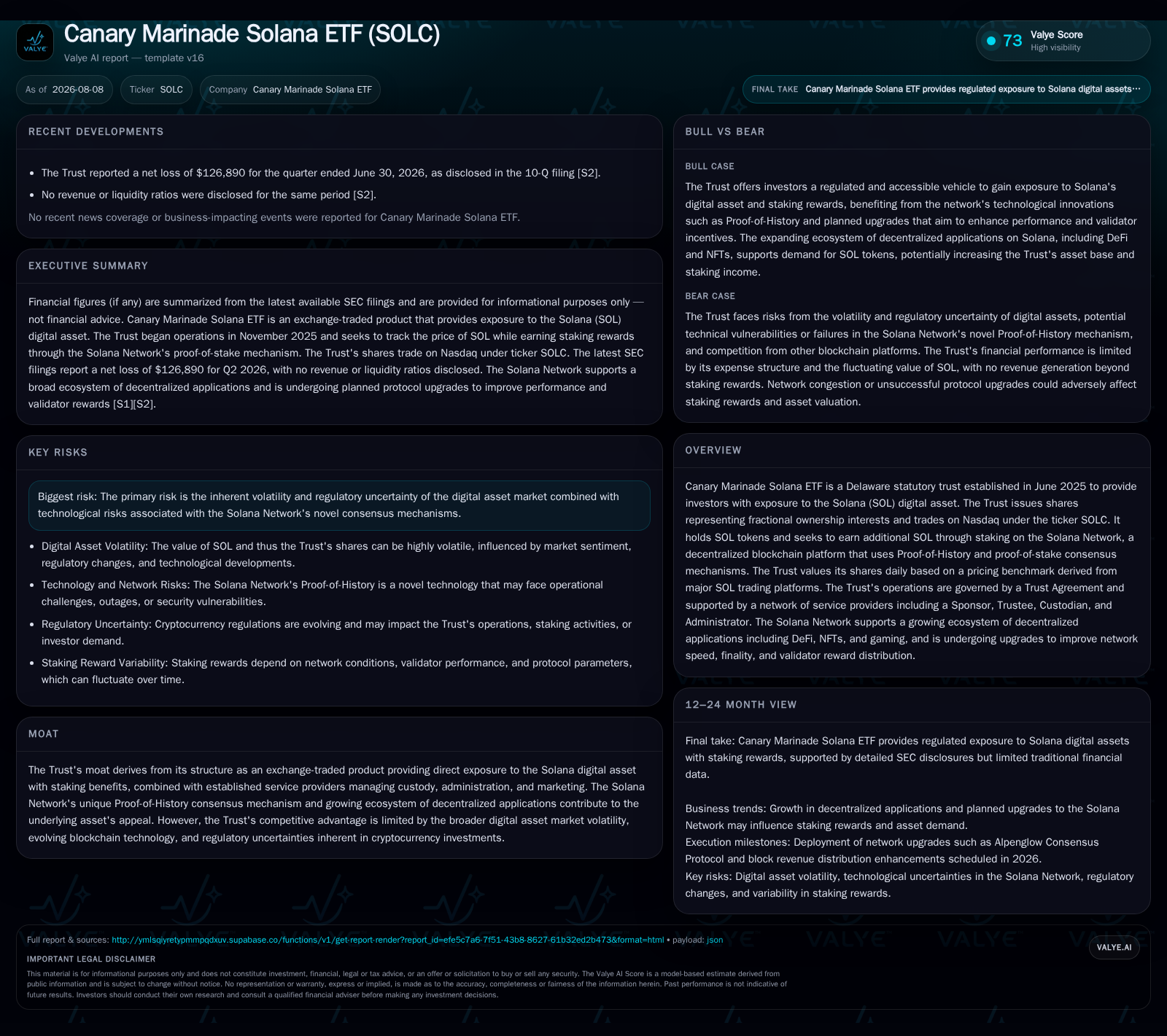
Canary Marinade Solana ETF (SOLC) reported its August 2026 quarterly update highlighting the accrual of staking rewards on its underlying SOL holdings, providing a yield buffer beyond pure price exposure. Established as a Delaware statutory trust, SOLC issues Nasdaq-listed shares that represent fractional ownership of staked Solana tokens, offering a regulated and liquid vehicle for crypto exposure without direct custody complexity. The Trust leverages recognized service providers, including BitGo for custody and U.S. Bancorp for administration, reinforcing operational security amid volatile digital asset markets. Investor appeal is driven by the combination of staking yield and network protocol innovation, though risks related to Solana’s technology and evolving regulatory environment remain significant.
Quarterly Staking Rewards Update Reframes Investor Returns Expectations
The Canary Marinade Solana ETF’s August 7, 2026 Form 10-Q provides the latest quantified insight into staking rewards earned on the Trust's underlying Solana (SOL) holdings [S2]. These staking rewards accrue by validating transactions on the Solana Network via its proof-of-stake consensus mechanism combined with its proprietary Proof-of-History innovation. Unlike pure price exposure to the cryptocurrency's spot market fluctuations, these rewards represent an incremental yield component directly enhancing total return to investors who hold SOLC shares. This yield element can help stabilize net asset value (NAV) per share performance during periods when SOL price volatility might otherwise depress returns. However, this benefit is exposed to protocol risks such as potential slashing penalties or network outages inherent in proof-of-stake systems. Tracking error against spot SOL prices may widen slightly as staking yields fluctuate based on network conditions but remains mitigated through precise daily valuation methodologies
ETF Structure Enables Direct Regulated Access to Solana’s Blockchain Protocol
Established in June 2025 as a Delaware statutory trust, Canary Marinade Solana ETF operates by issuing common shares that represent fractional undivided beneficial ownership interests in a pool of physical SOL tokens held in custody. These shares trade on the Nasdaq exchange under ticker symbol SOLC, providing investors with regulated equity-like instruments conveying economic exposure to both the appreciation of SOL tokens and the additional value from staking yield distributions. Pricing is conducted daily based on a net asset value established from a pricing benchmark aggregating major SOL trading platforms' quotes to ensure transparency and market accuracy.
The Trust's creation/redemption mechanism handles transactions in "Baskets" comprising blocks of 10,000 shares each. Authorized participants can create or redeem baskets by exchanging shares for the equivalent value of SOL tokens (net liabilities), facilitating share liquidity aligned with underlying asset real-time valuations. This structure invites institutional participation by enabling large-scale portfolio construction or liquidation while keeping market spreads narrow and tracking errors minimized. The regulatory wrapper reduces direct custody risk for retail investors unfamiliar with digital wallet management or blockchain operations while delivering transparent SEC-compliant disclosure [S1], [S2].
Custody and Operational Backbone: Service Provider Roles Mitigating Crypto Risks
Operational stability critical for investor confidence relies heavily on Canary Marinade’s established network of service providers detailed in SEC filings. BitGo Trust Company acts as custodian for all underlying digital assets—physical SOL tokens—employing state-of-the-art multi-signature security protocols recognized among leading digital asset custodians such as Coinbase Custody or BitGo itself in industry peer comparisons.
CSC Delaware Trust Company serves as Trustee ensuring fiduciary oversight consistent with Delaware corporate trust laws. Meanwhile, U.S. Bancorp Fund Services LLC fulfills multiple roles as Administrator, Accounting Agent, Transfer Agent, and also provides cash custody services through its affiliate U.S. Bank N.A., consolidating financial operations under experienced regulated entities.
Paralel Distributors LLC functions as Marketing Agent connecting product distribution channels with investors. This diverse ecosystem creates layered risk mitigation against hacking threats, operational failures, or regulatory lapses by separating duties among specialists proficient in their domains.
Together, these synergistic roles maintain continuous compliance with securities laws while addressing operational continuity concerns peculiar to digitized asset environments prone to cyber risk [S1].
Competitive Positioning Among Single-Asset Crypto ETFs Highlights Stakeholder Benefits and Limitations
Within the evolving landscape of digital asset exchange-traded products (ETPs), Canary Marinade’s Solana-focused ETF occupies a niche combining direct physical backing with active blockchain staking participation. This contrasts notably with larger benchmark offerings like Grayscale Bitcoin Trust (GBTC), which holds a single asset (Bitcoin) but traditionally lacked staking benefits due to Bitcoin's proof-of-work model.
Similarly, CoinShares Physical Bitcoin (BITC) provides physically-backed bitcoin ETPs but does not engage in yield enhancement through staking because Bitcoin lacks such mechanisms.
Moreover, futures-based ETFs like ProShares Bitcoin Strategy ETF (BITO) offer exposure via derivative instruments rather than physical holdings; these often experience greater tracking error relative to spot prices due to futures roll costs but avoid custody complexities.
SOLC's strategy to capitalize on Solana's unique proof-of-history plus proof-of-stake consensus delivers an identifiable incremental return vector but also concentrates risk around technology performance and specific tokenomics risks associated with slashing or network downtimes. This tradeoff differentiates it from peers and appeals particularly to investors seeking yield in addition to asset appreciation within a regulated environment provided by the Trust's legal structure [S1], [S2].
Growth Catalysts Encompassing Cryptocurrency Adoption and Blockchain Upgrades
The growth outlook for Canary Marinade Solana ETF is influenced by broader macro trends amplifying cryptocurrency investment demand alongside technological progress within the Solana ecosystem itself.
Institutional gateways opening up across financial intermediaries have increased inflows into regulated crypto investment vehicles like ETPs due to enhanced compliance clarity compared to direct crypto holdings. The expanding decentralized finance (DeFi), non-fungible token (NFT), and gaming applications running on Solana further underpin demand for native tokens including those held by the Trust.
Scheduled upgrades targeting improved network throughput speeds and augmented security measures on the protocol level stand to raise staking yields by optimizing transaction validation efficiency while reducing downtime risks—a positive signal for NAV growth via compounded staking returns.
These factors collectively improve investor confidence around sustainable staking revenue streams complementing outright token price appreciation potential driving assets under management expansion [S1]
Risks Rooted in Blockchain Technology and Regulatory Uncertainty Require Investor Vigilance
Despite encouraging developments, Canary Marinade acknowledges significant risk exposures tied both to inherent cryptocurrency volatility and uncertainties surrounding blockchain technologies.
Volatile pricing swings of SOL driven by speculative trading behavior directly affect NAV per share fluctuations realized by shareholders. Technical challenges unique to Solana's innovative Proof-of-History combined with proof-of-stake protocols include consequences like slashing penalties where validators lose staked tokens due to misbehavior or failure—risking reductions in expected rewards credited to the Trust.
Operational failure at any layer—custodian breaches or trustee lapses—pose counterparty risk potential despite established safeguards.
Regulatory environments worldwide remain unsettled; adverse interpretations could impose restrictions curtailing trading activity or imposing new compliance burdens impacting fund economics.
The Trust explicitly highlights these factors without speculating on outcomes but underscores their materiality when evaluating investment suitability within this novel asset class domain [S1], [S2], [S3].
Tracking Market Signals: What to Monitor in Shares Liquidity and NAV Alignment Next
Looking ahead, several KPIs inform ongoing assessment of Canary Marinade Solana ETF’s market health and execution efficacy: - Assets Under Management (AUM) growth rates signal sustained investor inflows which enhance the fund's scale economies potentially lowering expense ratios indirectly affecting net returns. - Share trading volume reflects secondary market liquidity quality; higher volume generally tightens bid-ask spreads minimizing investor trading costs compared to direct spot markets. - Tracking Error metrics monitor discrepancies between the share NAV—which includes staking yields—and underlying SOL spot prices aggregated across benchmarks used for daily valuation; low tracking error indicates efficient replication of economic exposure essential for investor trust. - Redemption/creation activity levels reveal institutional appetite dynamics adjusting supply-demand balance for shares versus actual token backing liquidity available through custodial mechanisms [S2]. Monitoring these indicators after each reporting cycle will clarify whether rising demand continues alongside effective operational governance minimizing divergences attributed to market friction or protocol anomalies
Disclaimer: This article does not constitute investment advice nor an endorsement of any financial instrument discussed herein. It aims solely to provide informed analysis based on public disclosures.
Disclaimer: This is research-only, informational analysis and not investment advice. It may include AI-generated interpretation and general industry context. Always verify important details using primary sources.

Comments