
Rayonier Expands Scale and Revenue Post-PotlatchDeltic Merger Amid Timber Price Volatility
Rayonier's latest quarterly results reflect integration progress from merger, strong timber sales growth, and continued capital discipline.
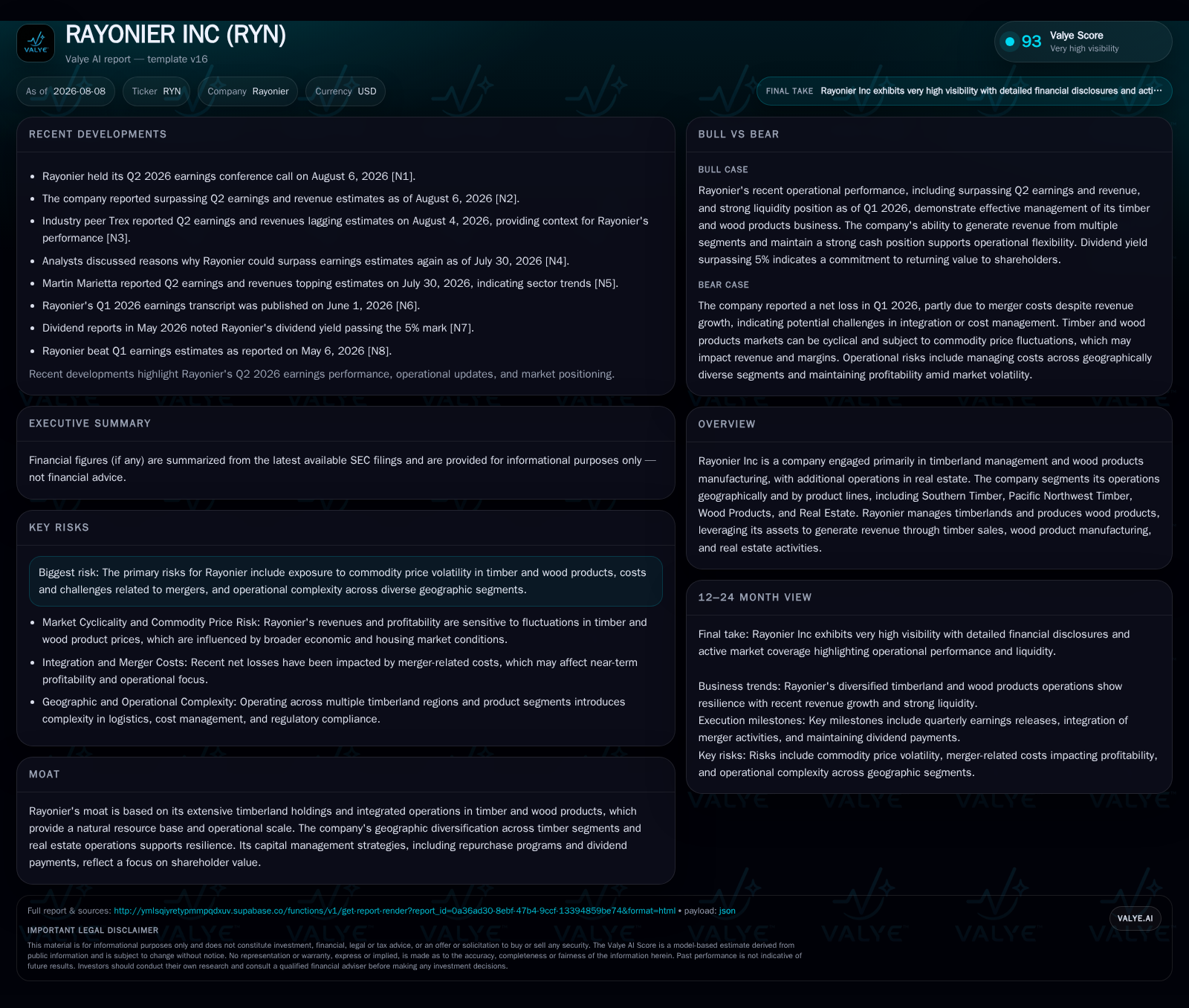
In Q2 2026, Rayonier Inc reported a substantial revenue surge driven primarily by timber sales following its recent merger with PotlatchDeltic Corporation. The company operates across diversified segments including Southern and Pacific Northwest timberlands, wood products manufacturing, and real estate development. Its integrated business model leverages extensive timberland assets to generate cash flow through timber harvesting and processing, complemented by real estate monetization. While commodity price volatility remains a key risk, Rayonier’s geographic diversification and long-term sustainable yield strategy underpin stable operations. Continued capital allocation flexibility, including dividends and share repurchases, supports shareholder value creation amid evolving market conditions.
Recent Operating Update: Scale Expansion and Revenue Growth
While earnings exact figures for Q2 are not detailed here, this sharp revenue rise fundamentally signals successful deal integration progress that enhances Rayonier’s presence in key U.S. softwood markets. The increased top line also tests the company’s ability to manage complexities of a larger combined footprint during commodity price cycles.
Business Model: Integrated Timberland Management with Diversified Income Streams
Rayonier is structured as a REIT focused principally on owning and managing high-quality timberlands—approximately 2 million acres spanning the U.S. South (about 1.69 million acres) and Pacific Northwest (circa 307,000 acres)—regions known for producing premium softwood lumber [S1]. These holdings are the linchpin of the company’s recurring income generation through sustainably managed harvest volumes intended to balance long-term biological growth with consistent cash flow.
Monetization occurs primarily through three channels: direct timber sales based on volume harvested (priced typically per ton or board feet), downstream wood products manufacturing converting logs into lumber or other materials adding processing margin capture, and real estate activities focused on monetizing higher-and-better-use land assets via development projects or land sales producing net operating income [S1,S9]
This vertical integration enables Rayonier to capture value both upstream (raw timber) and downstream (manufacturing) while supplementing cyclical timber revenues with diversified income sources from real estate operations which have lower revenue correlation to commodity market swings.
Industry Structure and Competitive Position
The timberland industry features high capital intensity coupled with long biological growth cycles requiring disciplined sustainable yield management—harvesting must align with reforestation rates and age-class profile maintenance to preserve inventory over decades. Rayonier's scale places it among large integrated peers like Weyerhaeuser and PotlatchDeltic (now merged), enabling operational efficiencies in both procurement/logistics and manufacturing throughput.
Geographically dispersed assets help mitigate regional demand-supply mismatches typical in forestry markets prone to weather impacts or localized pests/storms. Holding significant acreage in two core softwood-growing U.S. regions provides pricing power advantages versus smaller or more concentrated landlords. The recent merger notably increases this footprint but carries execution risk related to operational complexity.
Operating margins depend heavily on prevailing timber prices which are inherently cyclical due to housing starts fluctuations and supply constraints. Wood products manufacturing can provide upside margin contribution but also adds exposure to raw material cost volatility.
Pacific Northwest regions.
- Operating cash flows from core segments as a signal of margin stability amidst merger-induced cost changes.
- Real estate segment net operating income growth reflecting success of development projects amid market conditions.
- Capital expenditures focused on reforestation efforts and manufacturing maintenance revealing commitment to long-term asset health.
- Execution on synergy realization post-merger including integration cost savings or productivity improvements disclosed incrementally.
- Dividend payments consistency alongside any announced share repurchase activity illuminating capital allocation discipline.
- Possible impact from emerging carbon credit markets in enhancing future revenue streams tied to sustainable forestry practices.
Financial Profile Discussion
Rayonier maintains a solid liquidity position evidenced by $682 million cash & equivalents as of March 31, 2026 together with current assets of $896 million against current liabilities around $354 million yielding a healthy current ratio of approximately 2.53 suggesting sufficient short-term coverage [F1][S2]
Total debt was reported near $1.05 billion as of March 31, 2025 per available data; net debt after cash considerations was roughly $368 million at that time implying moderate leverage levels manageable under prevailing interest rate environments provided cash flows remain steady post-merger [F1]
Capital allocation policies emphasize flexibility accommodating dividends aligned with REIT requirements alongside opportunistic share repurchases when accretive—these moves combine with strategic investments in asset base expansion or enhancement [S5].
Top-line surged reflecting deal-driven scale effects rather than organic growth alone; ultimate margin trajectory will depend on operational integration success managing cost structures in harvesting plus production segments while balancing capital reinvestment demands. Continuous monitoring of free cash flow generation will clarify underlying business quality beyond headline revenue gains.
This analysis is intended solely for informational purposes based on publicly available data as of mid-2026 and does not constitute investment advice.
Disclaimer: This is research-only, informational analysis and not investment advice. It may include AI-generated interpretation and general industry context. Always verify important details using primary sources.

Comments