
Odyssey Marine Exploration’s Strategic Exploration Progress and Delisting Challenge
Odyssey Marine continues advancing its marine mineral exploration portfolio even as it confronts Nasdaq delisting pressures due to share price deficiencies.
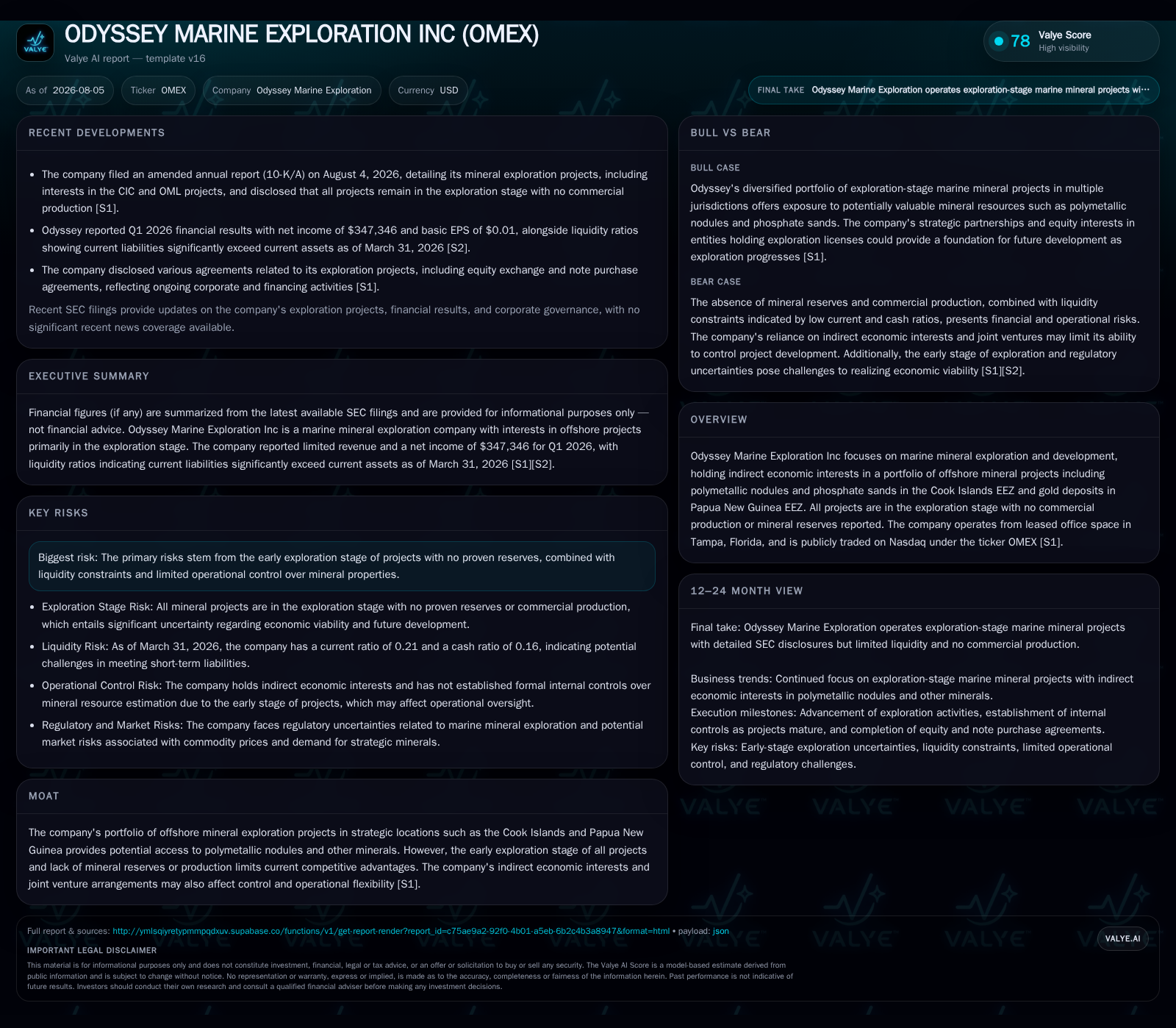
Odyssey Marine Exploration Inc’s latest quarterly filing highlights continued progress in early-stage offshore exploration projects across polymetallic nodules, phosphate sands, and gold deposits located primarily within exclusive economic zones (EEZs) such as the Cook Islands and Papua New Guinea [S2], [S1]. However, this operational advancement contrasts with a recent Nasdaq notice signaling failure to maintain the minimum $1.00 bid price, triggering potential delisting risk that introduces near-term financing and market-access uncertainties [S3]. The company’s business model centers on leveraging indirect economic interests and joint ventures in exploratory licenses lacking proven reserves, making technological, regulatory, and capital constraints critical factors shaping value realization over time. Odyssey’s capital-intensive burn paired with limited liquidity underscores financial vulnerability before asset monetization becomes feasible [F1]. Peer context reflects similar upstream marine exploration entities confronting analogous exploration risk profiles and regulatory complexities.
Quarterly Update Spotlight: Operational Advances vs Market Listing Risks
Odyssey Marine Exploration’s May 2026 quarterly report details continued activity in its suite of exploratory mineral projects within various exclusive economic zones (EEZs). Despite these advancements in resource delineation efforts — focused mainly on polymetallic nodules, phosphate sands, and gold deposits — the company faces immediate market-access pressure following a July 2026 Nasdaq notification regarding failure to maintain a minimum $1.00 per share bid price for 30 consecutive business days [S2], [S3]. This official warning initiates a compliance period wherein Odyssey must restore adherence or face delisting implications that could materially affect liquidity availability and investor confidence. The juxtaposition of strategic asset development against pressing listing continuity concerns underscores a pivotal moment in Odyssey’s trajectory.
Offshore Exploration Business Model: Portfolio Composition and Economics Under the Surface
Odyssey operates a portfolio-centered model heavily dependent on acquiring exploration licenses or indirect economic rights via joint ventures instead of direct mining concessions or developed assets. Its key holdings include polymetallic nodule claims within the Cook Islands EEZ, phosphate sands explorations linked to previous interest areas now under reconsideration post-mining concession revocation events, and gold deposit prospects in Papua New Guinea waters [S1]. No mineral reserves or commercial production have been recorded; thus revenue generation is currently non-existent aside from ancillary sources potentially tied to licensing or partnership arrangements.
The business economics remain tightly conditioned on progressing geophysical surveys toward feasibility studies that validate mineralization continuity suitable for commercial extraction. High entry barriers characterize the sector given the technical complexity, environmental permitting rigors, and multiyear lead times endemic to offshore mining contexts.
Competitive Dynamics in Early-Stage Marine Mineral Exploration: Peers and Positioning
Within the upstream marine mineral exploration niche, Odyssey’s focus on diversified EEZ rights with indirect stakes contrasts with vertically integrated peers such as DeepGreen Metals or The Metals Company who similarly target polymetallic nodules but may hold more direct resource development frameworks. Like Nautilus Minerals previously faced, Odyssey grapples with technological challenges intrinsic to subsea mining operations alongside nuanced geopolitical risk factors arising from jurisdictional oversight of remote oceanic regions.
Reliance on joint ventures dilutes operational leverage but allows a spreading of capital intensity risks — a common strategy among peers—but potentially restricts swift decision-making and project control. This comparative analysis illustrates typical trade-offs faced by early explorers balancing asset breadth versus depth in project ownership.
'Inventory of Exploration Milestones': Achieved Geological Insights and Strategic Levers for Value Creation
Operational disclosures signal incremental progress in geological survey completions across targeted blocks encompassing polymetallic nodules and phosphate sands zones [S2], [S1]. Odyssey has invested capital expenditures accordingly into advancing resource delineation phases necessary before transitioning toward commercial feasibility assessments.
While precise resource estimates (measured/indicated/inferred categories) remain undisclosed due to preliminary stages, expansion of licensed acreage under joint venture agreements hints at strategic positioning aimed at maximizing future optionality. Advancing environmental permitting frameworks also remains vital according to periodic updates accompanying filings.
'What Makes an Offshore Mineral Project Viable?' Regulatory and Technological Filters on Growth Prospects
Key bottlenecks for Odyssey revolve around securing comprehensive environmental permits amidst stringent regulatory standards governing ocean floor disturbance coupled with technology maturation concerns impacting operational cost assumptions. Environmental approval processes notoriously extend timelines uncertainly impinging project scheduling.
Technological readiness specifically addresses deep-sea extraction methodologies capable of safely recovering target minerals while minimizing ecological footprint — an area where peer firms have varied adoption speeds influencing project feasibility economics. These factors inherently elevate risk premiums investors assign until demonstrable milestones are achieved.
Capital Deployment and Partnership Significance: Financing Exploration Amid Uncertainties
Financial disclosures indicate substantial ongoing capital intensity demanded by extensive exploratory campaigns involving seismic surveys, sampling expeditions, and associated administrative costs. Cash & equivalents totaled roughly $2.1 million against current liabilities exceeding $13 million as of March 31, 2026 — underscoring persistent liquidity pressures faced by Odyssey absent revenue inflows [F1]
Joint venture arrangements offer partial capital burden sharing but do not fully mitigate exposure given operational cost rise linked to advanced survey phases. Continuous funding needs raise dilution risks if equity financing occurs under constrained market access scenarios like Nasdaq delisting threats.
'Liquidity Tightrope': Financial Position Limits Amid Capital Intensive Exploration Phase
Odyssey exhibits a current ratio of approximately 0.21 reflecting significant mismatch between short-term assets relative to current obligations at quarter-end March 2026 [F1]. The company holds about $2.1 million in cash and equivalents as of the same date [F1].
The low liquidity signals heightened vulnerability amid protracted exploration cycles typical for marine mineral pioneers, inciting scrutiny over sustainable capital management strategies essential for maintaining operations until commercial prospects are viable.
'To Watch Next': Critical Catalysts in Permitting, Joint Venture Activity, and Technology Adoption
Looking ahead, milestones worthy of close attention include progress updates on merger completion with American Ocean Minerals Corporation envisaged late Q2 / early Q3 2026 which may influence scale dynamics or financial strength [S3]. Proxy solicitations related to this transaction will also serve as barometers for governance direction.
Permitting advances particularly government approvals pertinent to Mexican-based Phosagmex projects will significantly impact asset valuations considering prior concession revocation setbacks [S1], [S24]. Joint venture partner expansions or modifications could reconfigure risk-sharing frameworks additionally affecting operating leverage.
Monitoring trends in deep-sea mining technology adaptations embraced by Odyssey versus peers will provide insights into practical pathway improvements mitigating cost escalations inherent to marine extraction environments.
Odyssey Marine Exploration Inc presents an archetypal case study of a nascent marine mineral explorer balancing tangible progress in expanding early-stage resource understanding against acute financial market headwinds exemplified by Nasdaq compliance challenges. This dual narrative frames core industry realities where long investment horizons, stringent regulatory filters, subdued near-term liquidity visibility, and reliance on collaborative frameworks dictate cautious valuation underpinnings pending hard resource validations or monetization avenues. Forward movement hinges not only on scientific breakthroughs around surveyed resources but equally on adeptness navigating capital markets’ immediate expectations tied to stock listing sustainability.
Disclaimer: This is research-only, informational analysis and not investment advice. It may include AI-generated interpretation and general industry context. Always verify important details using primary sources.

Comments