
Crescent Biopharma Advances Bispecific and ADC Pipeline Amid Strong Cash Reserves
Clinical-stage oncology biotech Crescent Biopharma progresses CR-001 trials and expands ADC programs while maintaining robust liquidity.
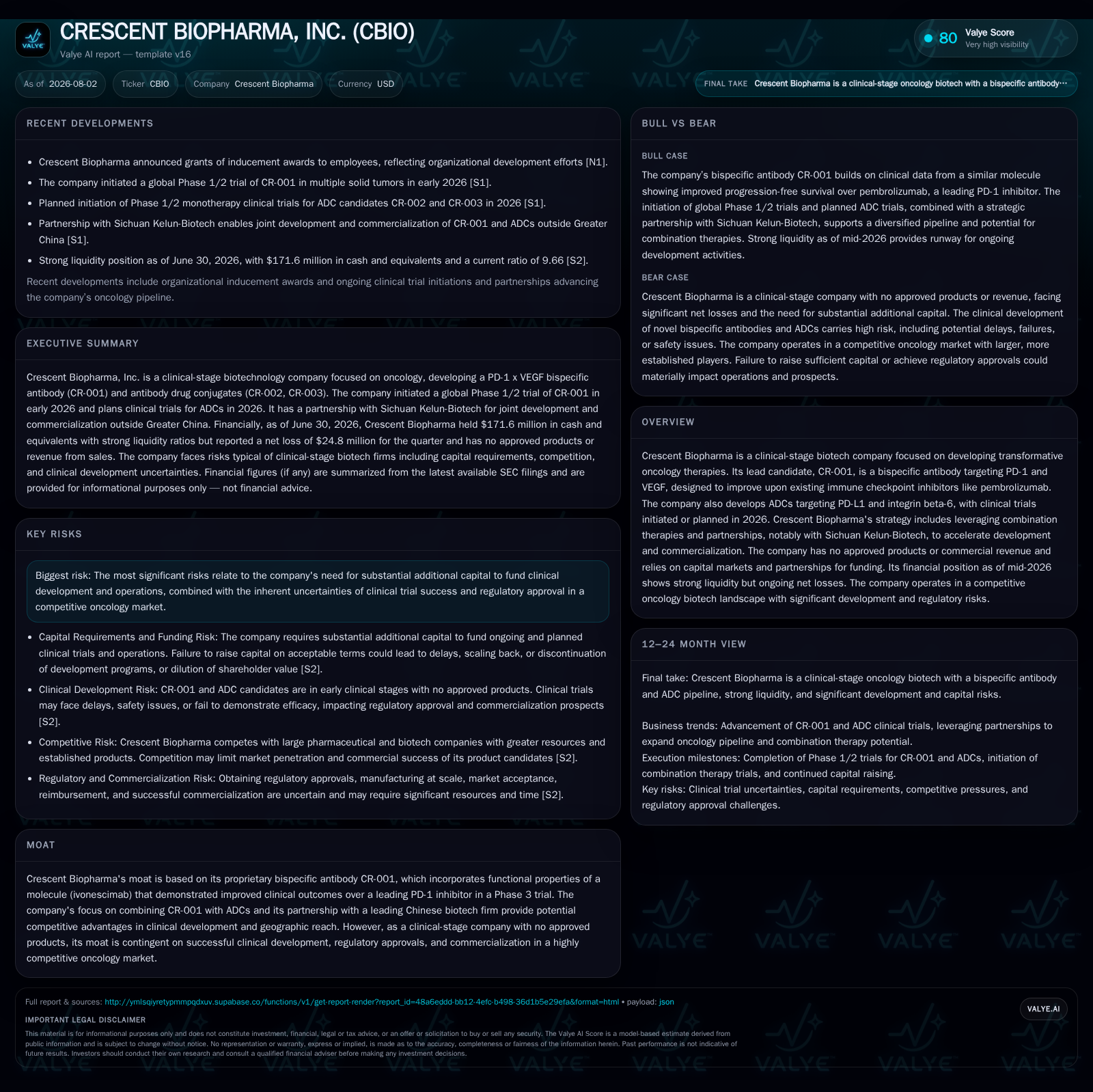
Crescent Biopharma, a clinical-stage biotechnology company developing novel oncology therapies, recently initiated a global Phase 1/2 trial of its lead bispecific antibody CR-001 and plans to advance two antibody drug conjugates (ADCs) into clinical testing in 2026. The company’s strategy leverages combination therapies and a strategic partnership with Sichuan Kelun-Biotech to accelerate development. While Crescent holds a strong cash position with $171.6 million in cash and equivalents as of mid-2026, it faces ongoing net losses reflecting typical early-stage biotech capital intensity and high clinical risk. Success in clinical milestones and sustained financing will be critical to validate its differentiated bispecific approach versus existing immune checkpoint inhibitors.
Recent Operating Update
Crescent Biopharma reported operational details in its 10-Q filing for the quarter ended June 30, 2026, highlighting major progress on its development programs [S2]. Most notably, the company initiated the global Phase 1/2 ASCEND trial evaluating CR-001, its lead bispecific antibody candidate that simultaneously targets PD-1 and VEGF pathways. This design aims to address limitations seen with current immune checkpoint inhibitors such as pembrolizumab by adding antiangiogenic effects directly into one molecule.
Additionally, Crescent outlined plans to begin clinical trials for two antibody drug conjugates (ADCs), designated CR-002 and CR-003. These ADCs each target distinct tumor antigens (PD-L1 and integrin beta-6) and are slated for monotherapy studies starting later in 2026. Importantly, Crescent expects to conduct the first combination trial assessing the synergy between CR-001 and these ADCs within the year [S2], [S3]. This complements its strategic intent to build a multi-modal oncology portfolio leveraging both bispecific antibodies and ADCs.
No commercial products or revenues currently exist as all candidates remain investigational. The company continues to operate at a net loss consistent with typical biotechnology firms focusing on costly preclinical and clinical development phases [S1]
Business Model Analysis
As a clinical-stage biotechnology company specializing in oncology therapeutics, Crescent Biopharma generates no product sales revenue yet; instead, value creation depends entirely on advancing multiple therapeutic candidates through early-to-mid stage clinical trials toward regulatory approval [S1]. Revenue sources traditionally anticipated would include licensing milestone payments or future royalties upon commercialization — neither present currently
The core offering centers around biologic molecules developed using advanced protein engineering techniques: a bispecific antibody (CR-001) designed to simultaneously inhibit PD-1 immune checkpoints while blocking VEGF-mediated angiogenesis, paired with antibody drug conjugates that deliver cytotoxic agents specifically to tumor cells expressing PD-L1 or integrin beta-6. These mechanisms aim to enhance efficacy either alone or in combination through complementary pathways.
Funding for operations comes primarily through equity financing and partnership collaboration rather than product sales [S1]. The partnership with Sichuan Kelun-Biotech is strategic for geographic expansion particularly in China’s large oncology market; it also provides development support that may extend operational capacity beyond internal capabilities [S1]. The company's revenue mechanics thus hinge on securing additional capital injections tied closely to achieving favorable clinical milestones.
Margins are currently negative due to R&D expense outpacing any income sources; they may improve significantly post-commercialization if candidates reach approval endpoints. Key revenue drivers will be successful pivotal trial outcomes leading to regulatory submissions worldwide.
Industry Structure and Competitive Position
Crescent Biopharma operates within the highly competitive clinical-stage oncology biotechnology sector dominated by extensive efforts around immune checkpoint inhibitors (ICI). Merck’s Keytruda (pembrolizumab), the market-leading PD-1 inhibitor with annual sales exceeding $30 billion globally, sets a high bar both clinically and commercially [S1]. Other companies are developing next-generation ICIs or bispecific antibodies intending to improve response rates or durability.
Crescent's main differentiator lies in its bispecific format combining PD-1 blockade with VEGF inhibition within one molecule. This dual targeting seeks not only immune activation but suppression of tumor neovascularization for enhanced anti-tumor effect — an approach validated in principle by prior data with ivonescimab showing outcomes superior to pembrolizumab in Phase 3 testing [S1]. However, this differentiation remains vulnerable until large-scale trial data confirm improved efficacy and safety.
Its ADC portfolio diversifies risk by addressing tumor types expressing alternative markers not universally targeted by current ICIs. The move toward combination therapies incorporating its bispecific plus ADCs reflects industry trends aimed at overcoming resistance mechanisms inherent in single-agent immunotherapies.
Compared to peers such as Mirati Therapeutics or Seagen who have frontrunners in similar modality spaces with more advanced clinical assets or approved products, Crescent remains earlier stage with associated uncertainties but also opportunistic upside should pipeline progression materialize successfully.
Growth Drivers
Key growth drivers include:
Clinical Trial Progress: Enrollment rates in the ASCEND trial along with milestone completions of Phase 1/2 studies for CR-002 and CR-003 will pave regulatory engagement opportunities. Demonstrating superior patient response rates or improved safety compared to existing standards will be critical.
Regulatory Milestones: FDA acceptance of investigational new drug (IND) applications and eventual breakthrough therapy designations would propel valuation and access financial resources from partners/investors.
Partnership Expansion: Strengthening collaboration with Sichuan Kelun-Biotech could facilitate faster development timelines and provide regional commercialization channels aiding eventual market penetration.
Combination Therapy Development: Successfully executing combination trials validating synergistic efficacy between CR-001 and ADCs may open broader indications beyond monotherapy use, enhancing commercial potential.
Capital Financing Capacity: Maintaining sufficient cash runway enables uninterrupted R&D campaigns; positive interim data can catalyze further capital raises under favorable terms.
Risks and Watchpoints
Several critical risks include:
Clinical Trial Uncertainties: As is typical for biotech firms without approved products, significant risk exists that any candidate may fail efficacy or safety endpoints causing program delays or discontinuations.
Capital Requirements: Substantial funding needs persist due to costly late-stage trials. Rising interest rates and volatile biotech equity markets exacerbate fundraising challenges potentially diluting shareholder value if equity issuance occurs under pressure [S1], [S2].
Regulatory Approval Challenges: The dual-targeting mechanism requires thorough regulatory scrutiny regarding safety profiles; unexpected adverse events linked to VEGF inhibition could limit approvals.
Competition: Established checkpoint inhibitors dominate many malignancies; Crescent must demonstrate compelling benefits over entrenched therapies like pembrolizumab that physicians currently favor based on extensive real-world experience.
Manufacturing Scale-Up: Transitioning from small-scale clinical production to commercial scale for bispecific antibodies and ADCs involves complexities around antibody conjugation consistency affecting supply reliability.
Monitoring enrollment velocity, interim safety reports from active trials, progression through IND enabling studies for new candidates, liquidity status updates, partnership deal expansions or amendments constitute important near-term indicators of operational health.
What to Watch Next
Investors should focus on several upcoming milestones:
- Enrollment progress announcements from the ASCEND Phase 1/2 trial evaluating CR-001 efficacy/safety.
- Initiation timing for monotherapy trials of CR-002 and CR-003 expected within calendar year 2026.
- Updates regarding the ADC combination study commencement alongside CR-001 showcasing possible synergistic effects.
- Regulatory communications such as FDA feedback on ongoing studies or granting of fast track designations which would accelerate pathways.
- Financial disclosures highlighting cash burn trajectories relative to current reserves impacting timing/flexibility of next financings.
Financial Profile Discussion
As of June 30, 2026, Crescent Biopharma holds $171.6 million in cash and equivalents against current liabilities of approximately $18.5 million resulting in a current ratio near 9.7—an ample liquidity buffer suitable for supporting operations well into future clinical phases [F1]. This substantial cash position underpins ongoing expensive clinical activities including dosing patients globally in ASCEND.
Operating expenses remain elevated due predominantly to research & development costs integral to advancing multiple early-stage assets [S2]. No revenues from product sales have been realized historically nor are expected imminently given pipeline status [S1]. The company’s net loss mirrors typical patterns seen across clinical-stage biotechs prior to product approvals when R&D expenses massively outweigh income streams.
Going forward, sustaining financing capability is vital; economic headwinds in capital markets heighten fundraising difficulty risks particularly amid rising interest rates referenced in filings [S1]. Strategic partnerships thus serve dual roles providing non-dilutive funding facets plus developmental expertise mitigating total cash burn requirements internally.
Continued burn rate monitoring tied dynamically against enrollment pace and milestone achievement represents essential financial/operational integration metrics going forward. Capital efficiency relative to peer mid-stage immuno-oncology biotechs will help contextualize sustainability until regulatory successes permit transition toward commercialization-derived revenues.
This analysis is based solely on publicly disclosed filings as of mid-2026 without predictive commentary or investment advice.
Disclaimer: This is research-only, informational analysis and not investment advice. It may include AI-generated interpretation and general industry context. Always verify important details using primary sources.

Comments