
Advanced Energy Industries Strengthens Financials Amid Semiconductor Equipment Demand Momentum
AEIS reports solid Q2 2026 earnings and strong liquidity, reflecting resilience in semiconductor equipment components amid industry cycles.
Advanced Energy Industries Inc (AEIS) released strong second-quarter results for 2026, underscored by robust earnings per share, ample liquidity, and a healthy current ratio. The company's business model centers on supplying critical power management and precision components to semiconductor fabs and electronic device manufacturers, positioning it within a cyclical but structurally growing semiconductor equipment sector. While competitive and cyclical risks remain, AEIS’s balance sheet strength and continued product relevance support its operational stability. Key upcoming milestones include monitoring design win trends, capital expenditure cycles in semiconductor fabrication, and the impact of geopolitical factors on supply chains.
Recent Operating Update
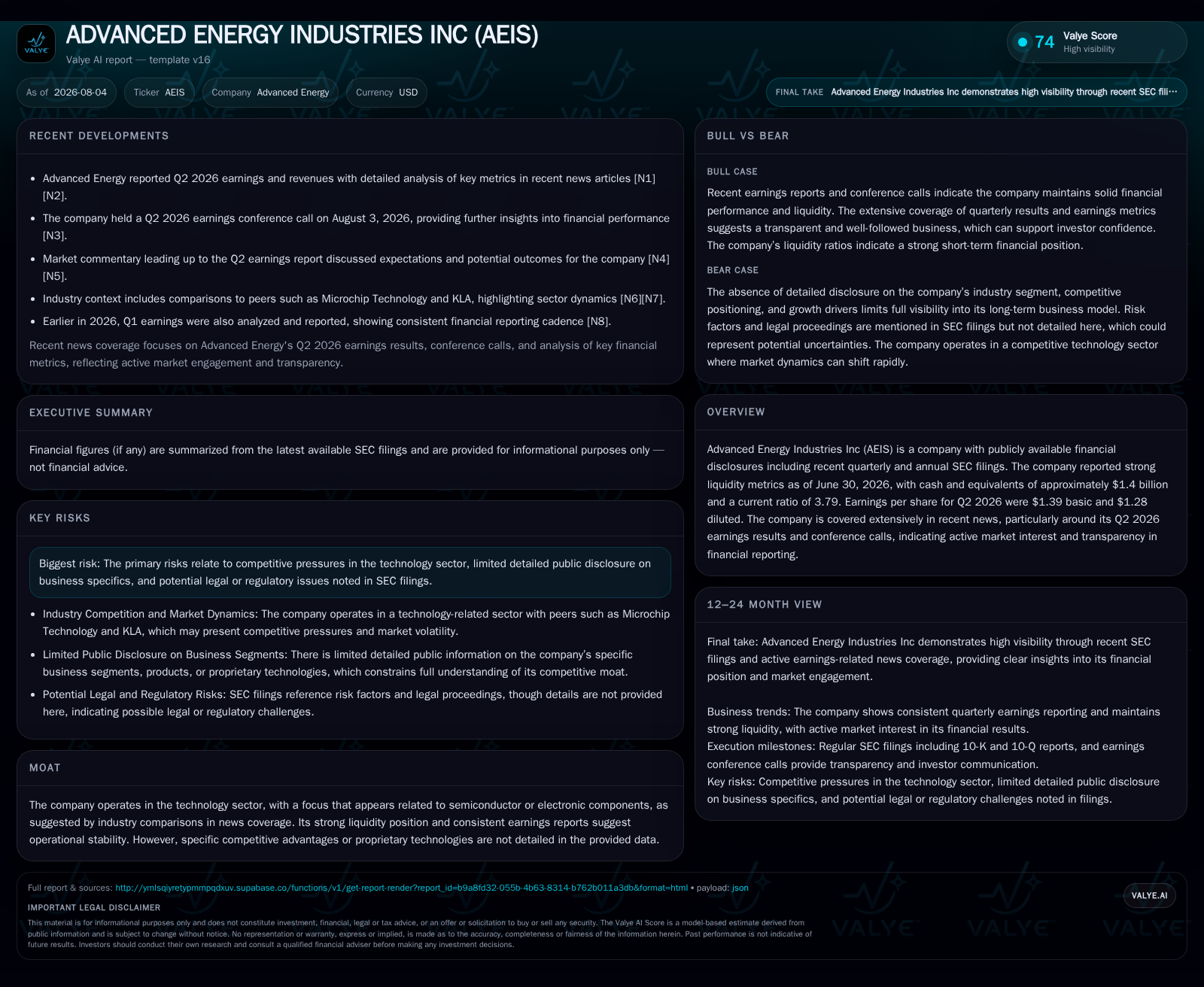
Advanced Energy Industries Inc (AEIS) reported its second-quarter earnings for fiscal 2026 on August 3, confirming a continuation of solid financial performance within the context of the semiconductor equipment components sector [S2][S3]. Notably, adjusted earnings per share came in at $1.39 basic and $1.28 diluted for Q2 2026—results that beat analyst expectations as corroborated by market coverage around the release day [N1][N2]. This outperformance signals operational leverage despite ongoing cyclical volatility characteristic of the semiconductor industry.
Business Model: Upstream Enabler in Semiconductor Manufacturing
AEIS operates predominantly upstream in the semiconductor manufacturing value chain by designing, manufacturing, and selling crucial power management products and components used in wafer fabs and electronics assembly processes [S1]. Its clientele consists mainly of semiconductor foundries, integrated device manufacturers (IDMs), and fabless companies who rely on precise power solutions to enable chip fabrication at advanced nodes.
The company’s revenue mechanics revolve around delivering specialized equipment sales coupled with aftermarket services. These latter services can generate recurring revenue streams with higher gross margins compared to initial product sales. Revenues fluctuate based on several key factors: capital expenditure cycles in fabs—particularly expansions or upgrades driven by new technology nodes—and AEIS’s ability to secure design wins that embed their products into next-generation fabrication tools.
Profitability drivers include product mix shifts toward more complex and higher ASP (average selling price) components aligned with advanced node requirements, attach rates that reflect how extensively AEIS products are utilized per unit fab capacity expansion, and efficiently managing channel inventory levels amidst supply chain challenges.
Industry Structure and Competitive Position
The broader semiconductor equipment industry is characterized by high capital intensity, rapid technological evolution, and fluctuating demand closely linked to semiconductor capex cycles. AEIS competes indirectly with large semiconductor equipment manufacturers such as Applied Materials and Lam Research that offer wafer fab toolsets but also overlaps with component suppliers such as MKS Instruments who focus on subsystems or parts.
In this ecosystem, AEIS’s strategic strength lies in its niche specialization in power management and precision components essential across various fabrication processes. Maintaining a favorable book-to-bill ratio—a critical KPI signaling incoming orders relative to shipments—is pivotal for gauging future revenue momentum given the long lead times typical in capital equipment supply chains. Customer concentration risk is moderated by serving multiple major fab operators globally but still remains a watchpoint due to dependence on fab capex budgets.
Growth Drivers
Growth for AEIS is underpinned primarily by ongoing expansions of semiconductor fabrication capacities globally driven by increasing demand from end markets like 5G wireless infrastructure, AI applications, automotive electrification, IoT devices, and data centers requiring cutting-edge chips. The transition to smaller technology nodes compels fabs to refresh or upgrade their manufacturing equipment suites—potentially raising ASPs and aftersales attach rates for AEIS’s specialized power products.
Government incentives targeting domestic semiconductor manufacturing bolster capital spending momentum in key regions such as the U.S., Taiwan, South Korea, and Europe, indirectly benefiting suppliers like AEIS. Moreover, replacement cycles from existing fabs upgrading aging equipment further support steady aftermarket service revenues.
Risks / Watchpoints / Growth Constraints
AEIS faces several structural risks inherent to its industry segment evident from recent SEC risk disclosures [S2][S20]. Chief among these is the cyclicality tied tightly to fab capex expenditures subject to broader macroeconomic conditions like global demand slowdowns or inventory corrections downstream.
Competitive dynamics represent another challenge where rapid innovation cycles can render some product lines obsolete or less relevant if design wins do not keep pace with evolving fab requirements. Supply chain disruptions—as seen recently across semiconductor sectors—can constrain component availability impacting delivery schedules.
Customer concentration introduces dependency risks; a handful of major fabs account for most orders so any reduction or delay from these customers could materially affect revenue visibility.
Regulatory scrutiny including trade restrictions or export controls can also impact operations given AEIS’s global customer footprint.
What to Watch Next
Upcoming indicators critical for judging AEIS’s trajectory include:
- Book-to-bill ratios reported periodically: A sustained above-1 reading would confirm strong order momentum ahead.
- New design win announcements or contract awards pointing toward enhanced penetration at emerging technology nodes.
- Aftermarket service revenue evolution confirming stickiness and margin improvements beyond initial sales.
- Corporate announcements regarding capacity expansion or operational efficiencies tackling product cycle duration.
- Geopolitical developments influencing supply chain lead times or access to key materials/markets.
- R&D spending relative to revenue reflecting commitment to innovation pipeline crucial for sustaining competitive differentiation.
Financial Profile Discussion
Advanced Energy’s financial profile as of mid-2026 quarter-end shows cash reserves of about $1.4 billion against total debt near $575 million reported three months earlier, translating into an approximate net cash position of $821 million [F1]. Current assets of $2.41 billion and current liabilities of $636 million yield a current ratio of 3.79, indicating solid short-term liquidity [F1]. This balance sheet strength supports operational stability through cyclical downturns typical for capital equipment suppliers reliant on volatile semiconductor capex flows.
Additionally, recent financing activity involving exchange transactions related to convertible notes has improved debt maturity profile without significant dilution impact evident so far [S17][S19]
Margins likely benefit from favorable product mix shifts toward higher ASP offerings aligned with advanced fab requirements; however continuous monitoring of gross margin mix remains important given possible pricing pressures in highly competitive segments.
In conclusion, Advanced Energy Industries demonstrates resilient execution within a demanding cyclical environment marked by structural growth drivers tied to technology node progression and fab capacity expansions. The company's disciplined approach to balance sheet management alongside its specialized product portfolio suggests durable operational footing while requiring vigilance over ongoing sector volatility drivers affecting demand patterns.
Disclaimer: This is research-only, informational analysis and not investment advice. It may include AI-generated interpretation and general industry context. Always verify important details using primary sources.

Comments