
Installed Building Products Expands Amid Construction Cycles With Robust Capital and Risk Controls
IBP leverages acquisitions and disciplined risk management to navigate cyclical construction sector dynamics.
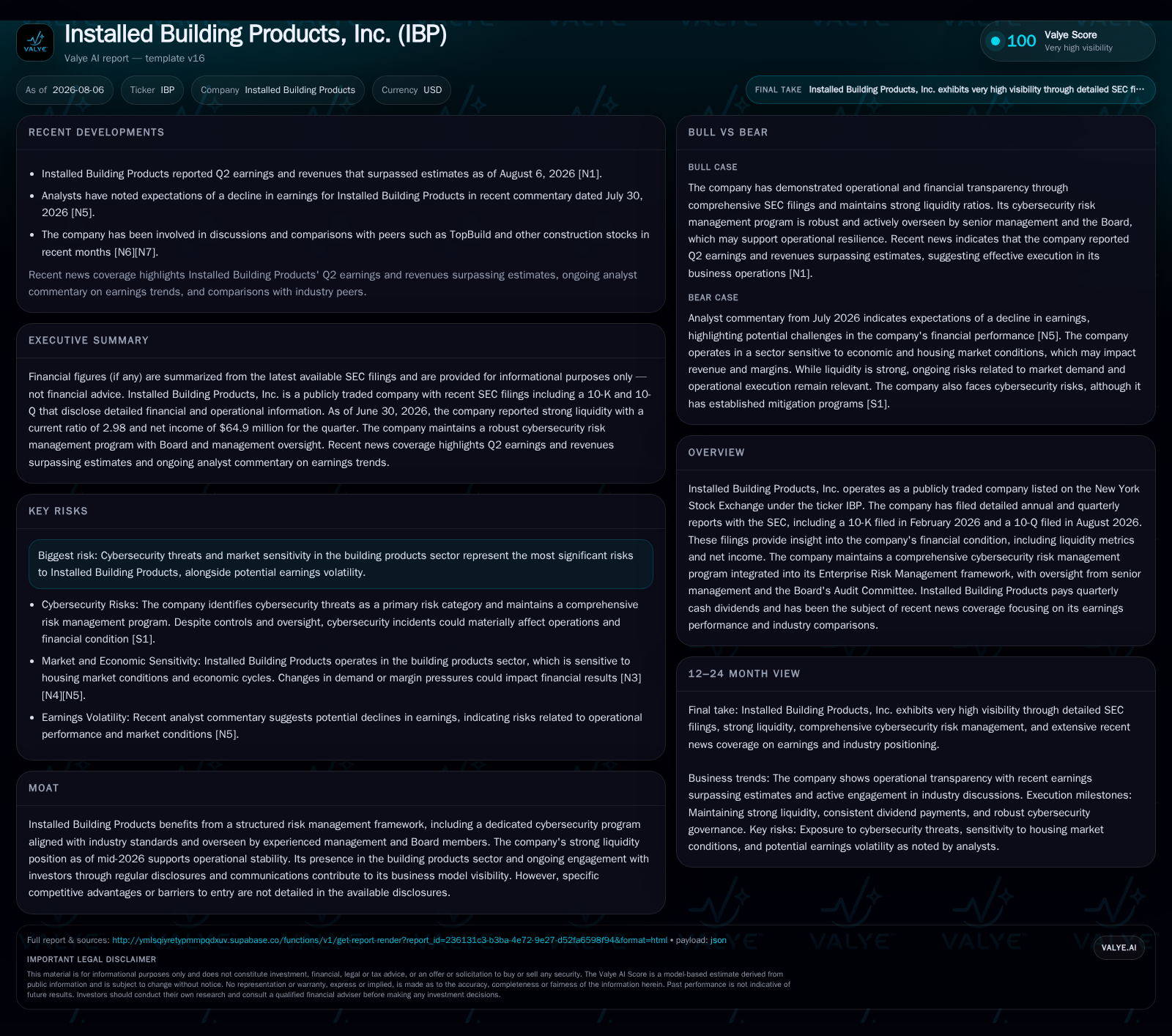
Installed Building Products, Inc. (IBP) reported Q2 2026 results showing resilience through construction cycle fluctuations with revenue and operational updates detailed in its latest 10-Q. The company’s business model centers on installation services for building products across residential and commercial projects, with growth supported by strategic acquisitions and geographic expansion. Despite industry headwinds such as labor market constraints and supply chain pressures, IBP maintains a strong liquidity position and integrates cybersecurity within enterprise risk management frameworks. Key risks include cyclicality in construction demand and margin pressures from competitive pricing and labor costs.
Latest Operating Update Highlights Resilience during Cyclical Pressures
Installed Building Products’ Q2 2026 Form 10-Q filing confirms continued operational stability despite broader residential construction softness seen across peers [S2], [N1]. The company demonstrated consistent execution of its installation services business model focused on essential interior finishing components such as insulation and drywall. Most notably, IBP’s operations benefited from recent acquisitions completed earlier in the year that augmented geographic coverage and service offerings without materially increasing financial risk [S6], [S9]. These expansion initiatives align with industry practice where scale enables better workforce deployment and supply chain logistics control.
The accompanying earnings release announced a quarterly dividend maintaining shareholder returns during capital expenditures aligned with growth objectives [S5]. This dividend consistency is notable given sector headwinds like housing demand fluctuations that often pressure subcontractors servicing builders.
Installed Building Products’ Business Model: Service-Focused Installation at Scale
IBP operates downstream in the construction value chain as a specialized installer of building products for primarily residential but also commercial construction clients [S1]. Revenue depends fundamentally on three operating levers: project volume driven by new housing starts and commercial developments; contract pricing tied to negotiated rates per square foot or unit installed; and geographic diversification allowing penetration into varied construction markets.
Contracts are generally project-based with pricing established through builder negotiations or general contractor agreements rather than long-term fixed contracts. The workforce component is crucial — IBP deploys a skilled labor force trained to manage complex job site conditions while adhering to safety standards. Managing labor productivity efficiently affects gross margins directly since wage inflation or shortages elevate costs without commensurate pricing power.
The company operates multiple service centers regionally to facilitate rapid response times to job sites and maintain close customer relationships. This territorial approach supports speed and quality in installations but also requires capital investment in equipment, training, and administrative infrastructure.
Industry Structure & Competitive Position
The building products installation industry features fragmentation with regional specialists alongside national players like IBP which leverage scale through acquisitions [S1]. Competition emerges on several fronts: price competitiveness influenced by labor cost variability; logistics efficiency affecting installation cycle time; safety compliance impacting reputational risk; and the ability to offer comprehensive service bundles to large builders.
Peers such as Builders FirstSource (BLDR) combine material supply with limited installation offerings but differ from IBP’s pure-service focus [N3]. Meanwhile, companies like Masco Corporation integrate manufacturing with installation services providing vertical integration advantages. IBP positions itself by emphasizing operational excellence in installation backed by disciplined risk management including cybersecurity awareness uncommon among regional subcontractors.
Growth Drivers: Acquisition Engineering and Market Expansion
IBP’s strategic approach to growth hinges significantly on acquiring smaller regional installers to expand its footprint efficiently while enhancing service capabilities [S6], [S9]. This bolt-on acquisition strategy provides immediate access to new markets without the slower organic build-up of skilled labor or infrastructure.
Additionally, increasing outsourcing trends by builders favor specialists over general contractors performing in-house installations—this structural shift underpins sustained demand even amid cyclical downturns.
Technological improvements targeting labor productivity—such as optimized workforce scheduling software or improved safety monitoring—also contribute incremental margin expansions though are less visible explicitly in filings.
Lastly, demand for energy-efficient building products presents opportunities for IBP to differentiate itself by installing advanced insulation or specialty materials which may command premium pricing.
Risks & Challenges: Construction Cycles Meet Operational Complexity
Installed Building Products faces standard cyclical risks endemic to the building products installation sector where residential starts can fluctuate sharply based on macroeconomic factors affecting household formation and credit availability [S1], [S2]. Commercial real estate cycles add another volatility layer potentially impacting project backlog levels critically linked to near-term revenue visibility.
Labor scarcity remains acute—the skilled installer pool has tightened nationally with wage inflation risks pressuring margin sustainability absent offsetting price increases. Regulatory scrutiny on job site safety also demands continuous investment in training programs increasing fixed costs.
Supply chain disruptions for materials indirectly affect IBP as delays can cascade into project postponements undermining volume throughput. Additionally, integrating recently acquired companies poses execution risk ranging from cultural alignment issues to systems consolidation challenges that could temporarily divert management attention.
Cybersecurity threats are singled out explicitly within IBP’s risk framework underscoring the importance of protecting operational technology systems used for scheduling, payroll, compliance reporting, and communication across distributed service centers [S1]. Board-level oversight backed by certified expertise reflects elevated governance prioritization albeit this remains an emerging threat vector within the sector.
What To Watch Next: Execution & Backlog Metrics Amid Volatile Demand
Key indicators that will clarify Installed Building Products’ trajectory through coming quarters include reported project backlog size—a proxy for future revenues—and trends in labor utilization rates which reflect capacity deployment efficiency [S2], [N1].
Installation gross margin progression aligns closely with contract pricing realization relative to input cost inflation particularly wages. Monitoring customer retention metrics or contract win rates would further illuminate durability although these are not routinely disclosed explicitly.
Capital allocation decisions post-acquisition wave warrant attention: continued share repurchases signal confidence versus reinvestment earmarked for organic capacity build-out or technological upgrades could indicate priorities shifting toward operational leverage gains.
Given the external sector context highlighted by peers such as Builders FirstSource trimming outlooks due to housing weakness [N3], IBP’s comparative performance offers insight into resilience derived from specialization versus integrated suppliers subject to material cost swings.
Financial Profile Discussion
Installed Building Products ended Q2 2026 with a solid liquidity footing evidenced by $394.5 million in cash equivalents against total debt approximating $1.06 billion yielding net debt near $667.7 million [F1]. The company’s current assets of $1.16 billion and current liabilities of $387 million imply a current ratio near 2.98x as of 2026-06-30, indicating ample short-term asset coverage over liabilities supporting smooth working capital management [F1].
The company refinanced longer-dated notes earlier this year enhancing capital structure flexibility while maintaining moderate leverage consistent with an acquisition-led growth model [S26], [S27]. Quarterly dividends remain steady at $0.39 per share reflecting stable free cash flow generation despite cyclical headwinds [S4].
Operating income reported annually is approximately $386 million with net income around $265 million suggesting respectable profitability metrics but nuanced by cost pressures related to wage inflation and integration expenses typical of M&A activity [F1]. Given the strategic emphasis on bolt-on acquisitions it will be important going forward to assess return on invested capital (ROIC) improvements aligning capital spend with incremental EBIT generation.
Conclusion
Installed Building Products demonstrates a coherent strategy balancing acquisitive expansion with disciplined risk governance including cybersecurity oversight uncommon among direct competitors. Its business model rooted in professional installation services ties closely to volatile residential and commercial construction dynamics requiring vigilant operational execution especially around labor productivity and backlog management. Financially robust with stable liquidity and a manageable leverage profile, IBP is positioned to navigate cyclical volatility provided it maintains pricing discipline amid wage pressures while successfully integrating acquired entities. Key upcoming milestones center on backlog evolution through construction cycles alongside margin trends reflecting cost absorption ability within increasingly complex demand-supply environments.
This analysis is based solely on information available from official SEC filings dated through August 6, 2026 ([S1],[S2],[S3],[F1]) complemented by recent market commentary ([N1],[N3]). It does not constitute investment advice but aims to dissect Installed Building Products' operating model within its sector context emphasizing sustainability of growth patterns amid cyclicality and strategic risks typical for building products installation service providers.
Disclaimer: This is research-only, informational analysis and not investment advice. It may include AI-generated interpretation and general industry context. Always verify important details using primary sources.

Comments