
American Realty Investors’ Q2 2026 Update Highlights Stable Rental Income Amid Profitability and Leverage Challenges
Q2 results show consistent rental revenue supporting operational stability, while net losses and substantial leverage underline execution risks in a capital-intensive REIT environment.
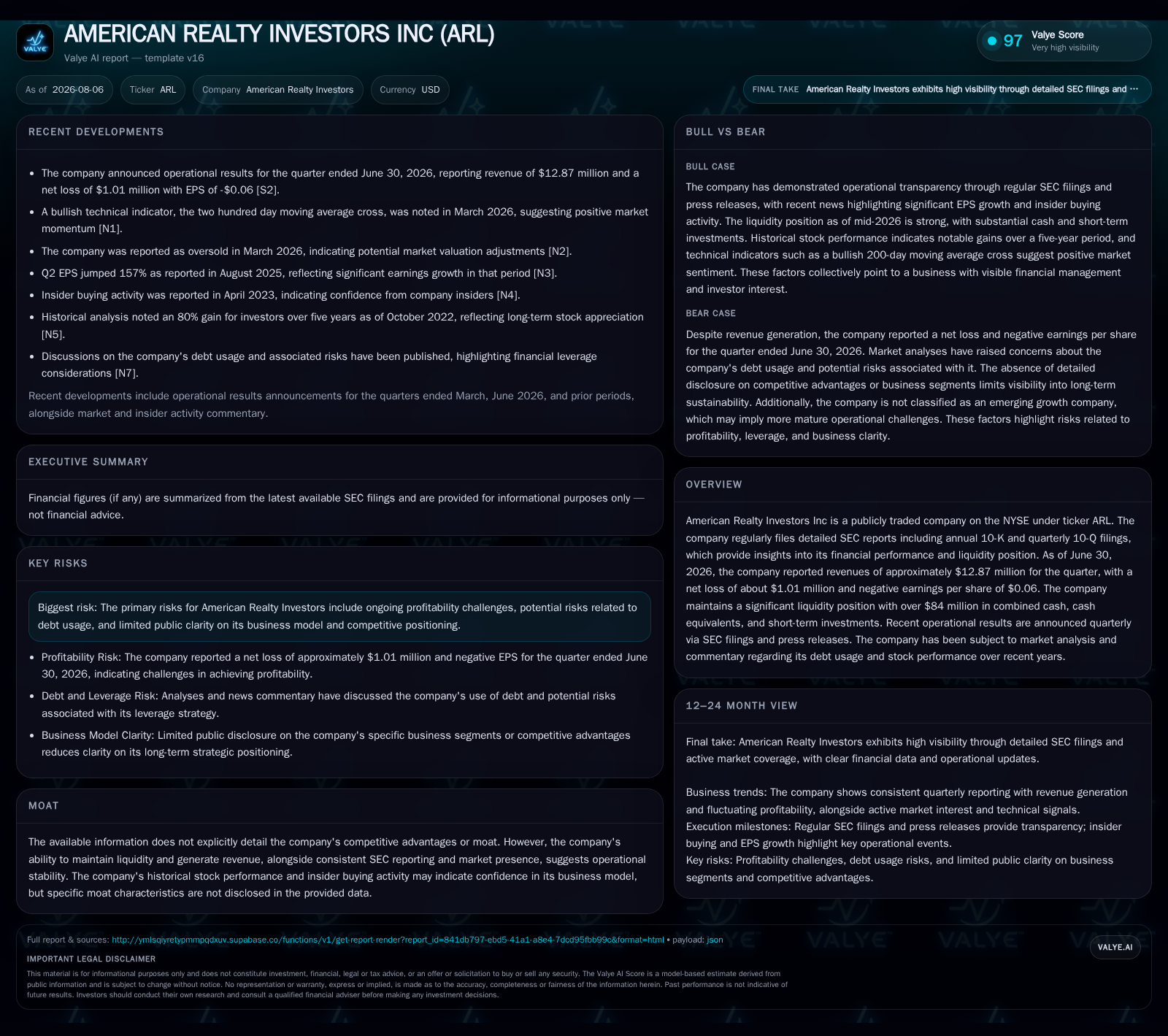
In Q2 2026, American Realty Investors (ARL) maintained steady rental revenue of approximately $12.87 million, reflecting stable property leasing performance. However, the company continued to report a net loss near $1.01 million, driven by operating costs and financing expenses tied to its significant debt load. With roughly $10.8 million in cash at quarter-end, ARL retains liquidity buffers but faces ongoing pressure from high leverage exceeding $200 million net of cash. Key near-term indicators include occupancy trends, lease renewals, and refinancing developments, which will be critical for assessing ARL’s ability to convert rental income into sustainable funds from operations and manage financial risk effectively.
Q2 2026 Operating Update: Stable Rental Revenue during Continued Net Losses
American Realty Investors’ Q2 report ending June 30, 2026 reveals consistent rental income generation totaling approximately $12.87 million, demonstrating resilience in leasing operations within its property portfolio [S2][F1]. This steadiness indicates stable occupancy levels and tenant retention during the quarter.
Despite this top-line consistency, ARL recorded a net loss near $1.01 million, reflecting persistent pressure from operating expenses combined with financing costs linked to its substantial debt burden [S2][F1]. This gap highlights the challenges faced by capital-intensive real estate investment trusts where heavy leverage can compress profitability despite steady rental cash flows.
Liquidity remains a relative strength for ARL; holding about $10.8 million in cash and equivalents at quarter-end provides essential flexibility for operational needs and upcoming debt maturities or refinancing activities [F1]. However, the scale of total debt—exceeding $214 million as of year-end 2025—means refinancing risk and interest expense remain key concerns [F1].
Business Model Overview: Rental Income Underpinned by Leasing Dynamics
ARL operates primarily as an equity REIT deriving revenues from leasing commercial or other real estate assets it owns [S1]. Rental payments from tenants form the foundation of its income stream. Therefore, occupancy rate—the percentage of leasable space currently rented—and lease renewal rates directly affect income stability and visibility.
Net operating income (NOI), calculated as rental revenues less property-related operating expenses, serves as a critical measure before financing costs. NOI drives funds from operations (FFO), a preferred industry metric that better reflects ongoing cash-generating capacity by excluding non-cash charges like depreciation. FFO underpins dividend payments and is central to evaluating REIT financial health.
Lease portfolio characteristics such as contract length influence exposure to market rent fluctuations upon expirations; longer-term leases generally provide greater revenue certainty while shorter leases increase re-leasing risk [S1]. These operational variables are pivotal for investors assessing ARL’s earnings quality beyond GAAP net income.
Industry Context: Operational Metrics and Capital Structure Considerations
From a capital structure standpoint, mortgage REITs illustrate sensitivity to borrowing cost fluctuations due to their focus on financing rather than owning assets outright [F1]. ARL’s elevated total debt level relative to liquidity suggests vulnerability to rising interest rates or tightening credit markets that could squeeze margins unless mitigated effectively
Financial Position: Managing Leverage Amid Capital Intensity
At June 30, 2026, ARL held approximately $10.8 million in cash against over $214 million in total debt reported at the end of 2025 [F1]. This results in a net debt position exceeding $200 million after accounting for available cash.
Such leverage is typical in asset-heavy REIT models but necessitates careful management of refinancing schedules and interest expense. The company’s ability to generate sufficient NOI to cover debt servicing obligations without resorting to asset sales or dilutive equity issuance will be critical.
Monitoring debt service coverage ratios—linking operating cash flow against interest payments—will offer insights into financial sustainability amid macroeconomic challenges influencing capitalization rates and borrowing costs.
Risks and Watchpoints: Profitability Pressure and Lease Expiration Exposure
Key risks include continued net losses limiting free cash flow generation needed for dividend sustainability within REIT tax frameworks [S1][S2]. Rising interest rates could exacerbate financing costs, further pressuring profitability.
Lease expiration timing poses operational risks if tenant turnover leads to vacancy spikes or forces rent concessions that diminish NOI. Geographic or sector concentration within ARL’s portfolio may amplify exposure to localized economic downturns or oversupply conditions.
High leverage heightens refinancing risk; any difficulty renewing debt on favorable terms could constrain liquidity despite current cash reserves [F1][S2]. Additionally, regulatory changes affecting dividend distribution requirements could impact investor returns though no such updates were noted recently.
Forward-Looking Considerations: Milestones for Investors
Investors should focus on subsequent quarterly disclosures providing clarity on trends in occupancy rates, rental pricing adjustments, and net operating income evolution reflecting market dynamics [S3]. Refinancing updates or strategic moves involving acquisitions or dispositions will reveal management’s approach to balancing growth ambitions with financial prudence.
Dividend policy announcements linked to realized funds from operations will also be important indicators of earnings quality improvements given recent net loss trends.
Together these factors will determine whether ARL can sustain its rental revenue base while navigating profitability challenges inherent in leveraged real estate portfolios.
Financial Profile Discussion
American Realty Investors entered Q3 2026 with approximately $10.8 million in liquid assets providing near-term operational flexibility [F1]. Its total debt exceeding $214 million underscores the capital-intensive nature of its asset ownership strategy common among equity REITs reliant on external financing.
The persistence of net losses highlights margin pressures largely attributable to financing costs outpacing operational gains—a dynamic warranting attention as interest rate environments evolve. Tracking funds from operations will be critical since FFO offers a clearer picture of distributable earnings supporting dividends compared with GAAP net income.
In summary, while liquidity buffers mitigate immediate solvency concerns, ongoing focus on cost control, occupancy maintenance, and proactive capital management will be essential for long-term financial stability amid cyclical real estate market conditions.
Disclaimer: This is research-only, informational analysis and not investment advice. It may include AI-generated interpretation and general industry context. Always verify important details using primary sources.

Comments