
Teleflex’s Strategic Restructuring and Portfolio Shift Tighten Focus on High-Growth Medical Devices
Teleflex advances its transformation with a major portfolio realignment and operational restructuring amid robust interventional device growth.
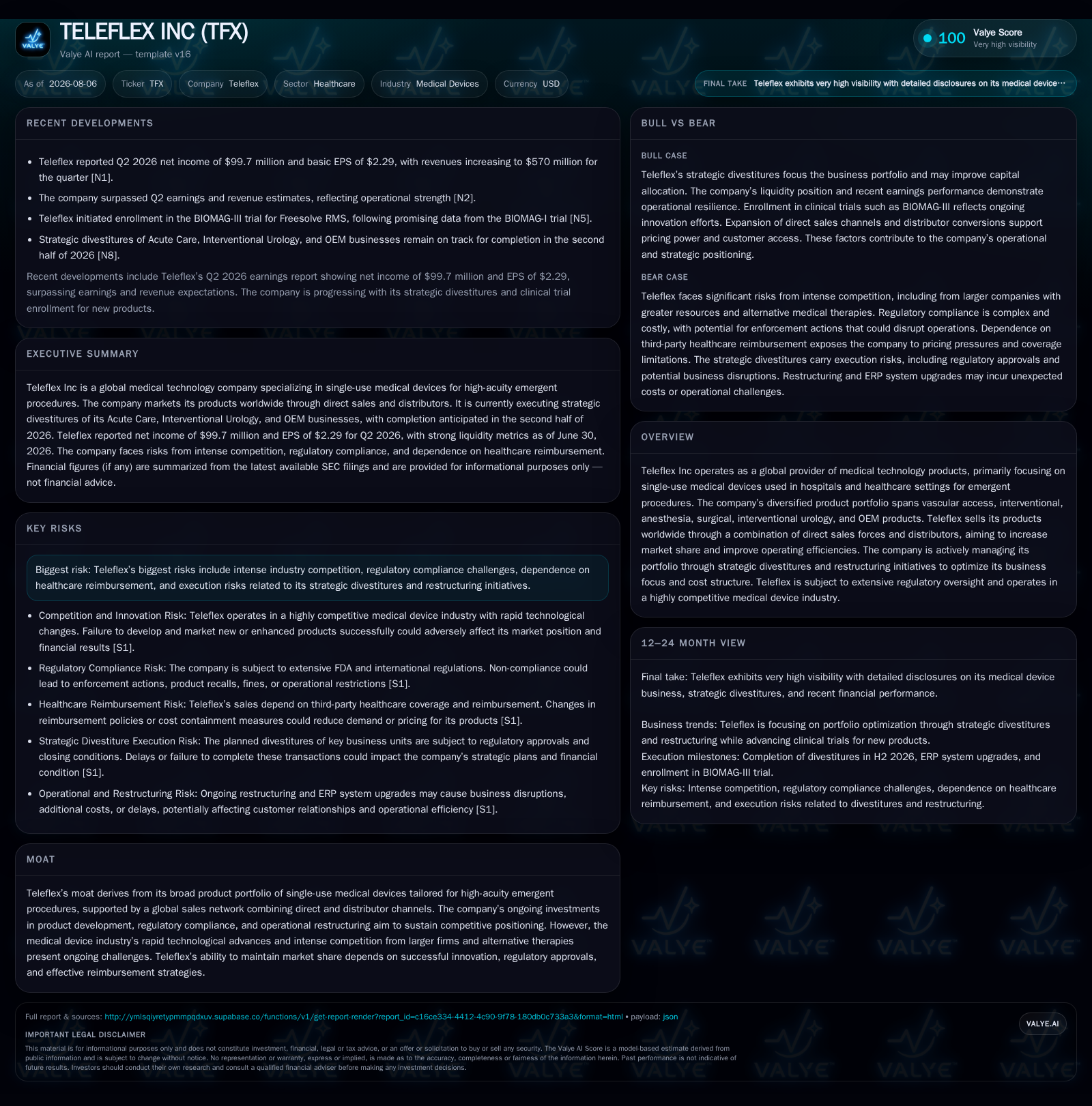
In Q2 2026, Teleflex reported solid revenue expansion driven by its vascular and interventional segments, reflecting successful integration of the BIOTRONIK Vascular Intervention acquisition. The company continues executing a multi-year restructuring plan tied to strategic divestitures, exiting Acute Care, Interventional Urology, and OEM businesses to sharpen its focus on emergent single-use medical devices. Despite increased restructuring charges temporarily compressing operating income, Teleflex maintains healthy liquidity and is deploying proceeds from pending divestitures towards debt reduction and shareholder returns. The firm faces typical sector risks including regulatory hurdles, reimbursement pressures, and competitive innovation, which will be critical to monitor alongside execution of its refined business model.
Recent Operating Update: Q2 2026 Highlights Signal Progress in Portfolio Shift
Teleflex’s latest quarterly filing dated August 6, 2026 provides valuable insights into its ongoing corporate transformation. Net revenues for Q2 reached $570 million, marking a substantial increase from $443 million a year earlier. This topline jump was primarily fueled by organic growth in the vascular access segment ($246 million) and the interventional devices segment ($212 million), the latter reflecting full integration benefits of the Vascular Intervention (VI) business acquired from BIOTRONIK in late 2025 [S2, S24]. The acquisition strategically expanded Teleflex’s footprint in coronary and peripheral devices such as drug-coated balloons and stents, complementing its emergent procedural focus.
However, this growth coincides with significant restructuring efforts adopted by management as part of a broader Strategic Divestitures plan announced at the end of 2025 [S2,S24]. This multi-year plan aims to streamline the company by exiting non-core Acute Care, Interventional Urology (IU), and OEM product businesses with expected aggregate cash proceeds near $2 billion [S1,S22]. Such moves reduce operational complexity but have introduced restructuring charges of roughly $17 million in six months ended June 30, 2026, suppressing operating income despite revenue gains.
The restructuring measures center on workforce reductions and capital assets rationalization targeted at optimizing global supply chain infrastructure among remaining businesses. These steps reflect management's intent to eliminate stranded costs while positioning Teleflex for improved operating margins over the longer term [S2]. As these strategic sales transactions are expected to close during H2 2026, transition service agreements with buyers have been negotiated though some remain subject to finalization [S22].
Business Model: Focused Medical Device Provider Targeting Emergent Single-Use Solutions
Teleflex’s core business model revolves around design, manufacture, and global sale of single-use medical devices tailored primarily for emergent hospital procedures. Its broad product portfolio spans vascular access systems used routinely for catheter insertion and drug delivery; interventional cardiology/peripheral devices including balloon catheters and stents; anesthesia instruments; surgical disposables; interventional urology products; along with OEM components supplied to other device manufacturers [S1,S12].
Revenue is principally generated through unit volume sales driven by hospital procedural volumes alongside average selling price (ASP) adjustments reflecting product mix shifts toward higher-value innovative offerings [S12]. Sales channels integrate a blend of direct sales forces penetrating major healthcare providers worldwide with distributor partnerships enhancing international reach. Payment cycles average around 30 days post-invoice with revenue recognized at product shipment
A vital attribute of Teleflex's model is its extensive R&D investment aimed at sustaining product differentiation through regulatory-approved innovations that improve clinical outcomes or ease procedural complexity for physicians. The company’s success depends upon timely regulatory clearances as well as effective coverage/reimbursement strategies across diverse healthcare systems — particularly given varying government budget constraints internationally [S1]. Thus, innovation pipeline health measured through new product launches combined with speed of regulatory approvals serves as a key operational KPI.
Industry Structure and Competitive Position
Teleflex sits amid a complex competitive landscape comprising large diversified medical device manufacturers (e.g., Medtronic), specialized single-use producers (e.g., Becton Dickinson), plus niche OEM suppliers. Its moat stems largely from specialization in emergent use single-use devices which require consistent clinical reliability under acute care conditions alongside broad geographic sales coverage supported by an agile go-to-market approach.
Compared to peers like Boston Scientific or Stryker who emphasize implantable or surgical tools respectively, Teleflex's strength lies in consumable medical disposables servicing high-frequency hospital procedures where infection control mandates favor single-use designs. However, the rapid pace of technological advancement among competitors poses ongoing innovation pressure. Market consolidation both among competitors—as larger companies acquire smaller innovators—and within buying hospital networks creates pricing pressure requiring operational efficiencies to sustain margins [S1]
Growth Drivers
Several structural drivers underpin Teleflex’s medium-term growth prospects. Globally aging populations increase demand for emergent medical interventions requiring vascular access or minimally invasive device applications. Expansion into emerging markets where healthcare infrastructure is developing offers incremental volume opportunities enhanced by distributor channels.
Product-driven growth is anchored in continued rollout of advanced interventional devices following the VI acquisition that broaden clinical indications addressed by Teleflex’s portfolio. Regulatory approvals enabling adoption also catalyze expansion alongside improvements in third-party reimbursement policies enhancing economic viability for purchasers.
Operationally, ongoing restructuring delivers cost savings that enable more competitive pricing without eroding profitability—a crucial factor given increasing price sensitivity among consolidated healthcare payers globally [S2,S22,S24]. Additionally, focused capital allocation toward higher-growth divisions while shedding lower-margin businesses improves overall returns on invested capital
Risks & Watchpoints
Teleflex faces several notable risks inherent to medical device manufacturing. Intense competition demands constant innovation—failure here risks erosion of market share or requires discounting that pressures margins. Regulatory approval processes remain lengthy and uncertain globally; any delay can defer revenue recognition or obsolete pipeline products.
Reimbursement dependence across public/private payors exposes demand to policy changes potentially restricting hospital budgets or altering coverage criteria. Moreover, execution risk accompanies large-scale divestitures including transition period operating disruptions or unanticipated separation costs which may impact near-term earnings.
Supply chain resilience is critical amid recent global shortages impacting manufacturing efficiency; Teleflex's rationalization program needs careful implementation to avoid capability bottlenecks that could constrain volume growth.
Currency fluctuations may affect reported results given significant international sales footprint while compliance with evolving medical regulations increases administrative burden [S1,S22]
What to Watch Next
Key forthcoming milestones include closure timing for the Acute Care/IU/OEM divestitures targeted for H2 2026 which will determine available capital deployment capacity for debt reduction or share repurchases—as indicated by management plans following transaction completion [S3,N5]. Monitoring restructuring progress against cost savings targets will illuminate trajectory toward improved operating margins.
Pipeline advancement metrics such as clinical trial enrollments or regulatory submissions for next-generation vascular/interventional products represent near-term demand signals. Changes in reimbursement landscapes across major geographies warrant scrutiny given implications on purchase patterns.
Finally, quarterly top-line trends post-divestiture within remaining core segments will reveal sustainability of unit volume growth versus prior contributions from sold businesses while assessing direct versus distributor channel effectiveness remains crucial for maintaining market penetration [N1,N2,S12]
Financial Profile Discussion
Disclaimer: This is research-only, informational analysis and not investment advice. It may include AI-generated interpretation and general industry context. Always verify important details using primary sources.

Comments