
CACI International’s Strategic Levers in Government IT Services After Q3 2026
CACI’s Q3 filing reveals backlog dynamics and innovation investments shaping its government contracting trajectory.
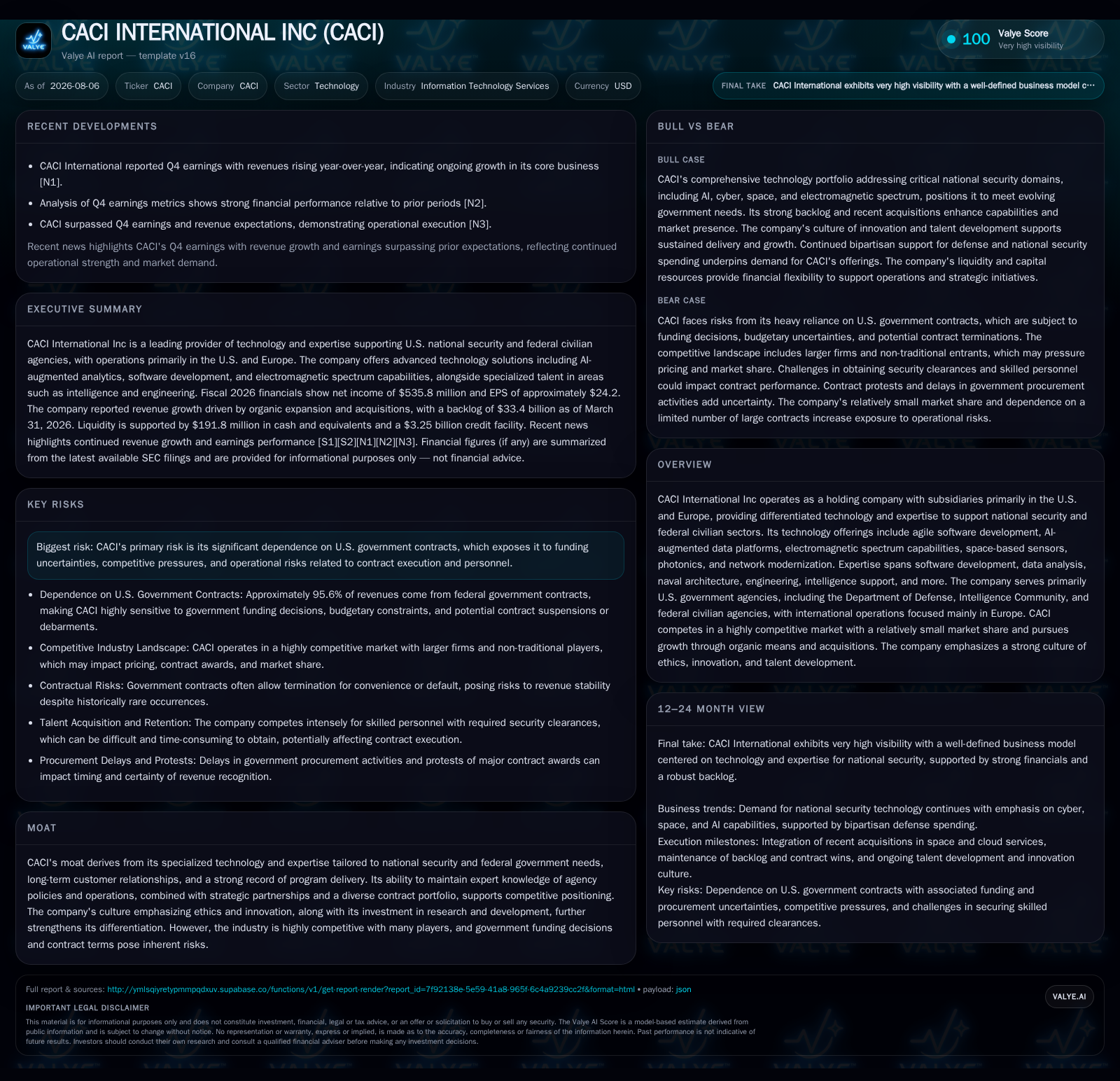
CACI International’s latest quarterly report highlights a stable contract backlog amid federal budget uncertainties and continuing resolutions, underscoring revenue visibility challenges typical in government IT services. The company’s technology portfolio—spanning AI-augmented data platforms, electromagnetic spectrum capabilities, and agile DevSecOps practices—remains core to maintaining competitive differentiation. CACI operates as a medium-scale prime contractor specializing in national security sectors, balancing specialized expertise against larger peers’ scale advantages. Growth momentum is supported by disciplined R&D spending and strategic acquisitions that enhance its space and cloud migration capabilities. Key risks center on dependence on U.S. government funding cycles, customer concentration, and regulatory compliance around security clearances.
Q3 Performance Highlights: Backlog Status and Contract Mix Shifts
CACI’s Q3 2026 10-Q filing details its operational footing amid an environment shaped by uncertain federal budget appropriations and continuing resolutions (CRs) that are endemic to government contracting cycles [S2]. The company’s contract backlog remains robust but exposed to timing delays caused by the continuation of CRs, which typically maintain funding at prior-year levels but defer new contract awards or extensions. This creates a temporary mismatch between expected revenue recognition schedules and actual contract start dates—an operational nuance critical for revenue visibility in government IT services.
Notably, CACI continues to serve primarily as a prime contractor on fixed-price and cost-plus contracts with the U.S. Department of Defense (DoD) and Intelligence Community (IC), sectors accounting for approximately 78% of total revenue—the DoD representing over half at 53.6% in fiscal 2026 [S1]. While prime contracting provides greater control over program execution and margin capture compared to subcontracting roles, it also amplifies exposure to funding shifts and regulatory constraints inherent in federal procurement. The combination of steady program delivery milestones and renewal activities observed in recent quarters helps offset some risks from appropriation delays.
Unpacking CACI’s Technology Edge: From AI Platforms to Electromagnetic Spectrum Solutions
A key pillar supporting CACI's competitive positioning lies in its differentiated technology offerings focused on addressing national security challenges. Its capabilities span agile software development employing open modern architectures and DevSecOps pipelines—both vital in accelerating deployment velocity in complex environments [S1,S2]. Furthermore, advanced data platforms augmented with artificial intelligence provide mission-critical analytics leverage for intelligence agencies coping with ever-increasing data volumes.
On the specialized technology front, CACI invests heavily in electromagnetic spectrum (EMS) capabilities including electronic warfare systems that ensure communication superiority across contested domains. Complementary technologies such as space-based sensors and photonics broaden its footprint into cutting-edge defense sectors where innovation cycles dictate strategic relevance. These product investments are underpinned by forward-looking research and development expenditures that constitute a meaningful percentage of revenue—a benchmark recognized among large integrators like Leidos or Booz Allen Hamilton [S2]. This sustained R&D commitment signals not only relevance but attempts to build operating leverage by migrating customers toward software-defined solutions that are potentially higher margin.
CACI’s Position Among Government Integrators: Specialization Versus Scale Tradeoffs
Within the competitive landscape dominated by large integrators such as Leidos, Booz Allen Hamilton, and SAIC, CACI occupies a middle-tier position characterized by specialized technology focus rather than sheer scale economies [S1]. This niche approach enables stronger differentiation through tailored expertise aligned with sensitive missions requiring cleared personnel—a high switching-cost barrier given stringent regulatory clearance requirements.
However, this specialization constrains market share expansion potential relative to larger players who offer a broader suite of services across more diverse government agencies internationally. Despite this limitation, CACI’s diverse contract portfolio across DoD, IC, and federal civilian markets somewhat mitigates concentration risk inherent in such businesses. Additionally, acting predominantly as a prime contractor allows CACI more direct client engagement but involves greater operational risks including contract performance obligations under fixed-price paradigms.
Growth Catalysts: Innovation Spend and Program Renewals Fueling Pipeline Robustness
CACI’s organic growth trajectory is buoyed by a disciplined innovation pipeline fueled through above-peer-average R&D investments targeting emergent national security needs—from cyber operations to space domain technologies [S1,S2]. Recent acquisitions bolster these capabilities; during fiscal 2026 alone, two strategic purchases enhanced offerings related to space situational awareness and specialist data/cloud migration services—areas anticipated for scaled federal funding increases given evolving geopolitical tensions [S3]
High contract renewal rates reinforce the company’s strong client trust base—critical in an industry where long-term relationships are paramount—and suggest resilient recurring revenue streams despite cyclical budget headwinds. Moreover, the bid pipeline quality disclosed indicates persistent demand for integrated technology-expertise solutions amidst intensifying competition for scarce government dollars.
Risks Under Watch: Federal Budget Cycles, CRs, and Customer Concentration Exposure
The sector-wide reliance on annual appropriations constitutes one of CACI’s thorniest risks [S1,S2]. The use of continuing resolutions causes delays in awarding new contracts or exercising options on existing ones, making near-term revenue recognition lumpy despite long-term budget stability claims by Congress. Such volatility can compel CACI to finance operations ahead of cash flow under cost-plus contracts or bear opportunity costs when decisions stall.
Equally material is CACI's customer concentration profile; with nearly 79% of revenues linked to the DoD and IC combined—the company faces vulnerability should policy shifts reprioritize spending away from its addressable markets or if reputational issues arise impacting access to sensitive programs. Maintaining a workforce holding appropriate security clearances adds operational complexity around retention risks compounded by increasingly stringent compliance requirements.
Competitive pressures continue intensifying as numerous firms vie for prime contracts with overlapping technology scopes while new procurement policies further raise barriers for incumbents. Reputational risk stemming from historical legal proceedings underscores the criticality of maintaining rigorous ethical standards.
Forward-Looking Signals: Future Contracts, Bid Pipeline Health, and Geopolitical Drivers
Recent management commentary accentuates confidence that escalating global threat environments will sustain bipartisan support for defense modernization funding programs that directly feed into CACI's core capabilities—particularly space domain awareness and electromagnetic warfare systems [S3,N1]. While specific contract award values remain confidential per standard practice, indicators such as strong bid pipeline activity paired with ongoing renewals offer forward visibility into demand durability.
Geopolitical trends—ranging from great power competition to hybrid warfare challenges—create tailwinds reinforcing investments into AI-enabled networks and sensing platforms where CACI competes actively. The company’s current assets and current liabilities stood at roughly $2.26 billion and $1.52 billion respectively, yielding a current ratio of approximately 1.48—indicative of adequate short-term liquidity coverage [F1]. This capital structure aligns with peers characteristic of the government IT services integrator segment where moderate leverage finances acquisitions along with working capital demands.
Operating income stood healthy at around $919.8 million reflective of consistent program delivery efficiencies bolstered by high-margin technology segments [F1]. The sizeable net income figure further corroborates underlying profitability despite federal contracting cyclicality.
This analysis synthesizes confirmed public filings without speculation on contract specifics or competitive rankings beyond documented evidence. The dynamic environment shaped by federal budget processes alongside rapid technology evolution mandates continuous evaluation of these interlinked factors influencing CACI International's prospects.
Disclaimer: This is research-only, informational analysis and not investment advice. It may include AI-generated interpretation and general industry context. Always verify important details using primary sources.

Comments