
Carter Bankshares Navigates Regional Banking Challenges with Prudent Risk and Capital Management
The bank addresses evolving liquidity needs and regulatory constraints while competing in Virginia and North Carolina’s competitive regional banking landscape.
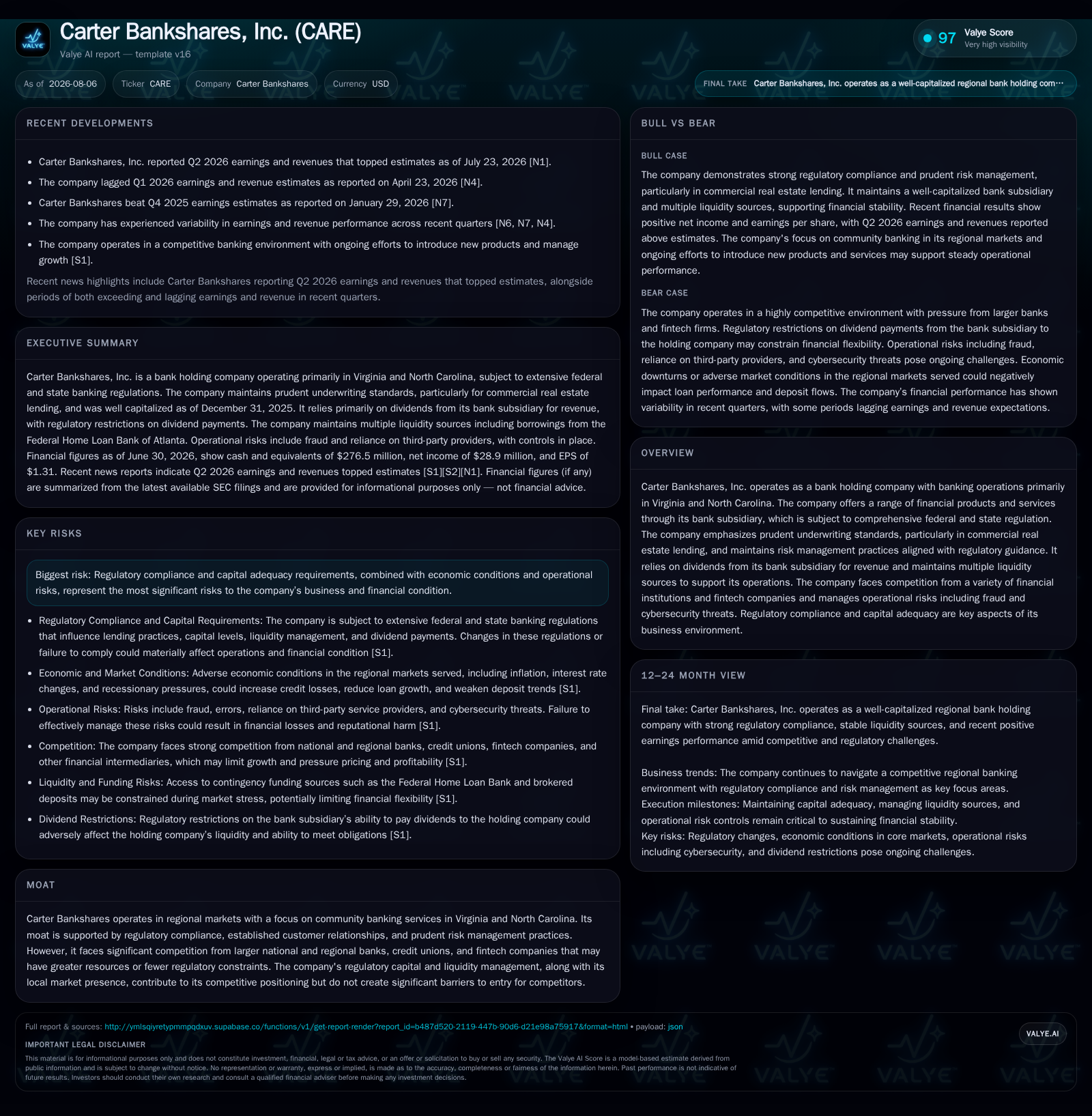
Carter Bankshares operates as a bank holding company focused on community banking in Virginia and North Carolina, deriving most revenue through net interest margin and dividends from its regulated bank subsidiary. The latest quarterly filing shows steady operational performance, with ongoing emphasis on strong underwriting, capital adequacy, and liquidity management, especially access to Federal Home Loan Bank advances. While the regional focus offers customer relationship advantages, competition from larger banks and fintechs pressures growth and profitability. Regulatory constraints on dividends and capital levels remain key risks. Overall, prudent risk management and local market knowledge provide stability amid evolving industry dynamics.
Recent Operating Update
Carter Bankshares' second quarter 2026 report reinforced the company's consistent operating posture within its core regional markets of Virginia and North Carolina. The 10-Q filing for June 30, 2026, indicated no significant shifts in risk factors compared to the prior annual disclosure, underscoring stability in both credit conditions and operational risk management [S2]. Earnings results published shortly before this filing showed revenues exceeding consensus estimates—reflecting effective balance sheet management despite competitive pressures [N1]. This update is critical as it confirms that Carter maintains robust underwriting discipline amid a macroeconomic environment that remains challenging for regional banks.
Key strategic emphasis continues to be on sustaining adequate regulatory capital ratios and managing dividend flows from the bank subsidiary to the holding company level. Given that Carter relies almost entirely on dividends from its bank for operational funds and shareholder distributions, regulatory constraints on these dividends directly influence corporate liquidity available for expenses, debt servicing, or stockholder returns [S1]. The holding company structure creates a dual-layer of oversight: the subsidiary must maintain sound earnings and capital levels to pay dividends while the parent manages external obligations.
Business Model Overview
Carter Bankshares operates primarily through its banking subsidiary offering traditional community banking products such as deposit accounts, consumer mortgages, commercial loans—and increasingly fee-based services like payment processing. Revenue generation strongly depends on net interest margin (NIM), essentially the spread between interest earned on loan assets versus interest paid on deposits. As is typical for regional banks focused on Virginia and North Carolina communities, deposits form the primary source of funding complemented by wholesale funding channels.
Loan underwriting standards prioritize prudent risk-taking, particularly within commercial real estate lending—a notable segment due to its inherent cyclical risks. Carter adheres to clear loan-to-value ratio limits aligned with federal guidance on CRE concentrations, employing board-level oversight along with market analysis and stress testing to monitor portfolio health [S1]. This measured approach aims to preserve asset quality amid regional economic variability.
Diversification within lending segments is limited by geographic concentration but partially offset by efforts in consumer lending and small business finance. Fee income supplements interest income but is a smaller share overall compared to larger banks with broad wealth management platforms.
Liquidity management is another cornerstone: Carter’s access to approximately $1.5 billion in borrowing capacity from the Federal Home Loan Bank system provides an essential contingency buffer backed by secured loans and securities collateral. Alternative sources include brokered deposits (subject to capital adequacy rules), correspondent bank lines, and utilization of investment securities portfolios when necessary [S1]. The ability to maintain diversified liquidity sources underpins ongoing lending activity stability.
Industry Context and Competitive Position
Operating within localized markets of Virginia and North Carolina places Carter Bankshares amidst competition from several categories: other regional banks with broader footprints such as Atlantic Union Bankshares (AUB), large national players like Truist (formerly SunTrust), alongside credit unions aggressively pursuing retail deposits through favorable terms. Additionally, fintech competitors have heightened disruption risks by providing digitally native lending solutions attractive to tech-savvy consumers.
Despite these headwinds, Carter’s community banking focus confers advantages in customer relationships—a moat built via personalized service rather than scale economies. However, this moat is relatively narrow given that regulatory parity enables multiple entrants without significant barriers beyond compliance costs.
Regulatory compliance itself is a major structural factor shaping operational freedom. Federal Reserve supervision mandates prompt corrective action when addressing deficiencies in capital or asset quality; staying "well-capitalized" or "adequately capitalized" status allows continuation of brokered deposits uptake—a nontrivial funding source—and dividend payments at both bank and holding company levels [S1]. These regulatory frameworks inherently cap growth or elevate funding costs if deteriorations occur.
Growth Drivers
Carter’s growth trajectory hinges predominantly on regional economic conditions stimulating loan demand among businesses and consumers. Expansion of the deposit base through targeted customer acquisition supports loan funding without heavy reliance on higher-cost wholesale borrowings.
Fee income from ancillary banking services offers incremental revenue upside as digital adoption penetrates these markets. Strategic acquisitions or new branch openings remain possible but unmentioned recently; organic growth through enhancing existing customer wallet share appears the present path.
Furthermore, recent increases in short-term interest rates across banking markets may bolster net interest margins if Carter can reprice assets more quickly than liabilities while monitoring borrower creditworthiness to avoid non-performing loan deterioration. Efficient capital deployment—balanced against regulatory capital buffers—is essential for sustainable profitability growth without risking forced limitations under prompt corrective action rules.
Risks and Watchpoints
Key risks revolve around regulatory compliance complexities related to dividend approvals, capital maintenance, liquidity sourcing flexibility, and stress testing outcomes [S1]
Credit risk remains prominently tied to commercial real estate loan concentrations despite conservative underwriting policies; any local economic downturn could amplify defaults or asset devaluations affecting provisions or write-offs.
Interest rate volatility introduces a dual-edged challenge where rising rates improve margins but potentially increase default risk or reduce borrower demand. Liquidity challenges could arise if access to FHLB advances or other wholesale funding avenues tightens due to collateral valuation changes or regulatory restrictions.
Operational risks including fraud schemes or cybersecurity breaches pose systemic threats requiring continuous mitigation aligned with evolving regulatory expectations. Competitor pressure from larger banks able to leverage scale or fintech platforms capable of faster innovation also constrains market share gains.
What To Watch Next
Observers should monitor future quarterly filings for updates on loan growth trends tied to regional economic activity measures such as employment rates or business expansions within Carter’s core markets. Loan portfolio quality metrics—particularly non-performing loan ratios in commercial real estate sectors—are critical signals of credit stability.
Changes in deposit mix composition between core vs brokered deposits will reveal liquidity management effectiveness amid external funding cost trends. Any shifts in regulatory ratings affecting capital classification could foreshadow adjustments in permissible dividend distributions.
Management commentary during earnings calls or investor presentations (noted recently issued) will provide clarity around strategic priorities for gaining efficiency or expanding fee income streams [S3]. Tracking competitor moves within Virginia/North Carolina retail banking landscapes provides comparative context regarding Carter’s positioning relative to institutions like Atlantic Union Bankshares or growing credit unions.
Financial Profile Discussion
The financial profile reflects a well-capitalized institution adhering closely to regulatory thresholds that enable dividend distributions from the banking subsidiary while maintaining sufficient buffers against prompt corrective action triggers [S1]. Reliance on dividends necessitates careful balancing between retained earnings at the bank to support growth versus outbound funds needed for parent obligations.
Broader funding encompasses access to approximately $1.5 billion in FHLB advances secured against eligible collateral pools—a critical contingency resource allowing flexibility in managing daily liquidity needs without excessive dependence upon potentially volatile brokered deposit markets or costly interbank borrowings [S1]
Overall financial discipline aligns with stable operating results reported recently by exceeding expected revenue benchmarks driven by consistent net interest spreads combined with controlled non-interest expenses [N1]. Continued vigilance over underwriting quality coupled with measured dividend policies remains pivotal for sustaining this profile amidst external uncertainties.
Disclaimer: This analysis is based solely on publicly available information including SEC filings dated up to August 6, 2026 ([S1],[S2],[S3]) and related news reports ([N1]). It does not constitute investment advice or research views but aims to provide an informed industry perspective grounded in documented evidence.
Disclaimer: This is research-only, informational analysis and not investment advice. It may include AI-generated interpretation and general industry context. Always verify important details using primary sources.

Comments