
Lamar Advertising’s Growing Digital Footprint Amid Capital Intensity and Contract Renewal Risks
LAMAR ADVERTISING CO/NEW leverages its extensive outdoor advertising portfolio and REIT structure to expand digital revenues, though capital demands and contract dynamics remain key factors.
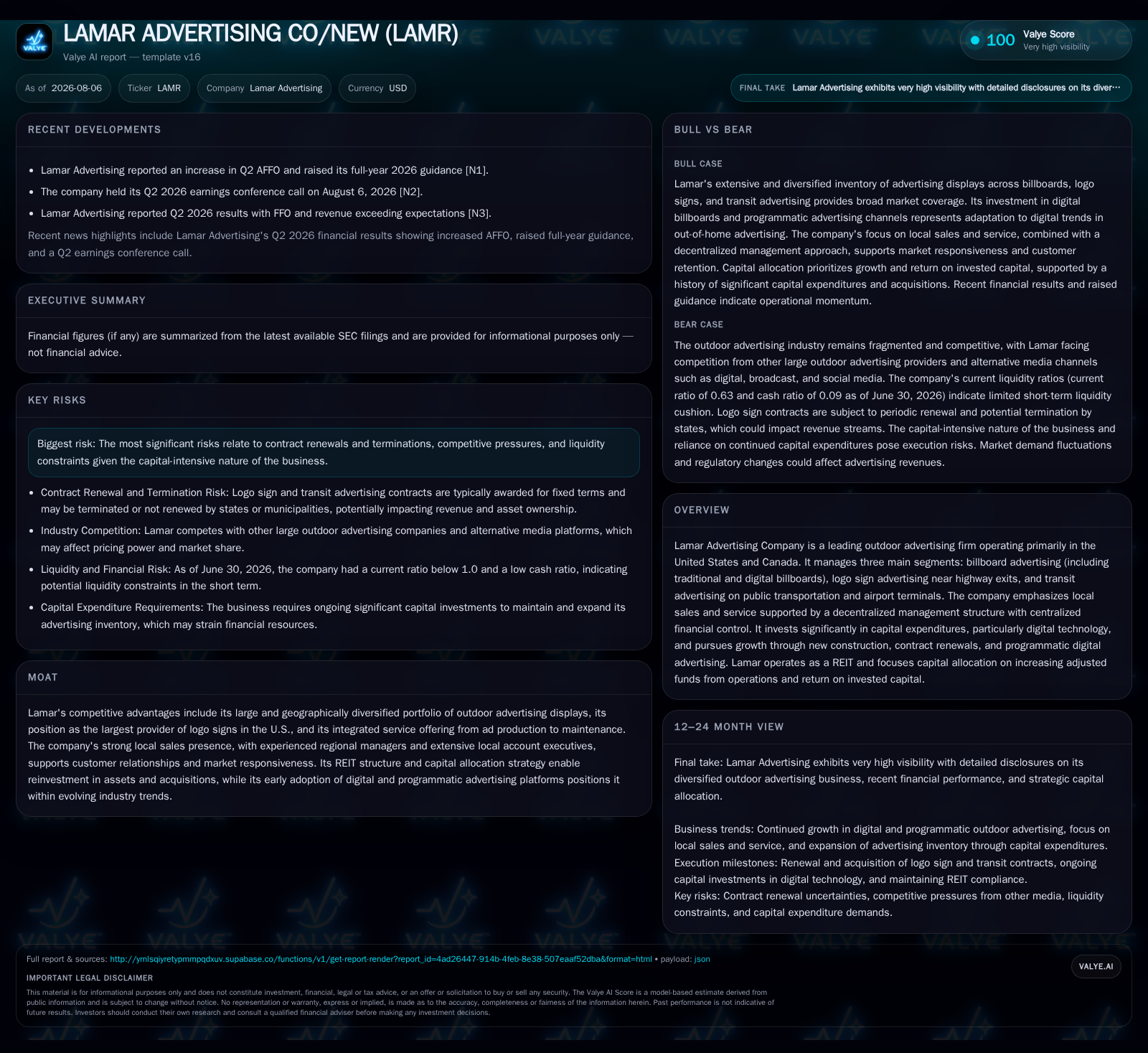
Lamar Advertising reported a solid Q2 2026 with revenue and adjusted funds from operations (AFFO) growth, supported by its diversified outdoor advertising assets including billboards, logo signs, and transit advertising. The company’s REIT structure underpins its capital allocation strategy focusing on digital billboard investments and new asset developments. Despite positive momentum in digital and programmatic advertising adoption, Lamar faces risks around contract renewals, high leverage, and the capital-intensive nature of asset upkeep. Ongoing monitoring of occupancy rates, renewal success, and technological execution will be crucial for sustaining growth.
Recent Operating Update
Business Model Overview
Lamar Advertising operates as one of the largest outdoor advertising companies in North America, managing roughly three primary segments: billboard advertising (including traditional large-format posters and bulletins plus an expanding fleet of digital billboards), logo sign advertising near interstate exits focused mainly on travel-related business promotions, and transit advertising encompassing public transportation vehicles and airport terminals [S1]. Revenue is derived predominantly through leasing contracts with advertisers who pay for space usage based on location visibility—measured by traffic impressions—and lease terms which often span multiple years.
Digital billboards represent a growing component offering programmatic buying capabilities that enable dynamic pricing models and more targeted ad placements compared to static assets. This digital transformation allows Lamar to capture incremental pricing premiums and adapt swiftly to market demand shifts [S1][S3]. The integrated service model extends beyond leasing; Lamar provides comprehensive support including creative production (ad copy development), installation logistics, licensing compliance with municipalities or states regulating sign placement, and ongoing maintenance [S1], all of which enhance customer stickiness.
Structurally organized as a Real Estate Investment Trust (REIT) via an Umbrella Partnership REIT (UPREIT) arrangement completed in 2022 facilitates tax efficiency while allowing property owners to contribute physical assets into the operating partnership on a tax-deferred basis [S1]. This structure optimizes capital recycling into high-return assets such as new digital billboard construction or programmatic platform enhancements
Industry Structure & Competitive Position
The outdoor advertising sector is capital intensive due to real estate ownership costs, regulatory hurdles for permitting signage installations, ongoing maintenance needs for aging physical displays, and significant upfront investment required for digital technology rollout. Lamar competes primarily with other large outdoor media firms such as Clear Channel Outdoor and Outfront Media but also faces indirect competition from digital platforms like Google or Facebook where advertisers allocate budgets.
Lamar's scale—operating over 159,000 billboard displays plus more than 144,000 logo signs—and geographic diversification across approximately 45 U.S. states plus Canadian provinces create barriers for smaller competitors regarding network breadth. Being the largest U.S. logo sign provider strengthens position in niche highway-travel-focused ad spending.
A decentralized local sales team model empowers regional managers familiar with market nuances to maintain strong relationships with advertisers ranging from national brands to small local businesses—a key factor supporting higher occupancy rates (advertising inventory utilization) and smoother contract renewals [S1]. This local expertise combined with centralized financial controls enables responsiveness without compromising overhead discipline
Growth Drivers
Several structural trends underpin Lamar's growth prospects:
- Digital Transformation: Increasing adoption of digital billboards improves average rental rates per display through premium pricing for flexible content delivery; enhances margins by reducing physical production costs; drives programmatic ad spend share expansion where automated bidding increases fill rates.
- Urbanization & Traffic Trends: Growth in vehicular traffic volumes at key corridors enhances impression counts justifying rent escalations.
- Contract Renewals & New Development: Long-term lease renewals lock in steady cash flows while incremental new billboard constructions boost inventory capacity.
- Programmatic Advertising Platforms: Technological innovations that integrate data analytics improve targeting capabilities yielding higher advertiser ROI reported by customers.
- Regulatory Environment Adaptation: Proactive compliance allows earlier deployment of permitted digital projects overcoming municipal zoning delays.
These drivers interact dynamically—successfully executing capex programs that aligns capacity expansions with advertiser demand boosts return on invested capital (ROIC) while maintaining AFFO growth critical for debt metrics [S1][S2]
Risks & Watchpoints
Despite positive trends, risks persist:
- Contract Renewal Uncertainty: High dependency on maintaining occupancy levels via contract renewals can cause sudden revenue volatility if major advertisers reduce spending or switch channels.
- Capital Intensity & Leverage: With net debt near $3.47 billion against a current ratio of 0.63, Lamar must sustain consistent operating cash flow coverage to meet interest obligations without disrupting ongoing capex plans [F1][S2].
- Competitive Pressures: Online ads continue eroding traditional media ad budgets; digital out-of-home must demonstrate sustained superior value proposition versus mobile/digital channels.
- Technological Execution Risks: Delays or failures in digital platform delivery could dampen anticipated incremental revenues from programmatic offerings [S1].
- Regulatory Constraints: Local government regulations evolving could restrict signage expansion or impose costly compliance burdens affecting supply-side growth.
What to Watch Next
Critical upcoming milestones and indicators include:
- Quarterly occupancy rates trends across board—maintained or rising figures would confirm stable advertiser demand.
- Reported split between revenue contributions from traditional vs. digital billboards reflecting successful transition execution.
- Programmatic advertising revenue as a percentage of total showcasing effective tech adoption.
- Capital expenditure disclosures detailing investments into new assets vs. maintenance spend influencing AFFO margins.
- Debt covenant compliance filings signaling liquidity stability amidst substantial leverage.
- Contract renewal announcements especially involving key clients or large regional markets providing forward visibility on booking stability.
Continued management commentary during earnings calls will illuminate strategic priorities around balancing growth investments against leverage risks [N2].
Financial Profile Discussion
At June 30, 2026, Lamar Advertising carried total debt net of financing costs of approximately $3.54 billion with cash and equivalents totaling about $67.95 million, resulting in net debt near $3.47 billion; the current ratio stood at 0.63, indicating working capital constraints relative to short-term liabilities [F1][S2]. Interest-bearing debt includes senior credit facilities and several series of senior notes with coupon rates ranging from approximately 3.6% to 5.4%, supporting refinancing risk management [S2].
Operating cash flows remain the primary source for servicing this debt load alongside proceeds from asset dispositions; depreciation and amortization expenses are significant given asset capital intensity but largely non-cash, aiding adjusted funds from operations (AFFO) calculations that support distribution capacity for investors [S2]. Stock-based compensation expense rose modestly, indicating incentive alignment efforts, while gains on asset dispositions contributed favorably but are expectedly fluctuating given periodic asset sales [S2].
Managing capital expenditures prudently remains essential given the trade-offs between deploying growth-oriented digital infrastructure versus sustaining legacy signage profitability, enabling sustained AFFO accretion crucial under REIT payout mandates [S1][N1]. Overall liquidity remains sufficient at present but depends heavily on execution consistency amid economic sensitivities impacting advertiser appetite for out-of-home media spend.
This report presents an analysis of Lamar Advertising Company based solely on publicly available SEC filings and recent news disclosures without any investment research views or price projections.
Disclaimer: This is research-only, informational analysis and not investment advice. It may include AI-generated interpretation and general industry context. Always verify important details using primary sources.

Comments