
Regions Financial Builds on Multi-Channel Strength Amid Interest Rate and Credit Dynamics
Q2 2026 results reveal firm net interest income growth and ongoing credit risk management supporting Regions Financial's diversified banking franchise.
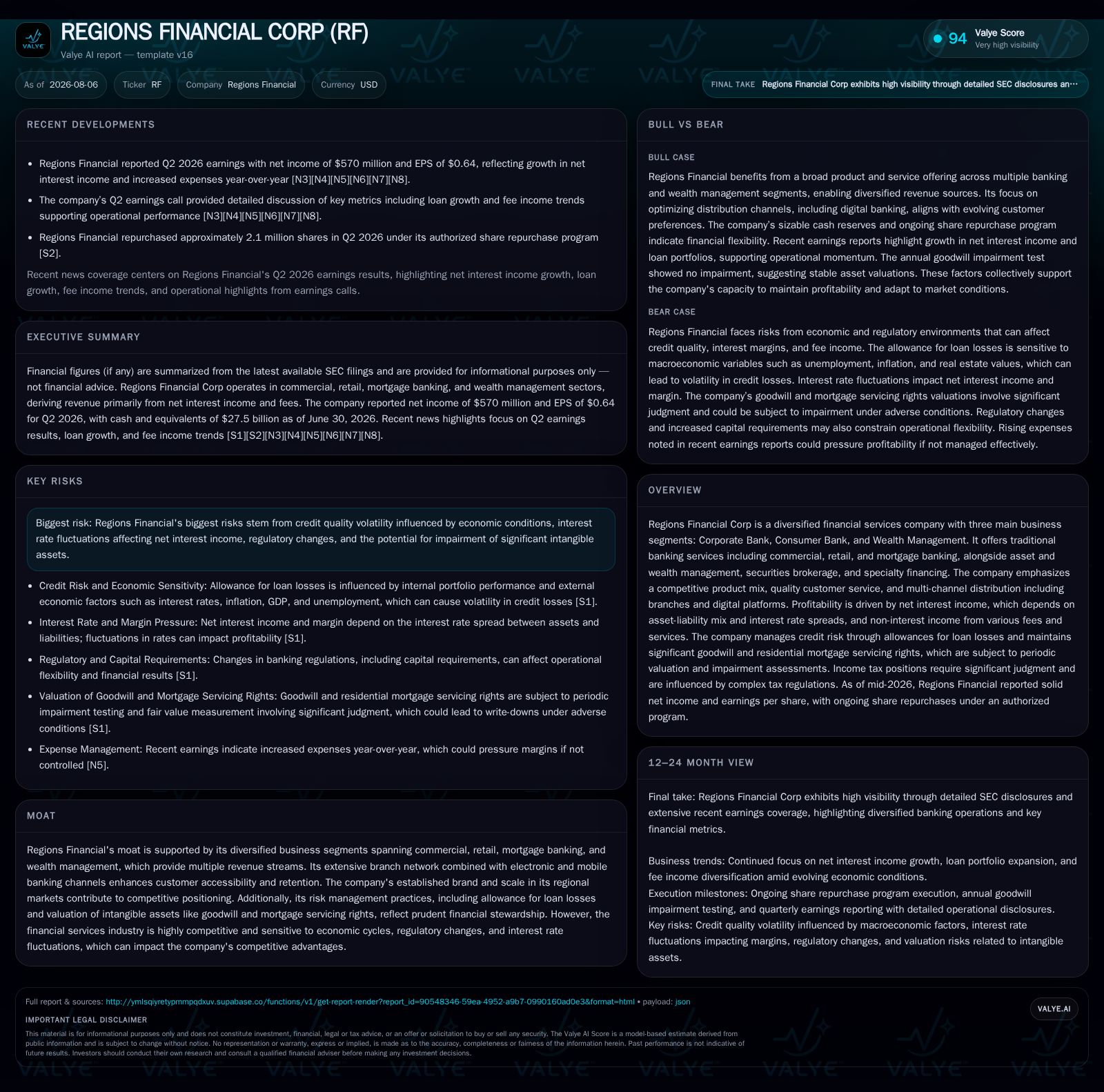
Regions Financial Corp’s second quarter 2026 results highlight sustained net interest income expansion driven by favorable asset-liability positioning and stable loan portfolio performance. The company’s diversified business model spans corporate, consumer, and wealth segments leveraged through an extensive branch network and digital channels. Asset quality remains resilient with prudent allowance coverage amidst selective portfolio runoff in leveraged lending. Operating efficiency and liquidity adequacy underpin the bank’s ability to manage interest rate shifts and regulatory expectations in a competitive regional banking landscape.
Recent Operating Update: Q2 2026 Performance Anchors Current View
Regions Financial Corp’s latest quarterly report delivered on its broader strategic narrative of navigating a challenging macroeconomic environment with measured growth across key profitability levers. The period ending June 30, 2026 demonstrated continued net interest income (NII) improvement driven primarily by expansions in interest rate spreads augmented by a deliberately optimized asset-liability mix [S2][S3]. Although total loans saw slight contraction due to runoff in leveraged lending exposures, this was offset by growth in investor real estate loans focused on apartments, data centers, and industrial properties—a segment viewed as comparatively resilient in current economic conditions [S11][S20].
Allowance for loan losses remains prudently sized at approximately 1.76% of net loans, decreasing marginally from prior periods but maintaining coverage over twice the non-performing loan balances—signaling conservative credit provisions capable of buffering anticipated economic variability [S12]. This reflects disciplined credit risk governance emphasizing sector diversification, collateral quality assessment including routine real estate appraisals aligned with regulatory guidelines, and stress testing across underwriting models [S11][S21].
Business Model: Diversified Revenue Streams Underpin Profitability
Regions operates as a classic regional bank ecosystem, anchored by three reportable segments—Corporate Bank, Consumer Bank, and Wealth Management—that collectively foster multiple revenue channels. Net interest income constitutes a majority of revenue generated from loans, leases, securities portfolios (largely government agency mortgage-backed securities), and deposits where Regions earns an interest rate spread reflective of market yields moderated by deposit costs [S1]. Interest-bearing assets are managed dynamically for yield optimization alongside stringent asset-liability management tools.
Complementing NII is non-interest income derived from fees on deposit accounts (including card and ATM charges), mortgage servicing activities emphasizing secondary marketing gains, investment advisory fees through wealth management operations, and securities brokerage commissions [S1]. This diversified fee base cushions earnings against margin volatility inherent in fluctuating interest rates or loan demand cycles.
Customer acquisition and retention rely heavily on Regions’ extensive physical branch footprint concentrated regionally—primarily Southern U.S., Midwest, and Texas markets—and increasingly through digital interfaces including online platforms and mobile applications tailored for convenience banking. While branches provide trust-building local presence crucial for commercial clients needing complex financial solutions or small businesses requiring relationship banking, digital channels cater effectively to retail consumers prioritizing transaction speed and accessibility [S1]. This dual-channel strategy aims to balance service quality with cost efficiency amid competitive pressure from fintech entrants.
Industry Structure and Competitive Position
Within a U.S. regional banking context alongside peers such as Fifth Third Bancorp, KeyCorp, and M&T Bank, Regions distinguishes itself through its scale across corporate lending sectors blended with residential mortgage servicing operations. Peers similarly face margin sensitivity tied directly to the federal funds target rates which govern the yield curve underpinning loan pricing; hence Regions’ emphasis on capitalizing wider net interest margins amidst rising rate environments aligns with industry trends documented in contemporaneous sector earnings calls [N3][N5]
Furthermore, Regions navigates an evolving regulatory milieu featuring heightened consumer protection standards promulgated by agencies like CFPB alongside changes to Community Reinvestment Act requirements that may increase compliance expense burdens or limit product flexibility [S7][S23]. Simultaneously, credit risk remains front-of-mind given exposure concentration risks within commercial real estate sectors vulnerable to macroeconomic shifts impacting occupancy rates or valuation resets.
Growth Drivers: Balancing Rate Tailwinds With Risk Discipline
Loan demand is expected to gradually respond positively to economic growth within Regions’ core geographies where business spending signals remain constructive. Investor real estate development projects particularly in multifamily housing units continue furnishing new term loan volumes reflective of demographic urbanization trends. Wealth management assets under administration present fee growth opportunities complementary to stable brokerage commissions as client portfolios expand.
Interest rate trajectories directly influence Regions' net interest margins—higher short-term benchmark rates enhance yield curves allowing incremental repricing of variable-rate loans before deposit reset lag induces cost adjustments. The bank’s mortgage servicing rights portfolio also offers embedded optionality benefiting certain rate scenarios though prepayment risk remains a factor necessitating calibrated valuation approaches.
Digital banking adoption accelerates cross-selling product penetration while potentially lowering ticket costs per transaction; successful integration will be a key execution metric going forward. Additionally, selective balance sheet optimization reducing higher-risk leveraged loans while growing lower-risk segments suggests proactive positioning towards sustainable risk-adjusted returns.
Risks and Watchpoints: Credit Sensitivity and Regulatory Ambiguity
Despite steady performance metrics reported recently, Regions confronts risks typical of regional lenders including potential upticks in credit losses if economic conditions deteriorate unexpectedly—especially within commercial real estate or home equity second lien exposures acknowledged as more vulnerable categories [S7][S9]. Interest rate volatility could compress margins if deposit pricing accelerates faster than asset yield re-pricings.
Regulatory environments remain fluid. The uncertain future contours of CFPB rules or CRA reform could introduce cost shocks or constrain growth avenues. Moreover, operational risks related to cybersecurity threats or system outages affecting digital systems represent latent vulnerabilities given increasing sophistication of cyber adversaries.
Competitive pressures from non-traditional entrants leveraging blockchain-based decentralized finance platforms may disrupt payment systems or wealth management channels albeit likely at nascent adoption phases restricting immediate impact.
What to Watch Next
Key milestones comprise monitoring upcoming quarterly performance indicators such as net interest margin shifts indicative of effective asset-liability repricing; new loan origination volumes segmented by industry exposure; allowance for credit loss adjustments signaling management’s evolving loss expectations; efficiency ratio trends reflecting operational leverage gains; branch versus digital channel mix changes quantifying customer behavior evolution; progress on capital deployment strategies including pace and scale of share repurchases; regulatory announcements affecting compliance landscapes; peer-to-peer benchmarking data contextualizing competitive positioning.
Financial Profile Discussion
Capital adequacy metrics conform with regulatory thresholds enabling discretionary capital returns without compromising buffer minima.
Cost structures encompass comprehensive non-interest expenses related to employee compensation, occupancy costs spanning branch network operation alongside technological infrastructure investments requisite for competitive parity. Shareholder-friendly policies manifest via authorized repurchase programs systematically executed when market opportunities arise within prescribed governance frameworks ensuring balanced stakeholder interests.
This analysis synthesizes the latest SEC disclosures together with contextual industry understanding pertinent to regional banks operating midstream in the U.S. financial intermediation chain. It highlights how top-line fundamentals interact dynamically with structural operational realities amid an evolving external environment modulated by macro-financial shifts and regulatory developments. Readers should consider this examination informational without reliance on any forecasting implied herein.
Disclaimer: This is research-only, informational analysis and not investment advice. It may include AI-generated interpretation and general industry context. Always verify important details using primary sources.

Comments