
Ormat Technologies Strengthens Renewable Footprint with Integrated Geothermal and Energy Storage Expansion
Q2 2026 results reflect Ormat’s growth in geothermal capacity, strategic acquisitions, and advancing energy storage operations.
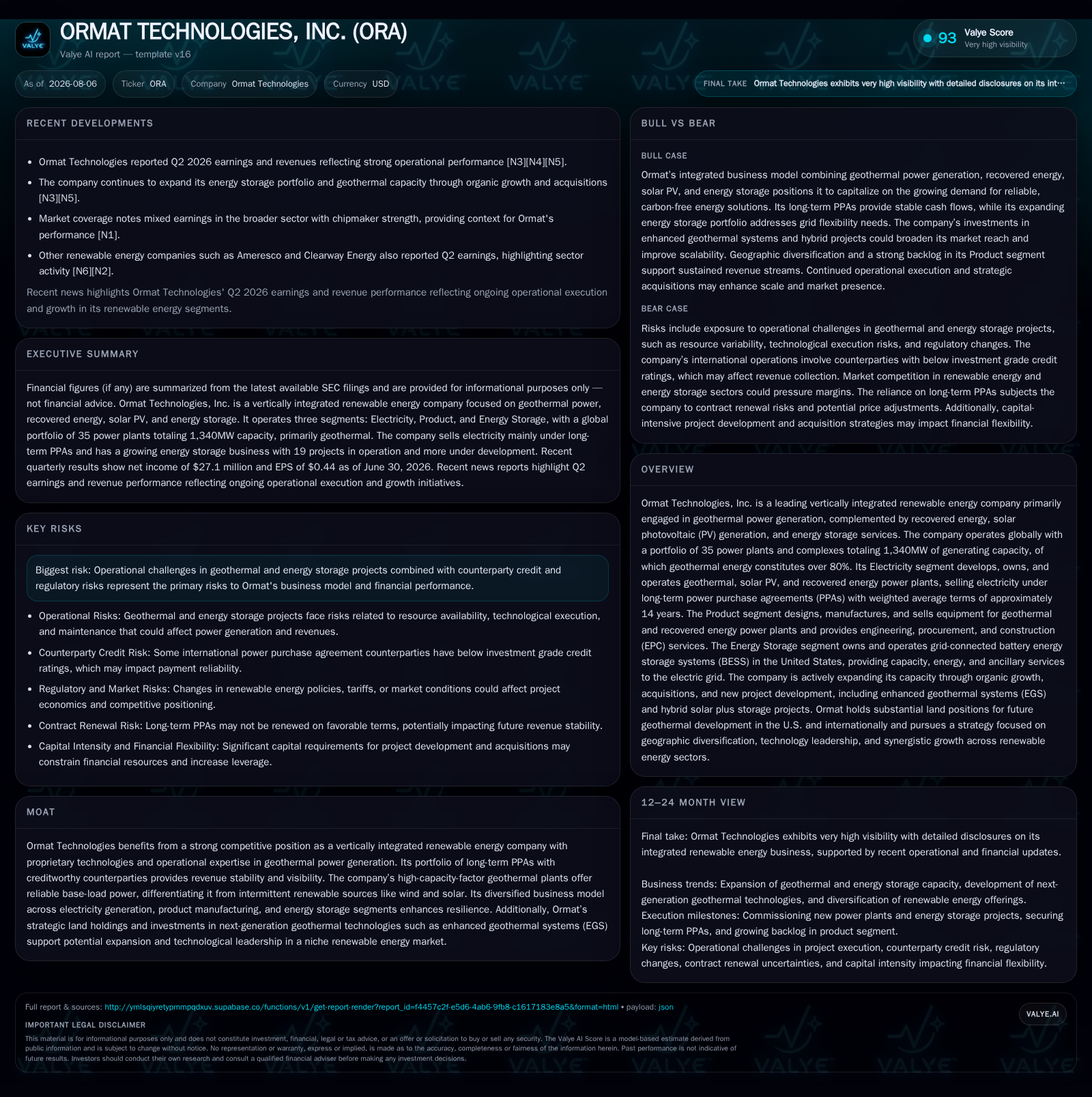
Ormat Technologies reported second-quarter 2026 earnings beating expectations on higher electricity generation and expanded capacity across geothermal and solar-plus-storage assets. The company's vertically integrated model—spanning power plant ownership, equipment manufacturing, and energy storage services—continues to provide revenue stability supported by long-term PPAs averaging 14 years. Notable developments include capacity gains from new geothermal and solar projects, acquisitions increasing geothermal output, and a strengthened backlog of product segment contracts. Growth is underpinned by advances in enhanced geothermal systems (EGS) piloting and expansion into utility-scale energy storage operating in merchant markets. Key risks center on operational reliability of geothermal reservoirs, evolving regulatory frameworks, and merchant market exposure for storage assets.
Q2 2026 Operating Update Highlights
Ormat Technologies’ latest quarterly report dated August 6, 2026 illustrated continuing momentum across its core renewable power business, driven primarily by its electricity generation segment encompassing geothermal and solar photovoltaic (PV) assets. The company expanded its commercial operations by approximately 115 MW since the beginning of 2025 through a combination of organic growth initiatives—such as the repowering of the Beowawe geothermal plant contributing 6 MW—and strategic acquisitions including a recently closed purchase adding an incremental 20 MW at Blue Mountain geothermal facility as well as a 30 MW solar PV plant integrated with battery energy storage in Hawaii acquired in early 2026 [S1][S2]. This capacity enhancement is a key driver behind improved production volumes and revenue growth.
On August 5, Ormat also announced earnings surpassing market estimates for the second quarter ended June 30, reflecting not only volume gains but optimized asset availability across its portfolio [S3][N3]. These operational achievements emphasize the company’s ability to leverage its vertically integrated platform effectively.
Business Model: Vertically Integrated Renewable Energy Provider
Ormat’s business model centers on three interconnected segments: Electricity (geothermal, solar PV, recovered energy generation), Product (design, manufacture, EPC services), and Energy Storage (standalone grid-connected battery facilities). This integration permits revenue diversification across electricity sales under long-term power purchase agreements (PPAs), equipment contracting revenue streams with backlog visibility extending multiple years, plus merchant-oriented ancillary services from energy storage.
Revenue flow is dominated by the Electricity segment contributing roughly 70.1% of total sales as of year-end 2025—with over 80% of this electric capacity sourced from geothermal assets boasting base-load reliability [S1]. Electricity is sold mainly under fixed or escalating rate PPAs averaging around fourteen years in term duration; this contractual profile secures predictable cash flows insulating Ormat partly from short-term commodity price volatility except for exposure at specific plants like Puna Complex whose pricing remains indexed to oil-related fuel cost parameters which are expected to normalize with a recently approved extension through mid-century
The Product segment enhances vertical integration by supplying proprietary equipment tailored to geothermal and recovered energy plants while providing EPC services to internal projects and third parties. Backlog additions in recent quarters have reached over $200 million including a major $100 million contract related to New Zealand’s TOPP2 project—a sizeable EPC contract transferred at commercial operation date indicating near-term revenue recognition opportunities [S1]
Energy Storage represents an increasingly strategic growth vector involving ownership and operation of large-scale In Front of the Meter (IFM) battery energy storage systems across key US markets such as California, Texas, and PJM on the East Coast providing grid capacity, energy arbitrage, and ancillary services primarily on merchant terms exposing Ormat to grid price fluctuations yet offering upside from participation in evolving ancillary service markets [S1]
Industry Positioning and Competitive Environment
Operating within renewable energy power generation—a sector driven by capital-intensive infrastructure development backed by regulatory incentives—Ormat distinguishes itself through a combination of technology leadership in geothermal power generation and operational breadth encompassing equipment manufacturing. Its geothermal plants benefit from high capacity factors often exceeding those of intermittent renewables like wind or standard solar PV projects offering dependable base-load power crucial for grid stability.
Peer benchmarks include other independent power producers specializing in geothermal such as Calpine Corporation as well as utility-scale solar operators who rely heavily on intermittent resource profiles complemented increasingly by energy storage partners like Fluence or Tesla Energy focusing purely on battery systems rather than vertically integrated generation plus equipment capabilities.
The portfolio's geographic diversity spans multiple countries along with significant US-based presence buffering regional regulatory variance risks.[S1]
Growth Drivers: Technology Innovation and Portfolio Expansion
Looking forward, Ormat is positioning itself to capitalize on several renewable sector tailwinds:
- The ongoing global push towards reliable clean base-load power aligns squarely with Ormat’s geothermal advantages over fossil fuels or intermittent sources.
- Technological advances around enhanced geothermal systems (EGS), an emerging field aiming to expand resource access beyond traditional hydrothermal reservoirs through engineered reservoirs technology, are being actively pursued via collaborations and pilot programs which may redefine growth ceilings if proven commercially viable [S1].
- Broader penetration into complementary renewable solutions such as hybridizing solar PV with storage integration creates bundled offerings enhancing grid flexibility.
- Long-term PPA expansions provide enduring revenue visibility critical for securing finance in capital-intensive project cycles where scale economies matter.
- Corporate ESG commitments accelerate demand for renewables procurement globally stimulating market opportunities especially in emerging regions.
Risks and Watchpoints
Operational risks inherent in geothermal exploration persist including geological uncertainty leading to reservoir pressure decline or temperature drop which can increase maintenance expenditure or reduce output capacity—a characteristic divergent from purely technology-driven sectors [S1]. Unplanned outages due to equipment failure or external environmental events such as volcanic activity pose tangible threats to uptime affecting financial results.
Additionally, exposure through merchant market participation mainly within the energy storage segment exposes Ormat to price variability absent fixed contracts unlike its core electricity sales underpinning revenue predictability [S1]
Regulatory shifts impacting subsidies or tariff structures globally remain a watchpoint given heterogeneous policy environments influencing project economics. Counterparty creditworthiness under long-term PPAs remains fundamental to risk profile though mitigated by contractual strength.[S1]
Finally, balancing the capital-intensive nature of expansion with effective debt management amid leverage levels near $2 billion requires continual scrutiny amid macroeconomic uncertainties especially interest rate movements despite large portions being fixed-rate [F1][S2]
What to Watch Next
Investors and industry watchers should track several near-term milestones indicative of Ormat’s execution health:
- Commercial operation dates (COD) for newly developed or acquired plants,
- Progress reports on EGS pilot programs revealing technological validation or setbacks,
- PPA negotiations or extensions particularly at exposed facilities such as Hawaii’s Puna,
- Backlog fulfillment pace within product manufacturing segments signaling demand health,
- Scaling efforts of energy storage assets within competitive merchant markets including ancillary services uptake trends,
- Regulatory developments across core geographies potentially impacting permitting or tariff frameworks.
Financial Profile Discussion
As of June 30, 2026, Ormat reported cash & equivalents approximating $514 million against current liabilities of roughly $976 million translating into a current ratio near parity at about 1.05 indicating adequate short-term liquidity supporting operational needs [F1][S2]. Total debt stood close to $2 billion per year-end December 2025 data with net debt after cash adjustments around $1.45 billion reflecting sizable leverage typical for capital-demanding renewable infrastructure players but balanced by long-lived asset bases generating steady cash flows.[F1]
The company maintains a prudent mix of fixed-rate borrowings covering over 84% of consolidated long-term debt mitigating interest rate exposure while retaining some variable-rate instruments exposing it modestly to rate fluctuations often tied to SOFR or EUROBOR benchmarks [S1]
Overall financial posture supports ongoing investment into emerging technologies alongside strategic acquisitions reinforcing diversified renewable capabilities essential for sustaining competitive positioning.
This analysis integrates filings through August 6, 2026 ([S1], [S2], [S3]) with company facts data ([F1]) alongside corroborative news reports ([N3]) without offering investment research views.
Disclaimer: This is research-only, informational analysis and not investment advice. It may include AI-generated interpretation and general industry context. Always verify important details using primary sources.

Comments