
Nexstar Media's Acquisition Strategy and MVPD Trends Define Growth Outlook in Broadcast Industry
Latest quarterly results highlight operational resilience amid subscriber pressures and ongoing merger uncertainties.
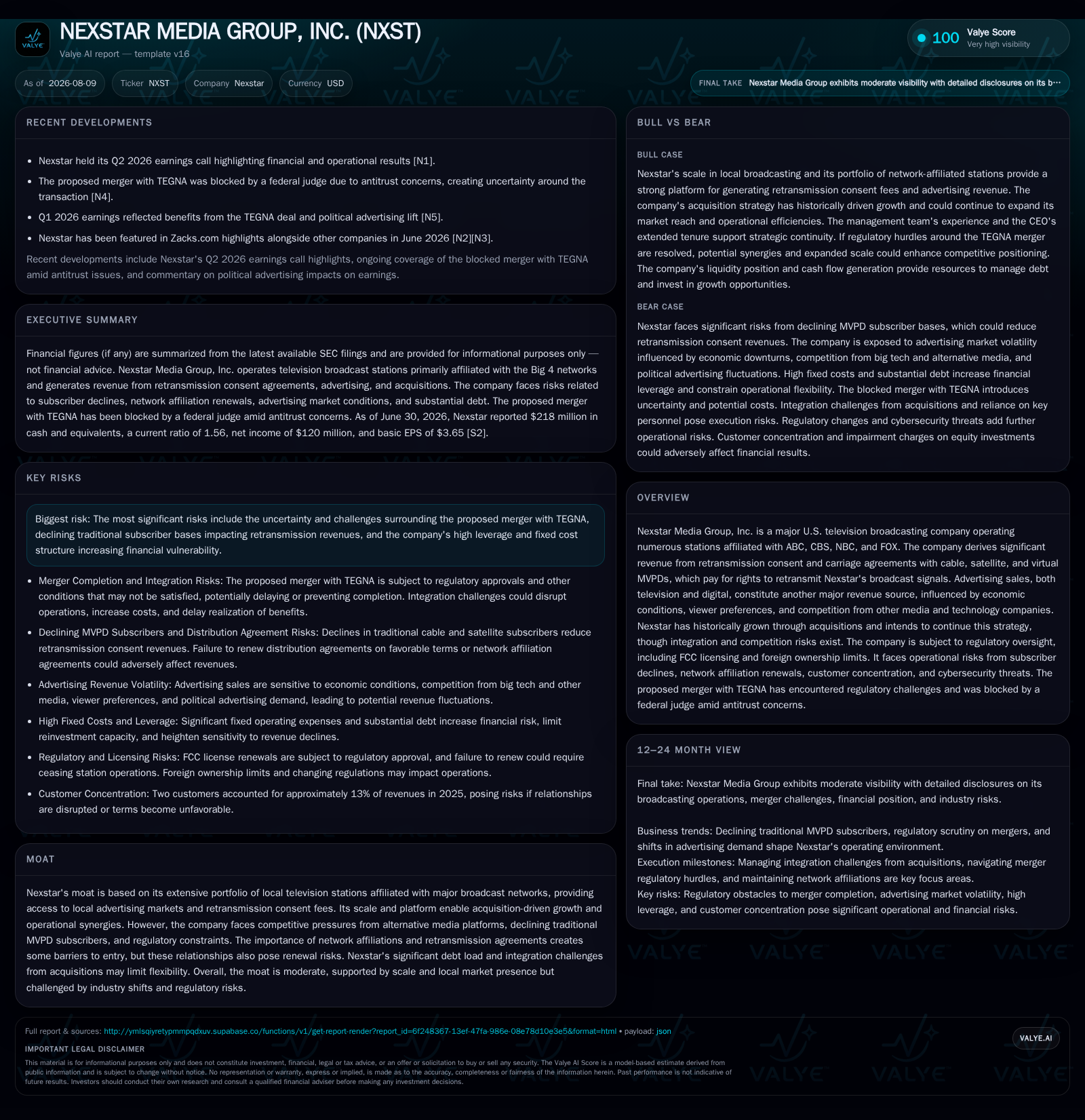
Nexstar Media Group’s Q2 2026 filings reveal steady advertising and retransmission consent revenues despite continued multichannel video programming distributor (MVPD) subscriber declines impacting distribution fees. The company’s core growth drivers remain station acquisitions and contractual renegotiations, while regulatory and integration risks loom from the pending TEGNA merger. Nexstar’s high leverage constrains flexibility but is balanced by solid liquidity and operating cash flow generation. Upcoming milestones focus on merger approvals, network affiliation renewals, and carriage agreement outcomes that will shape future profitability.
Latest Operating Update: Q2 2026 Financial Highlights
Nexstar Media Group’s second quarter 10-Q filing dated August 7, 2026, reflects operational stability amidst the ongoing challenges faced by traditional television broadcasters. The company acknowledges persistent headwinds from declining MVPD subscriber bases that weigh on distribution revenues, a structural challenge across the industry [S1]. However, Nexstar's extensive portfolio of network-affiliated local stations provides geographic breadth and negotiating leverage that help mitigate sharp declines in any single market.
Recent event filings underline that the company is actively negotiating carriage agreements expected this year, with outcomes materially impacting retransmission fees — a key driver of cash flow [S3]. Also highlighted are ongoing efforts to renew network affiliation agreements on favorable terms; failure here would risk access to popular content feeding audience ratings that underpin advertising inventory monetization [S3][S1]. This Q2 update underscores a cautious but resilient operational stance as Nexstar balances market pressures with strategic positioning.
Business Model: Dual Revenue Streams Anchored by Scale and Market Reach
Nexstar functions predominantly as a local broadcaster owning and operating numerous television stations affiliated mainly with ABC, CBS, NBC, and FOX networks. The business model monetizes two primary value streams. First is advertising sales — encompassing both local advertisers seeking targeted demographic reach within defined markets, as well as national campaigns leveraging broader regional aggregation through Nexstar's network of stations. Advertising effectiveness depends heavily on audience ratings, which in turn are influenced by program content quality and availability via network affiliations.
Second is retransmission consent fees arising from carriage agreements with MVPDs, such as Comcast or DirecTV. These fees compensate Nexstar for the right to distribute its broadcast signals through third-party platforms. These contracts typically involve negotiations over both fees per subscriber (average revenue per user or ARPU) and coverage terms. As traditional pay-TV subscriber counts decline due to cord-cutting trends favoring streaming services (e.g., Hulu, YouTube), retransmission revenues face structural headwinds.
To combat this decline in subscribers — a critical industry-wide KPI — Nexstar pursues an acquisition strategy intended to build scale. By increasing the number of owned-and-operated stations, Nexstar enhances its geographic footprint allowing more comprehensive advertising packages and greater leverage in retransmission negotiations [S1]. Acquisitions also open potential operating synergies through centralized administrative functions lowering station operating costs—a key margin driver given television broadcasting’s fixed-cost intensity.
Additionally, Nexstar explores digital advertising opportunities though these remain a smaller component relative to traditional linear broadcast revenues at present. Digital monetization strategies aim to complement core offerings without cannibalizing existing high-margin advertising inventory.
Industry Structure & Competitive Position
Nexstar sits within a fragmented but consolidating segment of local broadcast media dominated by several publicly traded groups including Sinclair Broadcast Group, Gray Television, and TEGNA — the latter becoming more salient as Nexstar pursues a proposed merger [S1]. Unlike national networks which provide programming content upstream (ABC, CBS, NBC), Nexstar operates downstream close to consumers/viewers delivering localized advertising solutions combined with secured network content through affiliation agreements.
A significant portion of Nexstar’s bargaining power stems from its large portfolio clustered across mid-sized to large markets enabling it to negotiate retransmission consent contracts more effectively than smaller competitors who lack scale. However, competition for advertiser budgets intensifies not only among peer broadcasters but more challengingly against digital streaming platforms capturing shifting consumer attention and reallocating advertising spend.
Regulatory oversight adds complexity: FCC licenses govern station operations requiring renewals typically every eight years under public interest standards; failure could force cessation of services impacting revenue streams [S29]. Moreover, foreign ownership limits constrain capital market flexibility for broadcast groups including Nexstar.
Growth Drivers
The most tangible growth avenues for Nexstar reside in: (a) strategic acquisitions expanding station count enabling broader market coverage; (b) successful carriage agreement renewals increasing retransmission consent fee rates or stabilizing ARPU despite subscriber erosion; (c) digital ad sales growth through enhanced targeting capabilities leveraging viewer data; (d) strengthening local and national advertiser relationships benefiting from economic cycles enhancing ad spending budgets; (e) favorable outcomes in network affiliation renewals securing access to popular content driving audience ratings.
Mergers such as the pending transaction with TEGNA exemplify the acquisition strategy aimed at scale expansion alongside anticipated operational synergies that may improve margins if successfully executed [S1][S3]. Progress on this front will be keenly monitored due to integration risks inherent in combining large multimedia operations.
Risks & Constraints
Several prominent risks complicate Nexstar’s prospects. Chief among these is the vulnerability of distribution revenues tied closely to MVPD subscriber trajectories—an industry structural trend difficult to reverse given consumer shifts towards direct-to-consumer streaming platforms [S1]. Aggravating this are fixed cost structures making earnings highly sensitive to revenue downturns.
Network affiliation renewal failures pose substantial operational risk since contractions here reduce attractive programming impairing audience draw thus lowering advertising demand [S1]. Regulatory uncertainties include potential FCC license renewal denials or conditions that could curtail broadcast operations at certain stations [S29].
The protracted TEGNA merger faces customary procedural hurdles including antitrust clearances—delays or failure would stall strategic growth plans while still incurring integration readiness expenses [S1][S3]. Additionally, heavy leverage with net debt approximating $11.7 billion constrained financial flexibility raising refinancing risks especially if cash flow weakens significantly or interest rates rise further [F1][S4][S5]. Lastly, rising competition from digital entrants erodes traditional viewing audiences thereby pressuring ad pricing even as overall media monetization evolves rapidly outside linear TV.
What to Watch Next
Key near-term catalysts include carriage agreement renewal outcomes this calendar year directly impacting retransmission consent revenue trends—a critical leading indicator for operating cash flows. Network affiliation agreement renewal statuses will signal program continuity important for sustaining advertiser interest.
Progress updates regarding regulatory approvals for the TEGNA merger remain pivotal variables shaping Nexstar's medium-term growth trajectory. Integration milestones post any closing will also test management’s ability to capture cost synergies without disrupting station operational stability.
Advertising revenue trends—especially shifts between local/national linear versus digital channels—will offer insights into competitive positioning against expanding streaming platforms altering advertiser behavior.
Finally, watching leverage metrics relative to cash flow generation provides early warnings on balance-sheet stress potentially constraining investment capacity or dividend policies.
Financial Profile Discussion
As of June 30, 2026, Nexstar reported cash and equivalents of approximately $218 million against total debt nearing $11.9 billion resulting in net debt around $11.7 billion highlighting substantial leverage consistent with prior periods [F1]. The current ratio stands at a moderate 1.56 reflecting adequate near-term liquidity buffers relative to current liabilities around $1.28 billion providing some cushion for working capital needs [F1].
Operating income around $849 million reported for calendar year-end 2025 indicates profitability at scale though margin pressures remain given industry cyclicality and structural challenges noted above [F1]. Cash flow adequacy hinges critically on stable retransmission revenue streams coupled with resilient advertising demand—both sensitive economic cycle indicators requiring monitoring going forward.
Disclaimer: This analysis is based solely on publicly filed documents dated up to August 7, 2026. It does not constitute investment advice or research views regarding Nexstar Media Group securities or derivatives thereof.
Disclaimer: This is research-only, informational analysis and not investment advice. It may include AI-generated interpretation and general industry context. Always verify important details using primary sources.

Comments