
Sabine Royalty Trust's Income Dynamics in Rising Oil Price Environments
Recent quarterly disclosures highlight how Sabine Royalty Trust’s cash distributions track commodity price shifts and production trends, reflecting its passive royalty interest model.
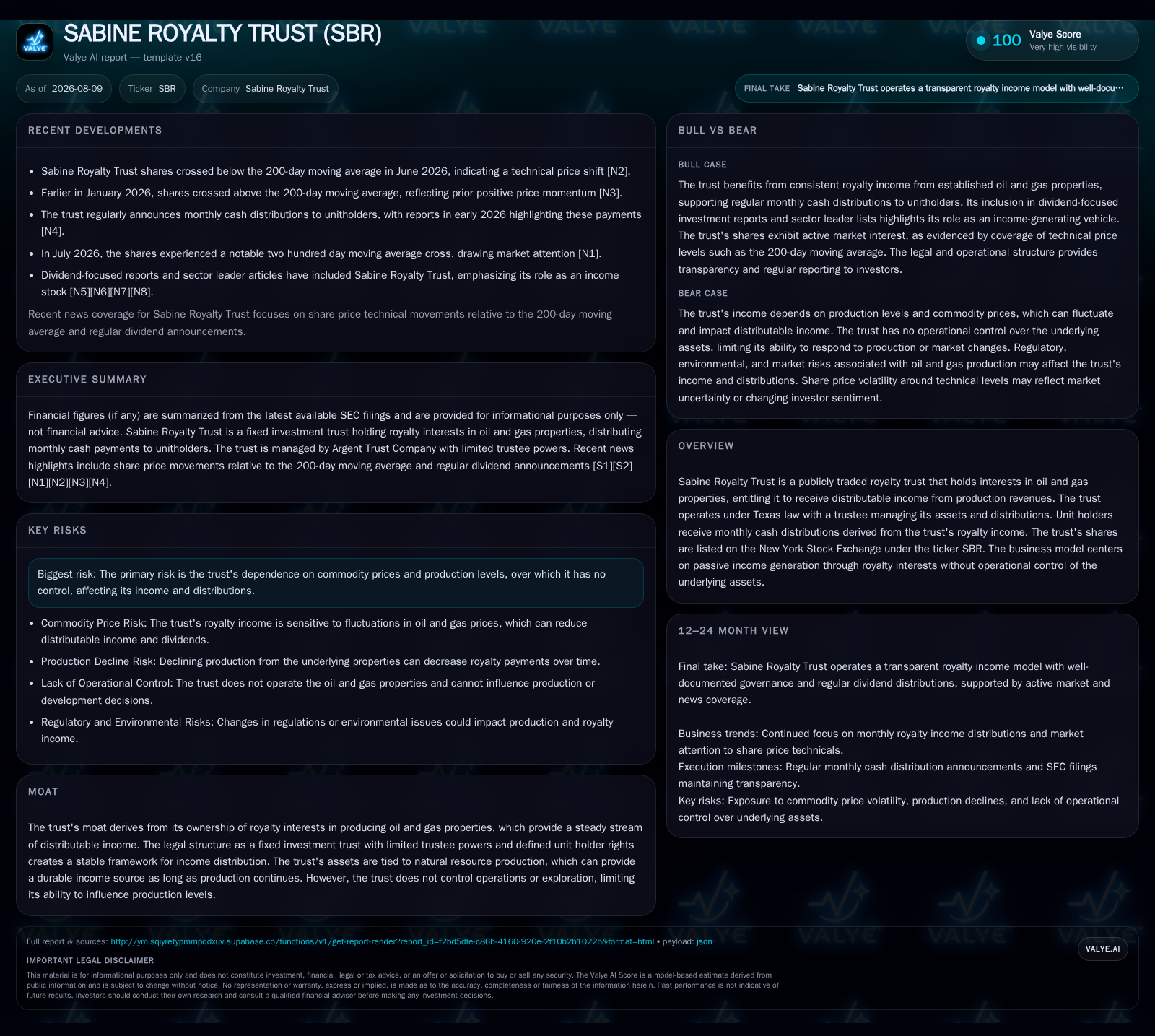
Sabine Royalty Trust's August 2026 quarterly filings and distribution announcements reaffirm its reliance on upstream production volumes and commodity prices, with monthly cash distributions serving as a key metric for income flow. The trust’s legal framework limits trustee influence over operations, anchoring it as a passive income vehicle with inherent sensitivity to oil and gas market cycles. Peer comparisons suggest exposure to production decline risks common in royalty trusts, while growth potential hinges on sustained production and favorable commodity markets. Monitoring upcoming distributions and operator reports will be essential to assess ongoing income stability.
Latest Quarterly Operating Update Explicates Distribution Patterns
Sabine Royalty Trust’s latest quarterly filing (10-Q) dated August 7, 2026, complemented by a contemporaneous 8-K press release, provides the most recent update on monthly cash distributions payable to unitholders of record [S2][S3]. The announcement underscores the ongoing direct linkage between underlying oil and gas commodity prices and the trust’s distributable income. While specific distribution amounts in the event filings serve as currency for unit holder returns, they effectively mirror the realized revenue derived from production volumes operated externally. Notably, the trustee’s limited power structure constrains any direct influence on production or operational adjustments that could enhance or stabilize these income streams [S1].
This dynamic highlights a fundamental characteristic of royalty trusts like Sabine: while monthly cash distributions are the primary KPI signifying unit holder value realization, they inherently fluctuate alongside upstream operators’ production results and prevailing market prices for hydrocarbons.
Trust Structure Limits Operational Influence but Anchors Steady Income Flow
The trust operates under Texas law as detailed in the annual Form 10-K from February 27, 2026, which clarifies its legal framework emphasizing fiduciary duties of the trustee versus its operational impotence concerning asset management [S1]. Argent Trust Company acts as trustee with responsibilities largely administrative—distributing cash flows derived from royalty interests rather than participating in exploration or development decisions.
This structure creates a moat founded on ownership of defined royalty interests yielding revenue without exposure to operating expenses borne by producing operators. However, this comes at the cost of strategic inflexibility; the trust cannot initiate new development projects or influence operational parameters that affect production volumes. Thus, while it secures a relatively stable passive income stream funded by royalty revenue shares, it remains vulnerable to external factors beyond its direct control.
Revenue Drivers Linked to Commodities Market Fluctuations and Production Trends
Sabine Royalty Trust's revenue mechanics revolve around legal entitlements to royalties on oil and gas produced by underlying fields managed by third-party operators [S1]. Monthly cash distributions hinge crucially on two variables: realized commodity prices (oil and natural gas) and actual production volumes. These factors interact multiplicatively—the available distributable income rises when either price strength or production gains materialize.
The recent quarterly context confirms no hedging arrangements inside the trust’s structure that might otherwise buffer against commodity price swings [S2]. Consequently, monthly distributions reflect raw exposure to price volatility, contrasting with other energy infrastructure entities that may deploy hedges to smooth cash flows.
Furthermore, aged reservoir life naturally drives declining production over time, imposing an inexorable downtrend pressure on volume-dependent revenue components. This interplay makes understanding both realized pricing dynamics and operator-reported production decline critical for projecting future distributable income.
Competitive Benchmarking Among Oil & Gas Royalty Trusts: Yield and Reserve Comparisons
Within the peer set of oil and gas royalty trusts—such as Permian Basin Royalty Trust—Sabine displays typical characteristics including sensitivity of distribution yields to cyclical commodity prices and inherent asset reserve aging profiles. Peers often face similar downward pressure from reservoir depletion impacting sustainable payout levels.
While precise reserve life metrics specific to Sabine are not publicly granular in recent filings, industry knowledge contextualizes that trust assets generally enjoy finite but multi-year productive life spans. This relative brevity can contrast with certain upstream producers or MLPs that might balance legacy asset decline with new development.
Moreover, governance practices anchored in trustee limitations focus Sabine more narrowly than some peers who might have broader operational mandates via affiliated entities. This difference affects comparative valuation sensitivity; unitholders rely heavily on consistent operator performance and commodity market conditions rather than active asset management intervention.
Growth Path Reliant on Production Sustainability and Commodity Price Momentum
Growth drivers for Sabine predominantly derive from maintaining stable or rising production volumes through enhanced field management by producing operators or accretionary acquisition of additional royalty interests—not evidenced in recent filings but a theoretical expansion path [S1]. Commodity price environments also critically shape distributable income trajectories; rising oil prices can fast-track distribution growth absent countervailing volume declines.
Absent meaningful capital expenditure by the trust itself or alterations in underlying contracts due to its fixed-income nature, further positive confirmation would come from sustained monthly distribution growth announcements aligning with favorable industry pricing cycles. Operators’ efficiency improvements or secondary recovery techniques enhance potential longevity of production contributions indirectly benefiting the trust’s cash flows.
Risks Highlighted by Production Declines, Regulatory Shifts, and Market Volatility
Sabine faces classical risks typical in oil & gas royalty trusts primarily linked to lack of operational control coupled with inherent exposure to commodity cycles [S4][S5][S8]. Declining production rates due to natural reservoir depletion represent an unavoidable erosion of asset base unless offset by operator initiatives or acquisitions. The trust depends entirely on upstream entities managing operating costs efficiently since those costs directly reduce net royalty revenues payable.
Regulatory or taxation changes influencing royalty payment formulas pose material uncertainty as well; fluctuations in state/federal surcharges could impair distributable income. Additionally, no internal hedging programs mean Sabine is exposed fully to volatile oil/gas markets without downside protection mechanisms.
Counterparty risk also exists regarding operators’ financial health—any disruption there could impact production continuity and payments received. Finally, market liquidity of trust units can fluctuate with macro energy sentiment affecting unit price even if distribution fundamentals remain sound.
What To Watch Next: Upcoming Distributions, Commodity Prices, and Operator Reports
Looking ahead, investors should monitor Sabine’s forthcoming monthly cash distribution announcements which concretize short-term revenue realizations post-factum [S2][S3]. Tracking fluctuation patterns versus benchmark crude oil and natural gas price indices will clarify macro sensitivity.
Additionally, updates from underlying asset operators—while outside trust control—serve as critical external inputs confirming ongoing production trends influencing future royalties. Any disclosure or public reporting indicating unexpected reservoir performance shifts or operational changes will materially affect income forecasts.
Finally, alterations in regulatory regimes impacting royalties must be followed closely given their outsized influence relative to the fixed investment nature of Sabine. A continued robust commodities environment combined with stable operator execution would remain key pillars supporting consistent monthly payouts within this inherently passive business model framework.
This analysis reflects publicly available information assembled from the company’s recent regulatory filings up through August 7, 2026. Observations emphasize structural characteristics unique to oil and gas royalty trusts including their passive investment stance amid externally driven revenue drivers rather than employer-operated asset control. Potential readers may want to monitor these factors alongside peer trends and market developments but this document does not constitute investment advice.
Disclaimer: This is research-only, informational analysis and not investment advice. It may include AI-generated interpretation and general industry context. Always verify important details using primary sources.

Comments