
Sharps Technology’s Strategic Pivot to AI-Driven Finance Challenges Execution and Regulatory Risks
Sharps Technology Inc. has abandoned its legacy syringe distribution to build an AI-driven agentic finance platform focused on emerging markets, leveraging Solana-based digital asset treasury management.
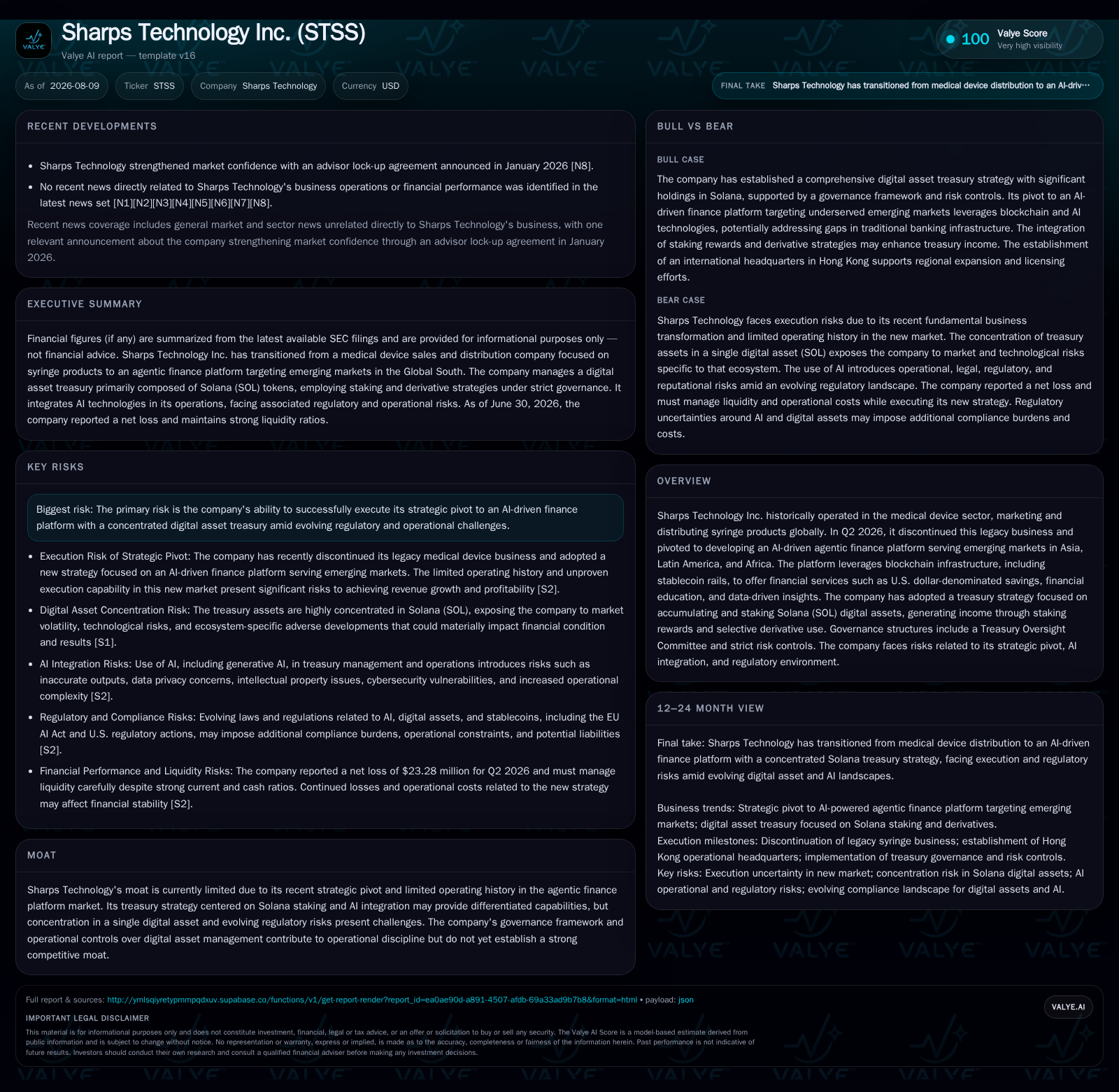
In Q2 2026, Sharps Technology transitioned from marketing and distributing medical syringes to developing a blockchain and AI-powered finance platform targeting underbanked populations in Asia, Latin America, and Africa. The company’s new model relies heavily on a digital asset treasury dominated by Solana (SOL), staking rewards, and usage of stablecoin rails to provide dollar-denominated financial services. While this positions Sharps within a fast-growing fintech sub-sector, the pivot carries substantial operational and regulatory risks related to AI integration, digital asset concentration, and untested market adoption. Financially, the company maintains a strong liquidity position but continues to operate at a significant net loss stemming from the transformation costs.
Recent Operating Update: Pivot Completion and New Business Focus
Sharps Technology completed its strategic pivot in Q2 2026 by discontinuing its legacy medical device business focused on syringe distribution. This marked a fundamental transformation as the company now concentrates exclusively on developing an agentic finance platform powered by artificial intelligence (AI) and blockchain infrastructure targeting the "Global South" -- emerging markets in Asia, Latin America, and Africa [S2]. The shift is designed to leverage blockchain networks such as Solana (SOL) alongside stablecoin rails to deliver U.S. dollar-denominated savings products, financial education modules, and data-driven insights that address underbanked segments facing local currency volatility challenges [S4].
This operational pivot anchors around utilizing the Solana blockchain both as an infrastructure foundation for the platform as well as forming the basis of its treasury policy via accumulation and staking of SOL tokens [S1]. Notably, this new mission involves significant software development investments in AI capabilities including generative models intended to enhance financial decision-making for end users. However, these technologies are at early commercial stages and expose the company to operational risks related to inaccuracies or biases in AI outputs [S2].
Business Model: Agentic Finance Platform with Digital Asset Treasury Income
Sharps no longer sells physical medical devices; instead it generates revenue streams from offering AI-driven financial services deployed on blockchain infrastructure. The key monetization avenues likely include fees or spreads associated with digital savings products denominated in stablecoins (USDC/USDT), educational service subscriptions or usage metrics, and data analytics offerings derived from on-chain financial behavior of its target users in emerging markets. Such users typically lack access to reliable banking systems but have growing smartphone penetration enabling platform adoption.
Complementing revenue from customer-facing services is Sharps’ digital asset treasury management strategy centered on accumulating large holdings of SOL tokens acquired through PIPE financing completed August 2025 (~$400 million gross proceeds) [S1]. These holdings are staked on the Solana network to earn yield via protocol-defined staking rewards while maintaining liquidity via un-staked tokens held in cash or highly liquid stablecoins [S1]. The approach aims both to support internal liquidity needs for platform operations and generate supplemental income enhancing overall margins.
Revenue dynamics in this model depend critically on the volume of active users engaging with stablecoin-based products (reflected in transaction volumes), the accuracy and efficacy of proprietary AI models (impacting retention and cross-sell potential), plus realized staking yields net of derivative-related costs such as collateral posting or options premiums inherent in their treasury strategy [S1]. The need to balance staked versus liquid assets highlights ongoing liquidity risk management as lock-up or cooldown periods can delay availability of funds needed for platform obligations.
Industry Structure & Competitive Position
The agentic finance platform industry represented by Sharps sits at the intersection of several fast-evolving subsectors: AI-powered fintech platforms; blockchain infrastructure utilization; stablecoin-based financial services; and digital asset treasury management firms. Established peers such as BlockFi or Celsius illustrate how staking/lending strategies can generate income streams within regulated boundaries while companies like Circle exemplify innovation in stablecoin issuance critical for dollar-peg reliability.
Sharps’ focus on emerging markets differentiates it from many peers that target developed economies; yet this also introduces complexity relating to fragmented regulatory regimes across Asia, Latin America, and Africa. Compared with incumbent fintechs such as Tala or Chime that emphasize microcredit or remittance facilitation respectively, Sharps aims to supplement basic financial access with sophisticated AI analytics layered onto blockchain rails — a business model still nascent globally.
At present Sharps must build credibility rapidly among consumers unfamiliar with crypto-finance concepts while navigating a fast-moving legal landscape regulating digital assets along with new AI-specific compliance requirements (e.g., EU’s incoming AI Act) [S2]. The absence of prior public-company experience among existing management further intensifies execution risk relative to more seasoned fintech operators
Growth Drivers
Key growth catalysts underpinning Sharps’ strategic repositioning include rising demand for financial inclusion in unbanked regions where local currency instability heightens appeal for U.S. dollar-denominated solutions supported by stablecoins. The increasing adoption of mobile internet combined with advancements in generative AI technology presents opportunity for richer user engagement through personalized insights and automated portfolio management tools.
Regulatory clarity expected from frameworks like the GENIUS Act may unlock institutional interest in stablecoins enhancing their trustworthiness which could increase transaction volumes across Sharps’ platform offerings [S1]. Moreover, expanding opportunities within decentralized finance (DeFi) open pathways for integration into broader ecosystems fostering greater capital access for underserved populations.
Partnership initiatives with third-party fintech providers could accelerate product rollout speed given resource constraints internally while leveraging external expertise especially within blockchain compliance monitoring or AI ethics oversight.
Risks and Watchpoints
Sharps faces multifaceted risks primarily anchored around its dramatic business model shift. First is the inherent uncertainty around successfully commercializing an agentic finance platform—both building user trust across culturally diverse emerging market geographies and sustaining engagement necessary for revenue scale remain critical unknowns given limited operating history [S2]
Technological risk includes challenges related to generative AI outputs that may be inaccurate or biased leading to poor financial decisions by users or damaging reputational fallout.[S2,S18] Compounding this are regulatory uncertainties globally surrounding both cryptocurrency handling — subject to rapidly evolving rules—and new statutes governing AI deployment particularly high-risk applications that may limit certain functionalities or impose costly compliance burdens (e.g., European Union's AI Act)[S18,S16].
Operational security threats loom large given exposure inherent in custodial responsibilities for private keys controlling significant SOL assets alongside cybersecurity vulnerabilities that could lead to theft or loss adversely impacting liquidity positions [S1]
Concentration risk derives from heavily focusing treasury investments into Solana’s native asset potentially exacerbating volatility effects should token price sharply fluctuate or network technical issues delay unstaking processes.[S1]
Competition against incumbents with established user bases, deeper capital reserves, and broader fintech offerings places pressure on customer acquisition costs while necessitating continuous innovation.
What To Watch Next
Key milestones include measurable progress toward user base development: active platform users growth rate, increases in total digital assets under management—including staked vs liquid ratios—stablecoin transaction volumes reflecting adoption depth; plus demonstrable improvements in AI model reliability lowering errors or bias-related incidents.
Monitoring regulatory developments both relevant to crypto-asset usage (stablecoin reserve requirements under GENIUS Act) and emergent AI laws will provide insight into potential operational constraints or cost impacts.
Financial performance trends post-pivot will be instructive though remain challenged initially due to elevated R&D spending required for platform development paired with staking income volatility [F1]
Management’s execution on partnerships especially around blockchain compliance vendors or established fintech channels can accelerate ecosystem integration vital for expanded geographic reach.
Finally, governance effectiveness reflected through Treasurer Oversight Committee’s risk mitigation will be crucial given complex intersection of digital asset custody combined with rapid technology evolution.[S1]
Financial Profile Discussion
As of June 30, 2026, Sharps holds $12.1 million in cash & equivalents against current liabilities totaling approximately $2.9 million resulting in a strong current ratio near 5.35—indicative of comfortable short-term liquidity sufficiency despite transition-related expenses [F1]
However, operating losses remain substantial with $269.7 million recorded at year-end 2025 driven principally by legacy product write-downs coupled with hefty investments into the new platform strategy [F1]. Net losses exceeded $282 million highlighting ongoing need for capital infusion alongside prudent expense management going forward.
Capital expenditure details indicate significant spend toward technology development consistent with building out core agentic finance functionalities including blockchain integration layers plus advanced AI capabilities.[S1]
The combination of high cash reserves relative to liabilities supports runway sustainability though success depends heavily on achieving scalability thresholds enabling healthy platform revenue growth rates sufficient to offset structural costs inherent during early commercialization phases [F1]
Disclaimer: This analysis is based solely on publicly available filings up through August 2026 combined with general industry knowledge and does not constitute investment advice or research views.
Disclaimer: This is research-only, informational analysis and not investment advice. It may include AI-generated interpretation and general industry context. Always verify important details using primary sources.

Comments